AI did not raise the bar for content. It raised the floor. Anything that was already competent, forgettable, and mid-tier is now indistinguishable from what a machine produces for free. The content that survives is the content a competitor cannot recreate by prompting ChatGPT.
There is a comforting narrative doing the rounds. It goes something like this: AI will never replace human creativity. Quality content will always win. Keep doing what you are doing, just do it better.
This is technically true in the same way that “eat less, move more” is technically true about weight loss. It is correct, useless, and lets you carry on pretending tomorrow’s problem is tomorrow’s problem.
Here is what is actually happening. AI flooded the internet with competent, well-structured, grammatically flawless content. Billions of pages. The kind of content that hits every keyword, answers the question adequately, and reads like it was written by someone who has read a lot about the topic but has never actually sat in the room where the decision gets made.
The bar did not rise. The floor rose to meet you.
And if your content was already sitting at floor level, comfortably producing “solid” blog posts that ticked the boxes, congratulations. You are now invisible. Not because you got worse. Because “good enough” got free.
Content Era | What “Average” Looked Like | What Happened to It |
Pre-2023 | Keyword-optimised, 1,500 words, answers the query, competent structure | Ranked. Got traffic. Justified the budget. |
2023–2024 | Same content, but now competing with millions of AI-generated versions | Started losing ground. Engagement dipped. Nobody panicked yet. |
2025–2026 | Indistinguishable from machine output. No original data, no unique perspective. | Invisible. AI cites it. Readers do not. Pipeline feels it. |
The test is simple. If your content disappeared from your site tomorrow, could a competitor recreate it by prompting an AI tool? If yes, you do not have a content strategy. You have a typing budget.
The Numbers Are Not Subtle
This is not a theoretical concern. The data is already in, and it reads like an intervention letter nobody asked for.
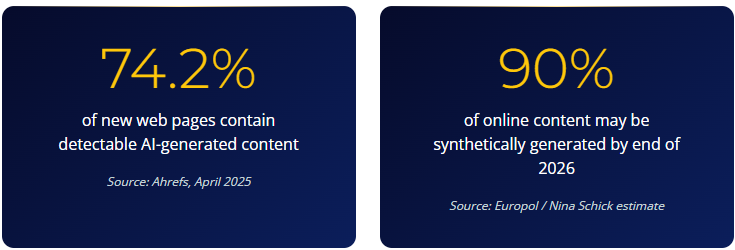
Ahrefs analysed nearly a million new web pages published in April 2025. Of those, 74.2% contained detectable AI-generated content. Not “AI-assisted”. Not “partly drafted by a tool”. Detectable. Flaggable. The kind of content that reads well enough to publish but not well enough to remember.
74.2% of new web pages contain detectable AI-generated content (Ahrefs, April 2025)
90% of online content may be synthetically generated by end of 2026 (Europol / Nina Schick estimate)
On LinkedIn, over 54% of long English posts are now likely AI-generated. Which explains why your feed feels like reading the same post written by 400 different people who all attended the same imaginary conference.
Graphite, an SEO firm, examined more than 60,000 articles published between 2020 and 2025. By late 2024, more than half of new English-language articles were primarily AI-written. The interesting part: Google Search still shows 86% human-written articles in its results. The machines are writing more. The algorithms are picking less of it. The floor is getting crowded and the ceiling has not moved.
The machines are writing more. The algorithms are picking less of it. That is not a contradiction. That is the market correcting.
The Blind Test Paradox (and Why It Should Worry You)
Here is the uncomfortable finding that the “AI will never replace real writers” crowd does not like to talk about.
Bynder surveyed 2,000 people in the UK and US. They showed participants two articles without telling them which was AI-generated and which was human-written. The result: 56% preferred the AI version.
Read that again. In a blind test, the majority chose the machine.
Scenario | Result | What It Means |
Blind test (unknown authorship) | 56% preferred AI version | Average human content is already at AI parity |
Labelled as AI | 52% felt less engaged | The stigma is real, but only when visible |
Consumer preference for AI creator content | Dropped from 60% to 26% (2023 to 2026) | People want human. They just cannot always tell. |
But here is the paradox. When participants knew the content was AI-generated, 52% felt less engaged with it. Consumer preference for AI creator content has dropped from 60% to 26% since 2023, according to Billion Dollar Boy.
So people prefer AI content when they do not know it is AI. And they reject AI content when they do know. Which means the problem is not that AI writes badly. The problem is that most human content was already writing at the level a machine can hit for free.
People prefer AI content when they do not know it is AI. They reject it when they do. Your “average” was already machine-level. You just had not been compared yet.
The content director who has been quietly proud of their “consistent, solid output” is now in the same position as the taxi driver who was proud of knowing every shortcut. Admirable. Also, Uber exists now.
What “Average” Used to Buy You (and Why It No Longer Does)
For fifteen years, average content worked. Not because it was brilliant. Because the alternative was worse. Producing keyword-optimised, structurally sound, adequately researched content put you ahead of the vast majority of websites that had none.
The economics were simple: creating content had a cost floor. A human had to research, write, edit, and publish. That cost floor meant most competitors could not keep up. If you could publish 20 solid articles a month and they could publish 5, you won by volume. Not by quality. By endurance.
AI removed the cost floor. Now anyone can publish 200 articles a month. They will be adequate. They will hit the keywords. They will answer the question. And they will sound exactly like yours.
You used to win by producing content your competitors could not afford to match. Now anyone with a ChatGPT subscription matches you before lunch. The competitive advantage was never quality. It was cost. And cost just went to zero.
The person in your team who was producing “good, reliable content” at a respectable pace is now competing against a tool that produces “good, reliable content” at infinite pace. The tool does not call in sick. It does not have a bad Tuesday. It does not argue about the Oxford comma in the style guide. It just writes. Dutifully. Expensively. Oh wait. For free.
- 94% of blog posts earn zero backlinks (Ahrefs). Most of those are perfectly adequate. Nobody cares.
- 85.1% of AI users deploy it for blog content generation. Your competitors are already doing this.
- Organic CTR has dropped 61% for queries with AI Overviews, from 1.76% to 0.61%. Even the clicks are leaving.
The Engagement Gap Is Already Measurable
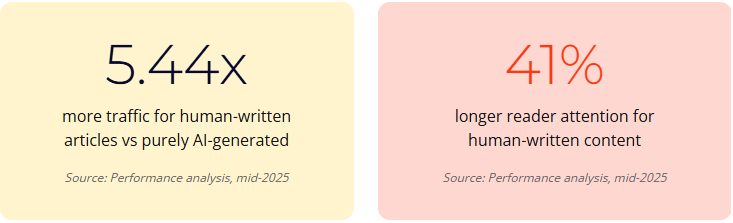
A mid-2025 performance analysis found that human-written articles now generate 5.44 times more traffic and hold reader attention 41% longer than purely AI-generated pieces. Google’s behavioural signals, dwell time, scrolling patterns, repeat visits, all reflect whether real people enjoy your content.
5.44x more traffic for human-written articles vs purely AI-generated (Performance analysis, mid-2025)
41% longer reader attention for human-written content (Performance analysis, mid-2025)
The Reuters Institute’s 2026 Digital News Report found that only 12% of readers feel comfortable with content produced entirely by AI. Meanwhile, 62% explicitly trust content created by humans. The gap is not closing. It is widening.
Organic click-through rates fell from 44.2% to 40.3% between March 2024 and March 2025. Zero-click searches now account for 58% of all Google queries (SparkToro). In Google’s AI Mode, 93% of searches end without a click.
There are fewer clicks available, and the clicks that remain are going to content that earns them. “Adequate” does not earn a click when the AI Overview already summarised the adequate answer. You need to be the thing the reader clicks past the summary to read. That requires being worth the extra effort.
It requires, in a word, being interesting. Not “engaging”. Not “value-adding”. Interesting. The kind of content someone reads and sends to a colleague with the note “you need to read this”. If nobody has ever forwarded your blog post to someone, you already know which side of the floor you are on.
The “Above the Floor” Content Assessment
We built this framework because “just make better content” is not advice. It is a bumper sticker. Here is how to actually evaluate whether your content is above the floor or sitting on it.
The five tests
For each piece of content, score it against these five criteria. If it fails three or more, it is at AI parity. It is not bad. It is just not defensible.
Test | The Question | What “Above the Floor” Looks Like |
1. The Replacement Test | Could a competitor recreate this by prompting an AI tool? | Contains original data, proprietary research, or named first-hand experience that a machine cannot access. |
2. The Perspective Test | Does this say something not everyone agrees with? | Takes a position. Makes a claim. Has a point of view that could be argued against. |
3. The Source Test | Are the insights sourced from somewhere a machine could not go? | Client conversations, internal data, industry access, original interviews, first-party analytics. |
4. The Forward Test | Would someone send this to a colleague? | The reader feels called out, validated, or genuinely informed. They want someone else to see it. |
5. The Memory Test | Could the reader describe this piece 48 hours later? | A specific line, statistic, framework, or observation sticks. The reader remembers something concrete. |
If your content passes all five tests, it is above the floor. If it passes one or two, it is teetering. If it passes none, you have spent money producing something a machine would have given you for free. That is not a content problem. That is a budget problem.
Running the audit
Pull your last 20 published pieces. Score each one honestly. If you need the content team to do it, fine, but make sure somebody in the room is willing to say “this one is at AI parity” without getting fired.
Most teams we work with find that 60–70% of their content library fails at least three of the five tests. This is not because they have bad writers. It is because the brief was “write 1,500 words about [topic]” and nobody asked whether the resulting piece would contain anything a machine could not produce on its own.
The brief is the problem. The writer did exactly what was asked. They just were not asked for anything defensible.
What the Survivors Are Doing Differently
The teams producing content that is actually above the floor are not working harder. They are working on different things.
- They start with what they know that nobody else does. Original data, client patterns, internal benchmarks, industry access. The content is built around a piece of information that requires being in the room. Not in the search results.
- They have a point of view that makes someone uncomfortable. Not contrarian for the sake of it. But a genuine position that not every reader will agree with. AI does not take positions. It summarises the average of all positions. Being average is literally what it is designed to do.
- They treat the brief as a strategy document, not a writing prompt. The brief answers: what do we know that nobody else does? What position are we taking? What should the reader do differently after reading this? If the brief does not answer those questions, the content will not either.
They use AI for the boring parts. Research acceleration. Structural drafts. Data formatting. They do not use it for the parts that make content worth reading: the perspective, the voice, the uncomfortable truths, the specific observations from actual experience.
AI is designed to produce the average of all available opinions. If your content also produces the average of all available opinions, you have been replaced. You just have not noticed yet.
The Authenticity Premium (and the Messiness That Earns It)
Here is something the polished-content brigade does not want to hear. The Sprout Social Q4 2025 Pulse Survey found that 55% of consumers are more likely to trust brands committed to publishing human-created content. Among Millennials, that jumps to 62%.
Becky Owen, CMO of Billion Dollar Boy, put it bluntly: “Consumer sentiment is roaring against AI. They hate it. We are in this massive reset.”
But here is the twist. The authenticity consumers want is not your brand’s carefully workshopped “authentic voice”. It is the opposite. Lisa Singelyn, SVP at Platinum Rye Entertainment, notes that brands now “prefer to see the reality of human life. Whether that is a bed not made or clothes not put away or your hair not perfect.”
Messy. Specific. Imperfect. The kind of content that makes someone in marketing sign-off slightly nervous. That is what earns the authenticity premium now.
The irony is perfect. Brands spent years polishing content to look professional. AI made “polished and professional” the default. Now the premium is on the unpolished. Your overproduced content library is not a strength. It is a liability dressed in a nice font.
Your content team spent a decade learning to write like a brand. Now they need to unlearn it and write like a human who happens to work at one. The person who sends emails in sentence fragments and explains things over a coffee the way they actually think about them, not the way the brand guidelines say they should. That person’s voice is now more valuable than your entire content playbook. And they probably do not even know it.
What This Means for Your Budget
The economics are shifting and most budget conversations have not caught up. Here is the maths nobody wants to do.
If 60–70% of your content is at AI parity, and AI can produce that content for near-zero cost, then 60–70% of your content budget is not buying you a competitive advantage. It is buying you parity with something that is free. That is not a content strategy. That is a subscription you are paying for out of habit.
The smart reallocation looks like this:
Budget Category | Old World (Pre-AI Floor Rise) | New World (Post-AI Floor Rise) |
Volume content production | 60–70% of budget | 15–20% (AI-assisted, human-edited) |
Original research and data | 5–10% | 25–30% (the new competitive moat) |
Subject matter expert access | Occasional | 15–20% (embedded in the workflow) |
Distribution and amplification | 10–15% | 20–25% (fewer pieces, harder promotion) |
Measurement and attribution | 5% | 10–15% (prove the premium content works) |
The CFO who approved 200 blog posts a year because “content marketing has good ROI” is about to discover that 140 of those posts are now at parity with something free. That conversation is coming. Better to lead it than to be on the receiving end of it.
Fewer pieces. Higher quality. More original data. More distribution. Less typing. More thinking. The teams that make this shift will have something to show for their budget. The ones that keep publishing at volume will have a very impressive content library that nobody reads.
The Uncomfortable Timeline
Gartner predicted that traditional search engine volume would drop 25% by 2026 due to AI chatbots and virtual agents. That prediction was published in early 2024. We are now inside that timeline.
Investment in AI SEO is accelerating. 98% of marketers plan higher spend in 2026 (Ahrefs). AI Overviews surged from 31% of tracked queries in February 2025 to 48% in February 2026. The generative AI market for content creation, valued at $14.8 billion in 2024, is projected to reach $80 billion by 2030.
This is not slowing down. The volume of AI content is increasing. The space for average content is shrinking. The window to differentiate is narrowing.
- Now: 74.2% of new web pages contain AI-generated content (Ahrefs)
- End of 2026: Up to 90% of online content may be synthetically generated
- By 2030: Some estimates put it at 99%
If your content is at AI parity today, it is already being outcompeted by teams that moved six months ago. In another six months, the gap will be wider. In a year, the teams that did not move will be having the budget conversation mentioned above. Except they will be having it without data to show their content was ever above the floor in the first place.
The floor is not finished rising. And the building does not have that many storeys.
Your Action Plan: The “Above the Floor” Audit
- Pull your last 20 published pieces. Score each one against the five tests (Replacement, Perspective, Source, Forward, Memory). Be honest. If you are not uncomfortable with the results, you were not honest enough.
- Identify your “at parity” content. Anything that fails three or more tests is at AI parity. Do not delete it. But stop making more of it.
- Rewrite your content brief template. Every brief must answer: what do we know that nobody else does? What position are we taking? What should the reader do differently? If the brief cannot answer these, do not commission the piece.
- Redirect budget from volume to differentiation. Fewer pieces. More original research. More subject matter expert access. More distribution. The goal is not more content. It is more defensible content.
- Build an original data pipeline. Client surveys, internal benchmarks, first-party analytics, industry access. This is the content moat that AI cannot cross. Invest here first.
- Use AI for the floor. Write above it. Let AI handle research acceleration, structural drafts, and data formatting. Keep human editorial judgement, perspective, and voice for the parts that make content worth reading.
- Measure what matters. Track forwards, time on page, return visits, pipeline influence, and AI citations. Not just sessions. Sessions do not tell you if your content is above the floor. They tell you if someone arrived. Not if they stayed.
Most content teams do not have a writing problem. They have a differentiation problem. If your content could be recreated with a prompt, it is not building a moat. It is filling a calendar.
At Seventh Element, we help brands figure out what is actually worth publishing in an AI-saturated search landscape – from content and SEO audits to strategy, AEO, GEO, and content systems built around original insight rather than output for output’s sake.
If you want to know whether your content is above the floor, let’s talk. Get in touch to audit what you have, identify what is at AI parity, and build a content strategy that gives people a reason to click, read, remember, and act.
Frequently Asked Questions
Has AI actually killed content marketing?
No. AI has not killed content marketing. It has killed average content marketing. The distinction matters. Content that offers original data, genuine expertise, or a perspective that cannot be replicated by prompting a language model is more valuable than ever. Content that was already competent, forgettable, and interchangeable is now indistinguishable from what a machine produces for free. The discipline is not dead. The floor has risen.
How do I know if my content is at AI parity?
Ask one question: if this content disappeared from your site tomorrow, could a competitor recreate it by prompting an AI tool? If the answer is yes, your content is at AI parity. It may be accurate, well-structured, and grammatically sound, but it contains nothing that requires human experience, original data, or genuine expertise to produce.
What makes content “above the floor” in 2026?
Content that is above the floor has at least one of these qualities: original research or proprietary data, a perspective rooted in specific experience, named sources and verifiable claims, a point of view that not everyone agrees with, or a structure that serves the reader rather than the algorithm. The common thread is that it requires something a machine does not have: access to the real world.
Should I stop using AI for content creation?
No. The problem is not AI as a tool. The problem is AI as a replacement for thinking. Eighty-eight per cent of marketers use AI in their daily roles, and the best-performing teams use it to accelerate research, structure drafts, and handle repetitive tasks. They do not use it to replace editorial judgement, original reporting, or strategic thinking. Use AI to go faster. Do not use it to skip the parts that make content worth reading.
How quickly is AI-generated content growing?
Fast. Ahrefs analysed nearly a million new web pages in April 2025 and found 74.2% contained detectable AI-generated content. Experts estimate that up to 90% of online content could be synthetically generated by the end of 2026. On LinkedIn, over 54% of long English posts are now likely AI-generated. The volume problem is not theoretical. It is already here.
Author information
With 15 years of hands-on SEO and digital marketing experience, agency director Ash is the driving element behind our digital team. Ashley heads our digital execution team, delivering innovative strategic and tactical marketing initiatives and campaigns; helping propel our clients’ growth and success.
Learn more about Ashley Salek, Agency Director, Seventh Element

Sources
Europol / Nina Schick estimate – 90% of online content may be synthetically generated by 2026
Bynder (2025) – 56% preferred AI content in blind test; 52% less engaged when labelled as AI
Billion Dollar Boy / eMarketer (2026) – Consumer preference for AI content dropped from 60% to 26%
Digiday (2026) – Authenticity and messiness in high demand; Becky Owen, Billion Dollar Boy quotes
SparkToro / Genesys Growth (2025) – 58% zero-click searches; 93% zero-click in AI Mode
Gartner (2024) – Search engine volume predicted to drop 25% by 2026
Nieman Journalism Lab (2025) – AI will outwrite humans in 2026; Davey Alba analysis
CoSchedule (2025) – 88% of marketers use AI daily; 85.1% use AI for blog generation
WiFi Talents (2026) – Gen AI market for content: $14.8B (2024) projected to $80.12B by 2030