Your competitor’s content is plain. Functional. Borderline dull. It also has clean heading hierarchy, answer-first formatting, and schema markup on everything. Your content is beautifully written, creatively structured, and completely invisible to AI. The machines do not reward prose. They reward clarity.
There is a website out there. You know the one. Their blog looks like it was written by someone who read every content marketing playbook published since 2014 and followed them all. To the letter. Without any personality whatsoever.
Clean headings. Short paragraphs. Answer in the first line. Schema markup on everything. Tables where tables belong. FAQs at the bottom. Every section a self-contained unit that a machine could parse, extract, and cite without breaking a sweat.
It is, in a word, boring.
And it is outranking you. Getting cited by ChatGPT. Appearing in AI Overviews. Showing up in Perplexity results. While your beautifully crafted, narratively rich, creatively structured content sits there, accumulating dust and the kind of internal applause that does not translate into pipeline.
Your content team won the internal award. Their content won the traffic.
Your Content | Their Content | Who AI Cites |
Narrative intro, creative structure, brand voice throughout | Answer in the first sentence, clean H2/H3 hierarchy, schema markup | Theirs. Every time. |
Elegant paragraph flow, story-driven, builds to a conclusion | Each section stands alone, self-contained, directly answers the query | Theirs. The AI does not read to the end. |
Creative subheadings that sound good but mean nothing to a machine | Descriptive H2s that mirror search queries, logical hierarchy | Theirs. The machine understood the structure. |
No schema, no FAQ markup, no structured data | Article schema, FAQPage, HowTo, BreadcrumbList | Theirs. By a margin that would make you uncomfortable. |
This is not a quality problem. Your content may be better written. It may be more insightful. It may be genuinely useful. None of that matters if the machine cannot find the answer in the first 60 words, because it will move on to the page that gave it what it needed without making it work for it.
What the Data Says About Structure vs Prose
The Princeton, Georgia Tech, and IIT Delhi research team that defined generative engine optimisation analysed 10,000 real-world queries. The finding: pages with structured lists, quotes, and statistics had 30-40% higher visibility in AI responses.
That is not a rounding error. That is the difference between being cited and being invisible.
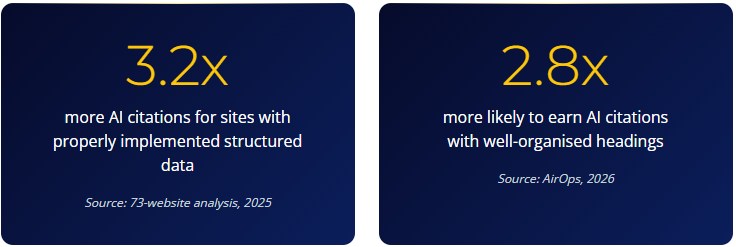
3.2x more AI citations for sites with properly implemented structured data (73-website analysis, 2025)
2.8x more likely to earn AI citations with well-organised headings (AirOps, 2026)
BrightEdge found that sites implementing structured data and FAQ blocks saw a 44% increase in AI search citations. Pages with well-organised headings are 2.8 times more likely to earn citations in AI search results (AirOps). Content with independent, semantically complete sections gets cited 65% more frequently than dense, interconnected paragraphs.
And here is the number that should make your content team pause: 44.2% of all LLM citations come from the first 30% of text. The intro. The first few paragraphs. The part where your beautifully crafted narrative is still “setting the scene” while their structured page has already delivered the answer.
44.2% of all AI citations come from the first 30% of your content. If your opening is “setting the scene” instead of answering the question, you have already lost the citation before the reader gets to the good part.
How AI Actually Reads Your Page (It Is Not How You Think)
Here is what most content teams do not understand about AI search. The machine does not read your article from top to bottom, the way a person does. It breaks your page into passages, evaluates each one independently, and decides whether any of them are worth citing.
Each passage is judged on its own. Not on what came before. Not on the narrative arc. Not on the clever callback to the intro that ties the whole piece together. Each section stands or falls alone.
This is why 68.7% of pages cited in ChatGPT follow logical heading hierarchies. 87% use a single H1 as the primary anchor. Nearly 80% include lists to structure key information. These are not stylistic preferences. They are mechanical requirements.
| What AI Needs | What Creative Content Often Does | The Gap |
|---|---|---|
| Answer in the first 40-60 words of each section | Builds to the answer through context and narrative | AI extracts nothing useful. Moves to next page. |
| Each section semantically complete and self-contained | Sections reference each other, build on previous points | Out-of-context extraction produces nonsense. |
| Citable data point every 150-200 words | Data woven into narrative, sometimes without explicit sourcing | AI cannot extract a fact that is buried in a metaphor. |
| Descriptive headings that mirror query language | Creative headings that sound clever but mean nothing to a parser | H2 “The Great Unravelling” tells a machine nothing. “Why Organic CTR Is Dropping” tells it everything. |
GPT-4 goes from 16% to 54% correct responses when content relies on structured data (Data World study). That is not a slight improvement. That is the difference between your content being useful to the machine and your content being noise.
Your creative heading “The Great Unravelling” tells a machine nothing. “Why Organic CTR Is Dropping” tells it everything. One wins awards. The other wins citations.
The Schema Gap Is Embarrassing
FAQPage schema has a 67% citation rate in AI responses for relevant queries. Let that sit for a moment. Two thirds of pages with FAQ schema get cited when the query matches.
Now ask yourself: does your website have FAQ schema? Does it have Article schema with proper authorship and publication dates? HowTo schema on your process pages? BreadcrumbList so the machine understands your site hierarchy?
If the answer is no, you are leaving citations on the table. Not because your content is bad. Because the machine literally does not know what it is looking at.
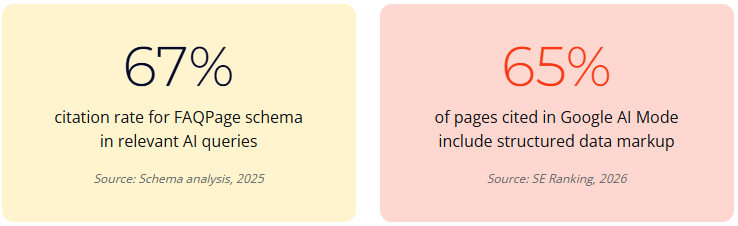
67% citation rate for FAQPage schema in relevant AI queries (Schema analysis, 2025)
65% of pages cited in Google AI Mode include structured data markup (SE Ranking, 2026)
In 2025, AI systems moved from just crawling web pages to actively fetching and parsing structured data during their response generation phase. SearchVIU’s tests confirmed that ChatGPT, Claude, Perplexity, and Gemini all actively process schema markup when accessing content. The machines are reading your structured data. If you do not have any, there is nothing to read.
Your competitor probably did not even write the schema themselves. Someone in their dev team spent half a day implementing it. That half-day is now responsible for more AI visibility than your entire editorial calendar. That is not a creative failure. It is an infrastructure one. And it is fixable in a week.
Creativity Is Not the Problem. The Absence of Structure Is.
This is where we need to be careful, because the wrong takeaway from this article would be “stop being creative”. That would be idiotic.
“Creativity is and always will be extremely important. It is what makes someone read a piece rather than skim it, share it rather than close the tab. But the science of ranking, being cited, and focusing on some of the ‘boring’ parts is all too often overlooked. You can write the most compelling article in your sector, but if the heading hierarchy is wrong, the schema is missing, and the answer is buried in paragraph four, no AI system will ever find it. Structure is not the enemy of creativity. It is the stage creativity performs on.”
Ashley Salek, Agency Director, Seventh Element
The teams getting this right are not choosing between creative and structured. They are layering voice and insight on top of a machine-readable foundation. Structure first. Then creativity. Never the other way around.
Think of it like architecture. The plumbing, the wiring, the load-bearing walls. Nobody visits a building to admire those. But without them, the beautiful interior does not exist. Your schema markup is the plumbing. Your heading hierarchy is the load-bearing walls. Your creative voice is the interior design. You need both. But you cannot hang the art before you build the walls.
- Structure without creativity gets cited but not read. It earns the click but loses the reader at paragraph three. It performs in dashboards but not in boardrooms.
- Creativity without structure gets read but not found. It earns internal applause but not external traffic. It lives in your content team’s portfolio, not in the AI’s citation list.
- Structure with creativity gets cited, read, shared, and remembered. It is visible to machines and valuable to humans. This is the target.
Structure is the stage creativity performs on. Without the stage, nobody sees the performance.
The AI Search Landscape Has Changed the Maths
AI Overviews now appear on 50-60% of US searches, up from 6.49% in January 2025. Organic CTR drops 58% when AI Overviews appear. But, and this is the critical part, brands cited in those Overviews earn 35% more clicks than they would have in a traditional results page.
AI Overview traffic converts at 14.2% versus traditional organic’s 2.8%. That is a 5x quality premium. The people who click through an AI Overview already know you are the cited source. They are not browsing. They are buying.
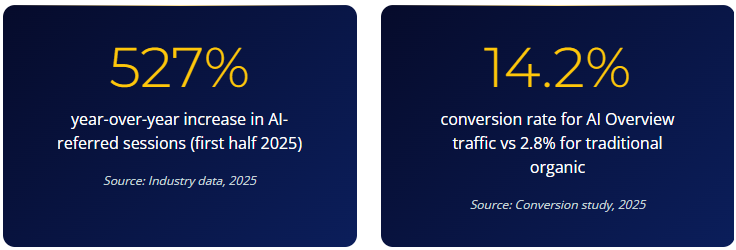
527% year-over-year increase in AI-referred sessions (first half 2025)
14.2% conversion rate for AI Overview traffic vs 2.8% for traditional organic
AI-referred sessions jumped 527% year-over-year in the first half of 2025. The GEO market was valued at $848 million in 2025 and is projected to reach $33.7 billion by 2034. This is not a niche. This is the new front door.
And the front door does not care how clever your subheadings are. It cares whether your content has a clean H2 that mirrors the query, an answer in the first 40 words, and a schema that tells it what kind of content it is looking at.
The person who wrote your competitor’s content may have less talent than anyone on your team. But their page is the one ChatGPT is citing. Because the machine understood it. Not because it was better. Because it was clearer.

The "Boring But Visible" Content Restructuring Guide
We call it “boring but visible” because the name makes content teams slightly angry. That anger is useful. It means they care. The guide is about keeping everything that makes content good while adding the structural bones that make it findable.
The seven structural rules
- One H1. Always. 87% of pages cited by AI use a single H1. If your page has two, the machine does not know which one is the topic. Neither does Google.
- Descriptive H2s that mirror query language. Not “The Big Picture” or “Our Approach”. But “How structured content improves AI visibility” or “What schema markup does for citations”. The heading should answer the question: what is this section about? If a machine cannot tell from the heading alone, rewrite it.
- Answer in the first 40-60 words of every section. This is your citation block. The exact text an AI might extract. If your section starts with context, background, or a rhetorical question, the citation window has already closed.
- A citable data point every 150-200 words. Specific statistic, percentage, or data point with a source. AI systems preferentially cite content with hard data because it adds credibility to their generated responses.
- Short paragraphs. Two to three sentences maximum. Long blocks of text are harder for AI to parse and less likely to be extracted as a citation. Break them up. Even if it feels choppy. Especially if it feels choppy.
- Schema markup on every key page. Article, FAQPage, HowTo, Organisation, BreadcrumbList. Match the schema to the content type. If the page answers questions, it needs FAQ schema. If it describes a process, it needs HowTo. This is not optional.
- Sections that stand alone. Each H2 section should be understandable without reading anything before it. If you extract just that section and show it to someone, does it make sense? If not, the AI cannot use it either.
The Freshness Factor Your Creative Calendar Is Ignoring
Here is a data point that should change how you plan your content calendar: 76.4% of ChatGPT’s most-cited pages were updated in the last month. Not the last year. The last month.
Pages that go more than three months without an update are over 3 times more likely to lose visibility. 85% of AI citations were published within the last two years, with 44% specifically from 2025 (Seer Interactive).
Your content team published a brilliant guide in 2024. It was well-written, thoroughly researched, and genuinely useful. It has not been touched since. The AI has moved on to something published last Tuesday that says roughly the same thing but has a more recent date.
The creative content team’s instinct is to produce new pieces. The structured content team’s instinct is to update existing ones. In 2026, the updaters are winning. Not because their content is better. Because it is newer. And the machines care about recency more than most content directors want to admit.
What Your Competitor's "Boring" Content Actually Gets Right
Let us be specific about what the structured, “boring” sites are doing that creative sites are not. Because the gap is not about talent. It is about priorities.
| What They Do | Why It Works | Why Creative Teams Skip It |
|---|---|---|
| Answer-first formatting on every page | 44.2% of AI citations come from the first 30% of content | “It kills the narrative arc” |
| FAQ schema on service and guide pages | 67% citation rate for relevant queries | “We will add it later” (they never add it later) |
| Monthly content updates with fresh timestamps | 76.4% of top-cited pages updated in the last month | “We prefer to create new content” |
| Descriptive headings that mirror query language | 2.8x more likely to earn AI citations | “Our headings need to reflect our brand voice” |
| Unblocked AI crawlers (GPTBot, ClaudeBot, PerplexityBot) | 80% of top publishers block at least one AI crawler | “Legal said no” (legal did not fully understand the question) |
Look at the “why creative teams skip it” column. Every single objection is reasonable. And every single one is costing visibility. The narrative arc does matter. Brand voice does matter. New content does matter. But not at the expense of the structural foundation that makes any of it discoverable.
The content lead who says “we will add schema later” is the same person who said “we will fix the mobile experience later” in 2015. Later never arrives. And by the time it does, the competitor who did it first has compounding citation authority that takes months to catch.
Your Action Plan: The “Boring But Visible” Restructure
- Audit your heading hierarchy. Every page should have one H1 and a logical H2/H3 structure. Rewrite creative headings a machine cannot understand.
- Add answer-first formatting to your top 20 pages. Every H2 section opens with a direct answer in 40–60 words.
- Implement schema markup this week. Start with Article, FAQPage, and BreadcrumbList on highest-traffic pages.
- Check your robots.txt. Are GPTBot, ClaudeBot, and PerplexityBot blocked? If so, unblock them.
- Set up a monthly update schedule for your top 10 guides. Refresh data, add “Last updated” timestamp.
- Run a GEO visibility scan. Search your brand in ChatGPT, Gemini, and Perplexity. Document where you appear.
- Rewrite your content brief template. Add mandatory fields for: target schema type, answer-first snippet, H2 structure.
Frequently Asked Questions
Does creative content hurt your SEO?
Creative content does not hurt SEO. But creative content without structure does. AI systems cannot parse a clever metaphor. They can parse a clean heading hierarchy, an answer-first paragraph, and a properly marked-up FAQ. The best-performing content in AI search is both editorially strong and structurally disciplined.
What is structured content and why does it matter for AI?
Structured content uses clear heading hierarchies, answer-first formatting, schema markup, short paragraphs, and semantic HTML. AI systems break pages into passages and evaluate each one independently. Pages with well-organised headings are 2.8 times more likely to earn citations in AI search results.
How do I make content both creative and machine-readable?
Start with structure. Use a single H1, logical H2/H3 hierarchy, and lead every section with a direct answer in 40 to 60 words. Add schema markup and citable data every 150 to 200 words. Then layer brand voice and editorial quality on top. Structure is the foundation. Creativity is the architecture.
What is generative engine optimisation (GEO)?
Generative engine optimisation (GEO) is the practice of structuring content so AI systems cite it in their responses. Unlike traditional SEO, which optimises for ranking positions, GEO optimises for inclusion in AI-generated answers. The GEO market was valued at $848 million in 2025 and is projected to reach $33.7 billion by 2034.
How important is schema markup for AI visibility?
Essential. Sites with properly implemented structured data are cited 3.2 times more often in AI responses. FAQPage schema alone has a 67% citation rate for relevant queries. 65% of pages cited by Google AI Mode include structured data markup. Schema is no longer a nice-to-have. It is infrastructure.
Find out where you show up in AI search. And where you don't.
Free GEO visibility scan. See what AI sees when it looks at your content.
Sources
- Princeton / Georgia Tech / IIT Delhi GEO Research (2024) – Pages with structured lists, quotes, and statistics have 30-40% higher visibility in AI responses
- AirOps (2026) – Pages with well-organised headings 2.8x more likely to earn AI citations; 44.2% of LLM citations from first 30% of text
- BrightEdge (2025) – 44% increase in AI citations with structured data and FAQ blocks
- 73-website structured data analysis (2025) – Sites with structured data cited 3.2x more often in AI responses
- Superlines AI Search Statistics (2026) – 68.7% of ChatGPT-cited pages follow logical heading hierarchies; 87% use single H1; 80% include lists
- SearchVIU (2025) – AI systems actively process schema markup when accessing content
- Averi / AI Overview Analysis (2026) – AI Overviews on 50-60% of US searches; CTR drops 58%; cited brands earn 35% more clicks; AI Overview traffic converts at 14.2%
- SEOmator (2026) – 527% YoY increase in AI-referred sessions; FAQPage schema 67% citation rate
- Wellows / SE Ranking (2026) – 65% of pages cited in AI Mode include structured data; content with independent sections cited 65% more
- PragoMedia (2026) – 76.4% of ChatGPT most-cited pages updated in last month
- Passionfruit / GEO Market Data (2025) – GEO market valued at $848M in 2025, projected $33.7B by 2034
- Gartner (2024) – Search engine volume predicted to drop 25% by 2026
- Digidop / Data World (2026) – GPT-4 goes from 16% to 54% correct responses with structured data
- Ahrefs (2025) – 80% of AI chatbot cited URLs do not rank in Google top 100