Quick Answer
Link building remains essential, but the game has shifted from counting hyperlinks to building brand authority. Ahrefs’ study of 75,000 brands found branded web mentions correlate 3x more strongly with AI visibility than backlinks do (0.664 vs 0.218). The strategy that wins in traditional SEO is increasingly the same strategy that wins in AI search. You need both.
There is a narrative circulating in marketing circles that link building is dead. AI search has killed it. LLMs do not care about backlinks. You should pivot to something called GEO and forget everything you learned about off-page SEO.
This narrative is comforting. Link building is hard. It is expensive. It takes time. The idea that you can simply stop doing it and focus on “citation optimisation” instead is extremely appealing.
It is also wrong.
The data does not support the “links are dead” story
Let us start with what the research actually says. Not the hot takes. Not the LinkedIn posts. The research.
According to Editorial.Link’s 2025 survey of 518 SEO professionals, 73.2% believe backlinks influence the chance of appearing in AI search results. That is nearly three-quarters of practitioners who work with this every day saying links still matter for LLM visibility.
But the real clarity comes from Ahrefs’ landmark study of 75,000 brands, first published in May 2025 and expanded in December 2025. They used Spearman correlation analysis across millions of AI responses to find out what actually drives brand visibility in AI Overviews, ChatGPT, and AI Mode.
The results upend a decade of assumptions:
Branded web mentions showed a 0.664 correlation with AI Overview visibility. Total backlinks? Just 0.218. YouTube mentions showed the strongest correlation of all at approximately 0.737 across ChatGPT, AI Mode, and AI Overviews.
What the web says about you matters more than how many sites link to you.
That sounds like terrible news for link building. Until you ask the obvious question: what creates those branded web mentions? What builds the presence that shows up as search volume?
The answer is the same work that good link building has always involved. Coverage in authoritative publications. Expert quotes. Original research that gets referenced. Digital PR that earns editorial attention. The outputs of quality link building are the inputs that AI systems use to decide who to trust.
The signal has changed. The source of the signal has not.
Google has been telling us this for years
The signals from Google’s own team have been consistent, if underappreciated.
At Pubcon Pro in September 2023, Gary Illyes stated bluntly that links are no longer in the top three ranking factors: “I think they are important, but I think people overestimate the importance of links. I don’t agree it’s in the top three. It hasn’t been for some time.”
At SERP Conf in April 2024, he went further: “We need very few links to rank pages. Over the years we’ve made links less important.” He later said on social media that he regretted saying it so publicly. He did not retract the substance.
John Mueller reinforced this on the Search Off the Record podcast: “Over time, the weight on the links at some point will drop off a little bit as we can figure out a little bit better how the content fits in within the context of the whole web.”
The March 2024 core update made the shift tangible. Google’s spam documentation changed “Google uses links as an important factor” to simply “Google uses links as a factor.” A deliberate semantic downgrade. The update also introduced new language targeting “low-value content primarily for the purposes of manipulative linking and ranking signals” and, for the first time, expressly mentioned examining outgoing links algorithmically.
Then the May 2024 Google API leak made things even more interesting. It revealed that “Link Distribution Diversity” was more important than previously believed and confirmed the existence of a domain authority-like score Google had previously denied using. Years of official denials, quietly contradicted by their own internal systems.
This is the bit where people panic and start doing extremely expensive, extremely silly things.
Yet links have not become worthless. Ahrefs’ own analysis confirms: pages ranking in Google’s top 10 still have 3.8 times more backlinks than lower-ranking competitors. As Mueller put it: “There could be one really good link from one website out there that is, for us, a really important sign.”
The nuance matters. A single editorially earned link from a topically relevant, high-authority source now vastly outweighs hundreds of directory submissions or guest posts on irrelevant blogs.
LLMs do not see links the way Google does
This is where the mechanics diverge, and where most of the “links are dead” narrative falls apart.
Traditional search engines build explicit link graphs. Google’s PageRank algorithm treats every hyperlink as a vote of confidence and follows a mathematical model to distribute authority across the web. LLMs work on an entirely different principle.
Models like GPT-4o, Claude, and Gemini are probabilistic text-prediction systems. During training, they ingest massive text corpora and compress information into neural network weights. They never build a database of links. They never track a link graph.
What LLMs learn instead is co-occurrence and frequency. Ryan Law, Director of Content Marketing at Ahrefs, explains it precisely: LLMs derive their understanding of a brand’s authority from words on the page, from the prevalence of particular terms, the co-occurrence of different topics, and the context in which those words are used.
A brand mentioned consistently across trusted sources develops a stronger neural representation. Whether those mentions include hyperlinks is secondary.
The Digital Bloom’s 2025 AI Visibility Report confirmed this directly, finding that backlinks show “weak or neutral correlation” with LLM visibility.
But here is the crucial mechanism most commentators miss: backlinks help pages rank in search engines, which places them in the “candidate sets” that Retrieval-Augmented Generation (RAG) systems pull from when AI tools like ChatGPT Search, Perplexity, and Google AI Overviews need real-time information. 76% of AI Overview citations come from pages already ranking in Google’s top 10, according to Ahrefs.
So links help you get found by AI. The AI itself does not care about your link count. It cares about your brand presence, your authority signals, and whether the web treats you as a credible entity.
Links create the conditions. Brand authority closes the deal.
The scale of the shift: AI search is no longer theoretical
For anyone still treating AI search as a future concern, here is the current reality:
| Platform / Metric | Value | Source |
| ChatGPT weekly active users | 800 million | OpenAI, Oct 2025 |
| ChatGPT daily prompts | 2.5 billion | OpenAI |
| Perplexity monthly queries | 780 million (up 239% YoY) | Perplexity |
| AI search traffic growth YoY | 527% | Industry data, early 2025 |
| AI Overviews appearing in US desktop searches | ~16% | Semrush, Nov 2025 |
| AI Overviews monthly users globally | 2 billion | |
| US Google searches ending without a click | 58.5% | SparkToro/Datos |
| Zero-click rate in Google AI Mode | 93% | Industry research |
| CTR drop for top-ranking page when AI Overviews appear | 34.5% | Industry research |
| CTR increase for brands cited within AI Overviews | 35% | Industry research |
The zero-click reality is intensifying. But brands cited within AI Overviews see 35% higher organic click-through rates. That creates a stark winner-takes-all dynamic.

The quality of AI traffic is remarkable. Ahrefs reported that AI visitors generated 12.1% of signups despite being only 0.5% of traffic. The audience is smaller. It is vastly more engaged.
The question is not whether AI search matters. It is whether you are visible in it. And that visibility depends on exactly the kind of authority that good link building creates.
The disconnect between SEO rankings and AI citations
Here is something that should concern anyone relying solely on traditional SEO: only 12% of citations in AI assistants (ChatGPT, Gemini, Copilot) also rank in Google’s top 10 for the original query.
Perplexity shows the strongest SEO alignment, with 28.6% overlap. But across the board, the overlap is startlingly low.

Brands are 6.5 times more likely to be cited through third-party sources than their own domains, according to Airops research from October 2025. AI Overview content changes 70% of the time for the same query, and nearly half of citations get replaced between snapshots.
This volatility is exactly why building deep, persistent brand authority matters more than optimising individual pages. You cannot game AI citations the way you might optimise a single page for a single keyword. You need to be the brand that the entire web treats as authoritative on your topic.
If you are not being talked about across the web, you are not being cited by AI. Full stop.
The shift: from counting links to building authority
The fundamentals of link building have not disappeared. They have evolved. Patrick Stox of Ahrefs describes it well: we have entered “the era of off-page SEO” where content about you on other pages is more valuable than content on your own site.
| Old Playbook | New Playbook | Impact |
| Chase high DA/DR scores | Prioritise topical relevance and context | High |
| Count referring domains | Track brand mentions alongside links | High |
| Any link from an authority site | Links from sources AI systems actually cite | High |
| Anchor text optimisation | Entity consistency across all coverage | High |
| Volume of links | Depth of presence in authoritative sources | High |
| Measure: rankings, traffic | Measure: rankings, traffic, AI citations, brand mentions | High |
| Build links to your site | Build mentions of your brand across the web | Critical |
The left column still works for traditional SEO. The right column is what you need to add for AI visibility. This is not a replacement. It is an expansion.
What makes content “citable” by AI systems
Research from Princeton’s GEO study, published at KDD 2024, established that generative engine optimisation methods can boost visibility in AI responses by up to 40%. The most effective tactics were adding statistics and quotation additions, which improved scores by 22–37%. Keyword stuffing actually performed worse than baseline.
Synthesising across multiple industry studies, the characteristics that make content citable by LLMs follow a consistent pattern:
- Information density ranks highest. Facts, figures, dates, and definitions rather than opinion or fluff. AI systems extract concrete data points, not vague assertions.
- Extractability matters. Self-contained passages of 50–150 words that can stand alone as answers. If an AI system cannot lift a clean, useful passage from your content, it will find one from a competitor who made theirs easier to extract.
- Freshness is weighted heavily, particularly for time-sensitive topics. Outdated content gets passed over in favour of recent, relevant sources.
- Credible authorship with visible credentials strengthens citation likelihood. This is E-E-A-T in practice, not as a checklist exercise.
- Original data is the single most powerful citation magnet. Proprietary statistics and unique research create assets that journalists cite, AI systems extract, and competitors cannot replicate. Content containing original data receives 5.2 times more backlinks than standard articles.
Entity presence is the connective tissue
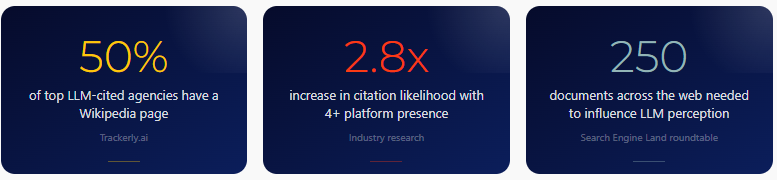
Brands appearing in Google’s Knowledge Graph have dramatically higher chances of being cited by Gemini. 50% of the most frequently LLM-cited agencies had a Wikipedia page, according to Trackerly.ai. Establishing entity presence across four or more third-party platforms correlates with a 2.8 times increase in citation likelihood.
An estimated 250 documents across the web are needed to meaningfully influence how an LLM perceives a brand, according to a Search Engine Land roundtable featuring Lily Ray, Kevin Indig, and other leading practitioners.
That is not a number you hit by accident. It is a number you build to through sustained, strategic authority building.
Digital PR has become the dominant strategy. Here is why.
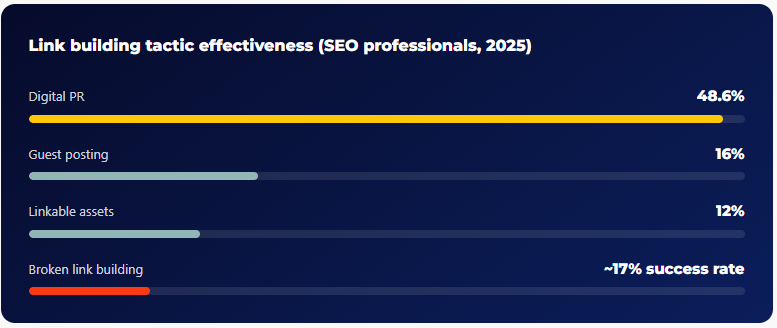
The industry has voted decisively. In Editorial.Link’s 2025 survey, 48.6% named digital PR the most effective link-building tactic, far ahead of guest posting (16%) and creating linkable assets (12%). This was the second consecutive year digital PR topped the rankings.
Digital PR’s dominance reflects its dual value in the AI era. A data-driven campaign published by a respected news outlet earns a high-authority backlink and creates a brand mention in content that feeds LLM training data and RAG retrieval systems.
As Rand Fishkin advised: leverage other people’s publications, especially the influential and well-subscribed-to ones. You get the authority of a third-party saying positive things about you, and likely a boost in LLM discoverability.
Data-led content powers the best campaigns
94.8% of digital PR practitioners use data-led content as their primary tactic, with 68% of reporters preferring pitches backed by data. Original research receives 5.2 times more backlinks than standard articles.
The economics have shifted
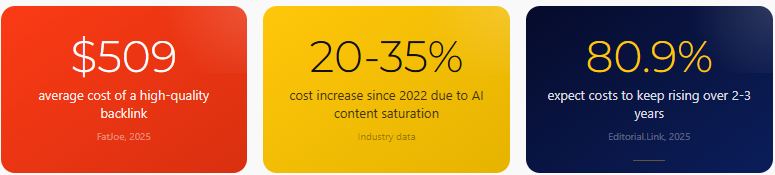
The average acceptable price for a high-quality backlink is now $508.95, with premium editorial links reaching $2,000–$2,500. Link building costs have risen 20–35% since 2022 due to AI content saturation and stricter editorial filtering. 81% expect costs to continue rising over the next two to three years.
This is not a market for cheap tactics. It is a market for quality.
What is no longer working
Traditional tactics have not disappeared entirely, but the hierarchy is clear:
- Guest posting remains effective only when targeting genuinely relevant, editorially rigorous publications. 85.3% of guest posting sites are low quality with Domain Rating below 40.
- HARO was shut down when Cision closed Connectively in December 2024 and relaunched under Featured.com with fundamentally different dynamics.
- Private Blog Networks are effectively dead. Google’s SpamBrain system identifies and deindexes them with increasing efficiency.
- Broken link building maintains a roughly 17% success rate. Useful, but not scalable.
Example: one campaign, dual visibility
Here is how a single piece of work now delivers value across both channels.
A fintech company publishes original research on SME lending trends in the UK.
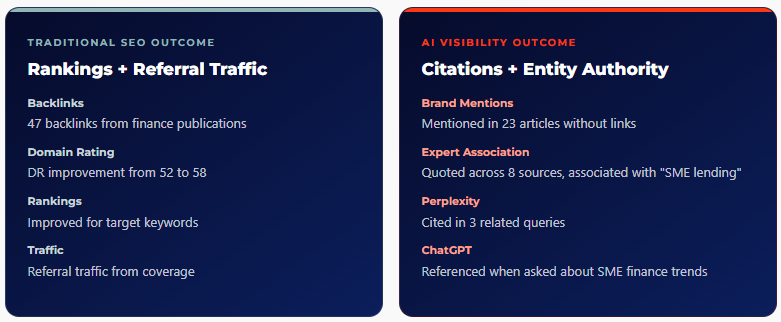
Same campaign. Same effort. Two visibility channels.
The research cost the same whether you are measuring links or citations. The expert commentary took the same time to prepare. The difference is that you are now capturing value in both traditional and AI search, instead of optimising for one and hoping the other follows.
Practical tactics that serve both search engines and AI
The most effective link building strategy in 2026 is one that simultaneously builds traditional ranking signals and AI citation potential. This is not about choosing between the two. It is about recognising that the same activities serve both goals when executed with quality and intentionality.
1. Prioritise digital PR with original data
One link from a respected industry publication beats ten links from generic directories, for both traditional SEO and AI citation potential. Build campaigns around proprietary data, original surveys, and industry benchmarks. These attract editorial links naturally and give AI systems something concrete to reference.
2. Think coverage, not just links
When your digital PR generates an article in a relevant publication, the link matters. The mention matters. The expert quote matters. The association between your brand and your topic matters. Evaluate campaigns on all of these dimensions, not just followed links.
3. Build entity consistency
Ensure your brand name, leadership names, and core positioning are consistent across every piece of coverage. LLMs build entity graphs from what they find. Inconsistency weakens the signal. This includes consistent NAP data, consistent brand descriptions, and consistent expert attribution.
4. Build topical authority through content architecture
Content clusters, a comprehensive pillar page supported by interconnected subtopic pages, drive approximately 30% more organic traffic and hold rankings 2.5 times longer than standalone pieces. Internal linking creates the semantic structure that both Google and AI systems use to understand your expertise on a topic.
Here is a detail from the Google algorithm leak that most people missed: insights suggest that launching 5–10 pages on a new topic is needed before a site’s “vector” begins to include that category. In other words, Google does not treat you as an authority on a subject until you have demonstrated depth. One page is not depth. Ten pages is a signal.
For AI specifically, well-structured content clusters create the kind of comprehensive, interconnected information that AI systems prefer to cite.
5. Invest in community and platform presence
Reddit is the number one cited source in both Google AI Overviews and Perplexity. Thoughtful participation in relevant Reddit communities, Quora answers, and industry forums builds the kind of contextual brand mentions that LLMs weight most heavily. YouTube mentions showed the strongest correlation with AI visibility in the Ahrefs study (~0.737), making video presence a serious authority lever.
Podcast appearances earn contextual backlinks from trusted domains while building entity associations. One case study showed a 45% boost in qualified lead conversions after adding podcasts to the marketing strategy. That is not a marginal improvement. That is a channel worth taking seriously.
6. Optimise for co-occurrence and co-citation
Your brand mentioned alongside relevant topic terms trains AI systems to associate you with specific expertise areas. Appearing in industry roundups, comparison articles, and expert lists positions your brand in the precise contexts where AI systems look for authoritative sources.
7. Monitor AI mentions alongside traditional metrics
Track where your brand appears in AI-generated answers. Track which competitors are being cited in your space. Google confirmed in June 2025 that clicks, impressions, and link positions in AI Overviews and AI Mode are now counted in Google Search Console’s Performance report. OpenAI tags outbound links with a utm_source=chatgpt parameter, making chatbot visits attributable in GA4.
8. Get anchor text and placement right
Google’s 2025 link spam updates specifically target overuse of exact-match anchors. Best practice is roughly 20% keyword-rich anchors with the majority being branded, partial-match, and generic. Editorial links within main body content carry substantially more weight than sidebar or footer placements.
For AI systems, the surrounding text provides the contextual signal that determines how your brand is understood. A link from a sidebar widget tells an LLM nothing about your expertise. A link within an editorial paragraph about your specific topic area tells it everything.
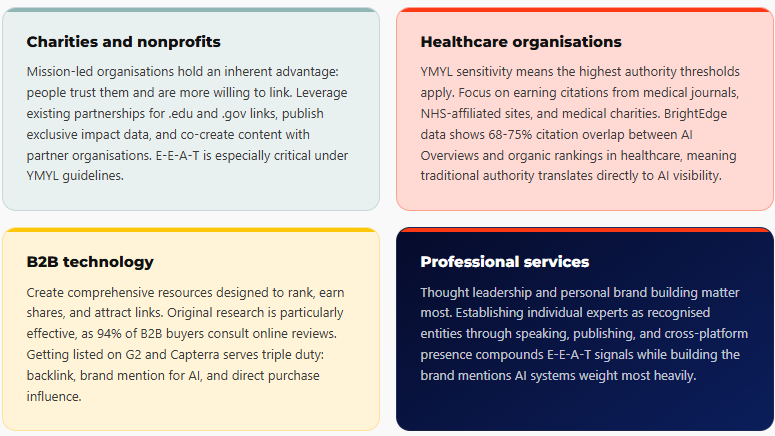
Sector-specific approaches
Quick diagnostic: is your link building AI-ready?
Answer yes or no:
- Do you track where your brand appears in AI-generated answers?
- Is your brand name consistent across all coverage and citations?
- Are you earning links from sources that appear in AI Overviews?
- Does your digital PR generate brand mentions, not just followed links?
- Are you creating original research or data that others want to cite?
- Do you monitor Reddit, YouTube, and industry forums for brand mentions?
- Is your content structured for extractability (answer-first, 50–150 word passages)?
- Do you have entity presence across four or more third-party platforms?
Mostly no? Your link building is optimised for 2019, not 2026.
Measuring link building when AI changes the equation
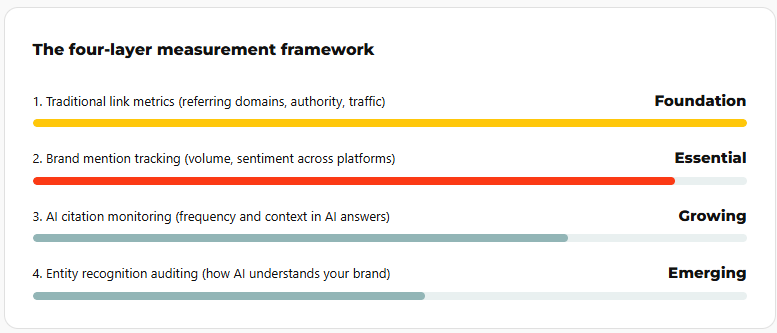
Traditional metrics remain relevant but insufficient. The emerging measurement framework combines four layers:
- Traditional link metrics: Referring domains, authority scores, referral traffic, ranking improvements.
- Brand mention tracking: Volume and sentiment across web, social, and AI platforms. Tools like Ahrefs Brand Radar, Chatbeat by Brand24, and Peec.ai now track this.
- AI citation monitoring: Frequency and context of brand appearances in AI-generated answers. Google Search Console now reports AI Overview performance.
- Entity recognition auditing: How accurately and completely AI systems understand your brand’s expertise areas.
68% of organisations are actively changing their strategies in response to AI search, according to BrightEdge’s survey of 750+ marketers. 60% of marketing teams plan to reallocate part of their SEO budgets toward AI search optimisation by 2026.

The bottom line
Link building is not dead. It is not dying. It is evolving into something broader: authority building.
Links, brand mentions, entity presence, topical depth, and content quality have converged into a single interconnected system that serves both traditional search engines and AI platforms simultaneously.
Three principles define what comes next:
- Brand mentions are the new backlinks for AI visibility, but they do not replace backlinks for traditional search. You need both.
- Digital PR is the bridge between the two worlds, earning links and mentions simultaneously while building the kind of authoritative third-party coverage that AI systems prioritise.
- Quality has won definitively. One editorially earned link from a topically relevant, high-authority source delivers more value across both traditional and AI search than hundreds of manufactured links ever could.
The brands that will thrive are those that stop thinking about “link building” as a discrete activity and start thinking about building genuine authority. The kind that makes journalists cite you, AI systems reference you, and customers trust you.
They are not choosing between SEO and GEO. They are doing both, with the same work.
Your competitors are being cited by ChatGPT. Are you? We can audit your current link profile and brand presence across AI platforms, identify where you are visible and where you are invisible, and build a digital PR strategy that drives rankings and citations together.
FAQs
Has link building become less important with the rise of AI search?
No. Research shows 73.2% of SEO professionals believe backlinks influence AI search visibility. While LLMs do not count links the same way Google does, backlinks help pages rank in traditional search, and 76% of AI Overview citations come from pages already in Google’s top 10. The authority and brand signals that links create still matter. High-quality backlinks from relevant sources build the reputation that AI systems rely on when choosing who to cite.
What matters more for AI visibility: backlinks or brand mentions?
Brand mentions show a much stronger correlation with AI visibility than backlinks do. Ahrefs’ study of 75,000 brands found branded web mentions correlate at 0.664 with AI Overview visibility, compared to just 0.218 for total backlinks. However, the two are not independent. Good link building and digital PR generate both links and brand mentions. The most effective strategy builds both simultaneously.
What is the most effective link building tactic in 2025–26?
Digital PR is the dominant approach, with 48.6% of SEO professionals ranking it as the most effective tactic. It generates authoritative coverage, high-quality backlinks, brand mentions, and expert positioning, all of which contribute to both traditional rankings and AI citation potential. Data-led content is particularly effective, with original research receiving 5.2 times more backlinks than standard articles.
Do brand mentions without links have value for AI visibility?
Yes. LLMs are trained on the web, including content that mentions brands without linking. Consistent brand mentions across authoritative sources strengthen your entity recognition in AI systems, even without hyperlinks. Ahrefs found that branded web mentions, linked or unlinked, show the highest correlation with brand presence in AI Overviews.
How should I measure link building success for AI visibility?
Track four layers: traditional link metrics (referring domains, authority scores, ranking improvements), brand mention tracking (volume and sentiment across web and AI platforms), AI citation monitoring (frequency of brand appearances in AI answers, now reportable in Google Search Console), and entity recognition auditing (how accurately AI systems understand your brand). Tools like Ahrefs Brand Radar, Chatbeat, and GA4 with ChatGPT UTM tracking make this measurable.
Which sectors benefit most from this shift?
Healthcare and education organisations see 68–75% citation overlap between AI Overviews and organic rankings, meaning traditional authority translates strongly to AI visibility in YMYL categories. Charities and nonprofits benefit from natural trust signals and willingness to link. B2B technology companies benefit from original research and review platform presence. Professional services firms benefit from personal brand building and thought leadership.
Author information
 With 15 years of hands-on SEO and digital marketing experience, agency director Ash is the driving element behind our digital team. Ashley heads our digital execution team, delivering innovative strategic and tactical marketing initiatives and campaigns; helping propel our clients’ growth and success.
Learn more about Ashley Salek, Agency Director, Seventh Element
Sources
- Ahrefs – An Analysis of AI Overview Brand Visibility Factors (75K Brands Studied) – Branded web mentions 0.664 correlation, backlinks 0.218
- Ahrefs – Top Brand Visibility Factors in ChatGPT, AI Mode, and AI Overviews (75K Brands) – December 2025 expanded study, YouTube mentions ~0.737
- Ahrefs – How to Rank in AI Overviews – 76% of AI Overview citations from top 10 pages
- Editorial.Link – Link Building Statistics 2026 – 518 SEO professionals surveyed, 73.2% believe links influence AI visibility
- BuzzStream – 70 Link Building Statistics 2025 – 94% of content gets zero external links, 3.8x backlinks on #1 pages
- Search Engine Land – Links are not a top 3 Google Search ranking factor, says Gary Illyes – Pubcon Pro September 2023
- TechCrunch – Sam Altman says ChatGPT has hit 800M weekly active users – October 2025
- The Digital Bloom – 2025 AI Visibility Report – Backlinks show weak/neutral correlation with LLM visibility
- Search Engine Journal – Ahrefs Data Shows Brand Mentions Boost AI Search Rankings – Ryan Law on co-occurrence and frequency
- Siege Media – How To Rank in LLMs Using Digital PR – Digital PR as bridge between SEO and AI visibility
- iProspect – Beyond Backlinks: Why Brand Mentions Matter More Than Ever – Brand mentions in the age of LLMs
- The Drum – Digital PR is the way to win over LLMs – Digital PR as dominant tactic
- Wellows – LLM Citation Trends – Citation trend analysis
- Backlinko – SEO Strategy 2026 – SEO strategy data
- FatJoe – The Future of Link Building 2025 and Beyond – Link building cost data, industry trends
- Position Digital – 90+ AI SEO Statistics – Comprehensive AI search statistics compilation