The one-paragraph answer (for people in a hurry)
Link building remains one of the most effective ways for UK charities to increase visibility, attract donors, recruit volunteers, and get cited by AI systems like ChatGPT and Perplexity. Charities hold several natural advantages: inherent public trust (75% vs 38% for corporations), .org.uk domain credibility, original research data, and partnerships with high-authority institutions. Yet 29% of UK charities rate themselves as poor at maximising their website for visibility, and only 44% have a digital strategy at all. The gap between what charities have and what they do with it is staggering. This article closes it.
Wait. Why are we leading with AI?
Because it is 2026, and link building now serves two masters instead of one.
Google has not gone anywhere. Traditional SEO still drives the majority of first-touch discovery for UK charities. Rankings still matter. Organic traffic still converts. None of that has changed.
What has changed is that a second discovery layer now sits alongside it. AI systems like ChatGPT, Perplexity, Gemini, and Copilot are answering questions your donors, volunteers, and service users used to type into Google. And those systems have their own way of deciding who gets cited.
Research analysing over 7,000 citations across 1,600 URLs found that brand search volume is the strongest predictor of AI citation, with a 0.334 correlation (The Digital Bloom, 2025). Domain authority, backlink profiles, and brand mention frequency collectively account for roughly 35% of AI citation likelihood (ALM Corp).
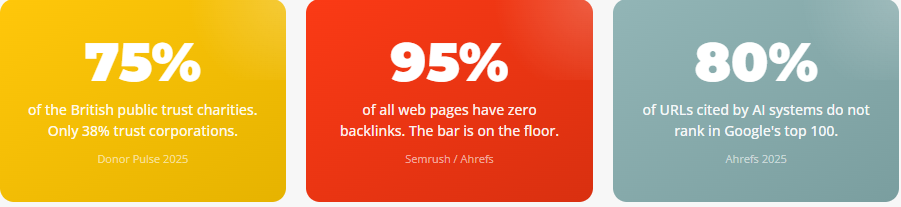
80% of URLs cited by large language models do not even rank in Google’s top 100 for the original query (Ahrefs, 2025). That is not a reason to abandon SEO. It is a reason to expand your definition of what link building is for.
The point is not that SEO is dying. The point is that link building now powers two engines instead of one. If you are only optimising for Google, you are leaving the AI discovery layer entirely to chance.
What link building used to be | What it needs to be in 2026 |
Google rankings | Google rankings + AI citations + brand authority |
DA as the goal | DA as one input into broader trust signal |
Backlinks as votes of confidence | Backlinks + brand mentions + structured content + freshness |
Traffic as success measure | Visibility, citations, and pipeline |
Standalone SEO activity | Woven into partnerships, campaigns, content, comms |
The link building landscape: a quick reality check
According to a 2025 study of over 500 SEO professionals by Editorial.link:
- 48.6% consider digital PR the most effective tactic. The old playbook of emailing strangers is on life support. Someone should probably send flowers.
- 73.2% believe backlinks influence AI search results.
- 52.3% find link building the hardest part of SEO. (The other 47.7% are either lying or doing it wrong.)
95% of all pages have zero backlinks (Semrush). Pages at number one have 3.8x more backlinks than positions two through ten (Backlinko). 67.6% of clicks go to the top five results (Zero Limit Web).
The bar is on the floor. 95% of web pages have zero backlinks. If your charity has even a handful of quality links, you are already ahead of almost everyone.
Why charities hold an unfair advantage (and mostly waste it)
Charities hold some of the most naturally linkable assets in existence. The problem is nobody has told you what you are sitting on. It is a bit like owning a Picasso and using it to prop open a fire door.
Asset | Why it matters for links | Why it matters for AI |
Original research data | Journalists and academics cite it | AI prioritises original structured data |
High-auth partnerships | Enormous link weight from .gov.uk, .ac.uk | Brand co-occurrence boosts citation likelihood |
Media relationships | News outlets want human interest | Coverage generates brand mentions AI tracks |
Public trust (75% vs 38%) | Trust is a link magnet | AI uses trust signals for citation worthiness |
.org.uk credibility | Built-in authority | Domain trust factor in AI source selection |
Commercial brands pay tens of thousands to manufacture these. Charities have them free.
The YMYL factor
Many charity websites deal with YMYL topics facing stricter quality evaluation. That sounds like a disadvantage. It is actually the opposite. Trust signals carry even more weight. The quality bar is higher, and charities are naturally better equipped to clear it.
The digital gap
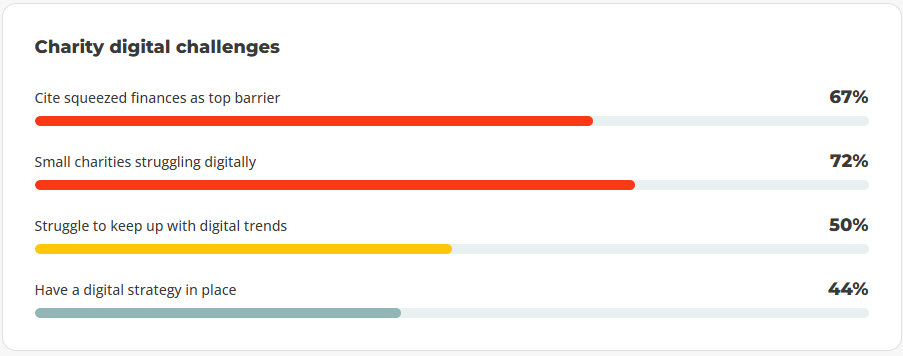
- 50% struggle to keep up with digital trends
- 67% cite squeezed finances as top barrier
- Only 44% have a digital strategy (down from 50%)
- 29% rate themselves poor at website visibility
Charities have the ingredients. They just lack the recipe. And in some cases, they do not even know they are sitting in a kitchen.
Proof it works: sector-by-sector evidence
All data from Torchbox’s SEO Super Trumps audit of 52+ UK charities.
Animal welfare: the Dogs Trust masterclass
Dogs Trust (£11M income) has DA 69, higher than RSPCA, Cats Protection, and Battersea. Monthly organic traffic: 1.2M. How? Content hubs covering breeds, care, rehoming. RSPB (DA 75, ~34,000 referring domains) uses its A-Z of Bird Breeds for the same effect.
Dogs Trust has ~£11M income but matches charities 10x its size on organic visibility. The difference is not budget. It is information architecture.
Mental health: Mind’s dominance
Mind leads the sector with ~49,000 referring domains. Samaritans: 34,300. Both DA 75. Built through structured content hubs with E-E-A-T signals including “about this content” transparency sections.
Healthcare: CRUK and BHF
CRUK: highest DA of all 52 charities, 37,000+ referring domains. BHF: DA 76. Technical performance (Core Web Vitals) is the underexploited advantage in this sector.
Environmental and maritime
Environmental sector: highest average DA at 69/100. WWF leads Core Web Vitals. RNLI: 92% donation-funded, became third largest UK charity on TikTok within one week. Every rescue story is a link opportunity. The RNLI does not do link building. It does its job, and the links follow.
Sector | Standout | DA | Key metric | What they did |
Animal welfare | Dogs Trust | 69 | 1.2M traffic on £11M income | Content hubs |
Mental health | Mind | 75 | ~49K referring domains | Condition/treatment hubs |
Cancer | CRUK | Top | 37K+ referring domains | Depth + institutional authority |
Environmental | Sector avg | 69 | Highest average DA | Niche topic expertise |
Healthcare | BHF | 76 | Highest in sub-sector | YMYL authority, E-E-A-T |
Maritime | RNLI | Strong | 92% donation-funded | Rescue stories, campaigns |
The Seventh Element Charity Link Equity Model
We built this four-layer model based on what the data shows works for non-profits. Each layer builds on the one below.
Layer | Name | Includes | Effort | Impact |
1 | Foundation | Directories, partner links, unlinked mentions, Ad Grants | Low | Baseline |
2 | Content Authority | Data pages, content hubs, research, toolkits | Med | Passive links |
3 | Earned Media | Digital PR, news, expert commentary, campaigns | Med-Hi | High-auth |
4 | AI Citation Ready | Structured content, schema, freshness, entity clarity | Med | AI cites |
Most charities are at Layer 0 or 1. The ones dominating are at 3 or 4. The gap is not budget. It is awareness and intent.
AI Citation Readiness Checklist
This checklist does not exist anywhere else. Because most link building articles were written before AI citation mattered.
Content structure
- Clear H2/H3 heading hierarchy
- Answer-first format: key information in opening paragraph
- Tables and structured data for comparisons
- FAQ sections with clear Q&A format on high-value pages
- Topic hubs with internal linking
Schema and technical
- Article, FAQPage, and Organisation schema applied
- Author pages with credentials
- “About this content” sections on YMYL pages
Freshness
- High-value pages updated annually (65% of AI bot traffic targets content under 12 months old)
- “Last updated” dates visible and accurate
- Statistics pages updated within one month of new data
Brand and authority
- Charity name consistently formatted across platforms
- Unlinked brand mentions monitored
- Named authors with visible credentials on all content
- Sources cited in body text and sources section
- Charity registration number prominently displayed
The tactics that work (and why)
1. The unlinked mention goldmine
This deserves its own section because it is, pound for pound, the single most underused tactic in the charity sector.
Your charity is mentioned on hundreds of websites right now without a link. Partner organisations, sponsors, event listings, local authority pages, media articles, grant directories. These are links you have already earned. You just have not collected them.
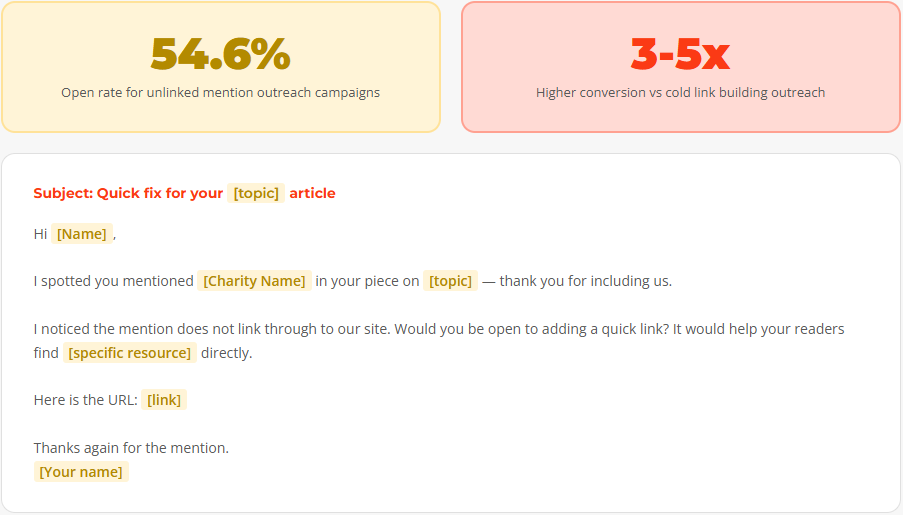
The conversion rate for unlinked mention outreach is three to five times higher than cold link building (Deep in SEO & GEO, 2026). Data from Mention.com shows campaigns achieve a 54.6% open rate and 11.8% response rate, significantly above cold outreach averages.
Method | Tool | Cost |
Google search operator | “your charity name” -site:yoursite.org.uk | Free |
Brand monitoring | Google Alerts, Mention, Brand24 | Free to £50/mo |
Backlink gap analysis | Ahrefs, Semrush | From £80/mo |
Historical audit | All of the above, 12-24 months back | One-off time |
How to prioritise: Focus on mentions from domains with higher authority than yours, in editorially controlled content, published recently. If the site has higher DA than yours and the mention is in an article, it is worth an email.
The outreach template: Short, specific, framed as helpful. “I spotted you mentioned [Charity Name] in your piece on [topic]. Would you be open to adding a link? Here is the URL.” No essay. No sales pitch. The link is not a favour they are doing for you. It is a service you are providing for their readers.
What if they do not respond? Follow up once after three to five days. Maximum four emails total. Following up the next day decreases response rates by 11%.
2. UK charity directories (more important than you think)
Most charity teams dismiss directory listings as busywork. But directories serve a function beyond the link. They create entity consistency. When Google and AI systems see your charity name, registration number, and URL appearing consistently across trusted platforms, it reinforces your identity as a known entity.
Platform | Provides |
Charity Commission | Official .gov.uk link |
Do-it.org | Volunteer connections, referral traffic |
JustGiving | Fundraising platform, high DA |
NCVO | National voluntary organisations directory |
Neighbourly.com | Charity-business CSR connections |
CharityJob | Employer profile pages |
GrantNav (360Giving) | Grant-related search visibility |
If you are not on all of these, stop reading and go do that first. We will wait.
3. Content hubs (the Dogs Trust playbook)
Why this works: Content hubs earn links passively because they answer the questions people are already asking. Dogs Trust does not pitch journalists to link to breed pages. Journalists find them because they rank for the queries journalists search when writing articles. The hub creates a gravitational pull. Over time, it compounds.
Asset type | Why it earns links | Effort |
Impact statistics page | Journalists and researchers cite sector data | Low |
Annual report (web, not PDF) | Academic and policy citations | Medium |
Survey or polling results | News hook for digital PR | Medium |
Toolkits and guides | Referenced by charities, councils, educators | Medium |
Species/condition/topic hubs | Passive link acquisition | High initial, low ongoing |
What if you lack resource for a full hub? Start with one page. Your most citable data point. Build it properly: clear headings, schema markup, sources cited, updated regularly. A hub of three well-built pages beats twenty thin ones.
4. Activate your partnership network
Why this works: Your partners have websites with higher DA than yours. They mention you without linking. Every partnership agreement should include a digital component.
How: Ensure links on partner pages, co-create content, request logo placement with links on CSR pages. Provide partners with a co-branded “Impact Badge” linking back to your transparency or impact page.
What if they say no? They rarely do. You are not asking for a favour. You are asking for a link on a page that already mentions you. Offer something in return: a reciprocal mention, social media shoutout, or co-branded content piece.
5. Digital PR (the charity version)
Why this works: 94.8% of digital PR professionals use data-led content, 92.5% use expert commentary (BuzzStream 2025). Charities have both in abundance. You have real stories, real impact, real people.
The Value Gap concept: Stop asking for links. Start creating value gaps. A value gap occurs when a journalist is writing about your sector and realises their piece is thin without your data point. When you provide it, the link is not a favour. It is a service you are providing for their readers.
How to be ready: Keep a press kit with three bullet points of data and a high-res chart, updated quarterly. When a news story breaks in your sector, you should be able to respond within hours, not weeks.
6. Google Ad Grants
£7,500 per month in free Google Ads for eligible UK non-profits. £90,000 per year. While this is paid media, the visibility creates brand awareness, which drives branded searches and organic mentions, which earn links. It is a flywheel. If you are eligible and not using it, we will not judge. But we will raise an eyebrow.
The PDF graveyard problem
We need to talk about your annual report. Not the content. The content is probably excellent. The problem is that it is buried inside a 45-page PDF titled Annual_Report_Final_v2_USE_THIS_ONE.pdf.
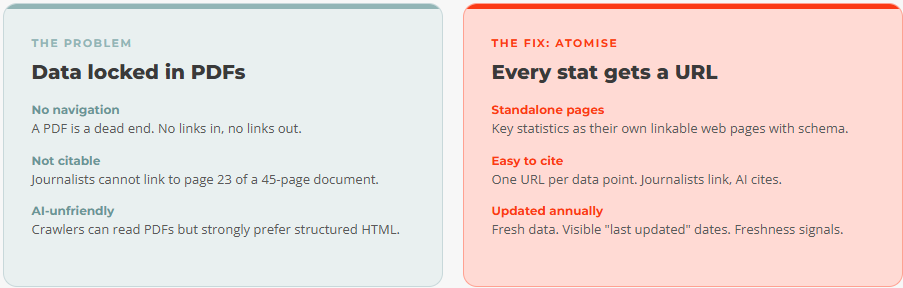
A PDF is a dead end. No navigation. No outbound links. No featured snippets. It is nearly impossible for a journalist to link to a specific data point on page 23 of a 45-page document. So they will not link at all.
The fix: atomise your reports. Every key statistic should be its own linkable asset.
Instead of this | Do this |
45-page PDF with everything | Dedicated statistics page, updated annually |
Impact data buried on page 23 | Standalone “Our Impact” page with clear headings |
Financial summary in appendix | Transparency page with headline figures |
Case studies scattered through report | Individual case study pages, each with own URL |
Infographics as images in PDF | HTML data visualisations with alt text |
If a journalist cannot link to a specific data point with a specific URL, that data point does not exist for link building purposes. PDFs are where citable data goes to die.
The ethical link builder’s manifesto
We are going to be direct about this because the charity sector cannot afford ambiguity.
Some agencies will offer to “build links” for your charity. What they mean is they will pay websites to place links. Sometimes on real sites. Sometimes on sites that exist solely to sell links. Either way, it is a link scheme.
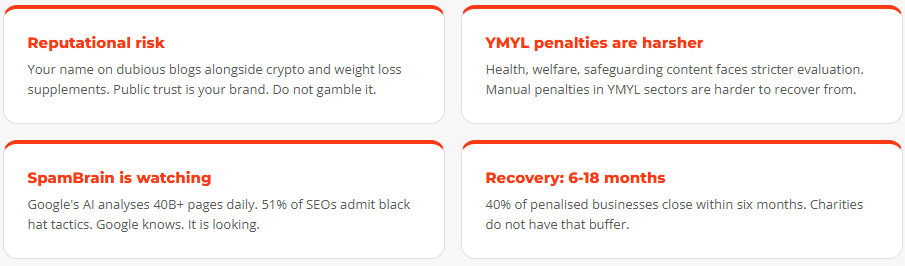
For a commercial business, getting caught means a ranking drop. For a charity, it means something worse.
- Reputational risk. Your brand depends on public trust. If your name appears on dubious blogs alongside cryptocurrency and weight loss supplements, that trust takes a hit.
- YMYL penalties are harsher. Charities in health, welfare, or safeguarding face stricter Google evaluation. Manual penalties in YMYL sectors are harder to recover from.
- SpamBrain is watching. Google’s AI spam detection analyses 40 billion+ pages daily. 51% of SEOs admit to black hat tactics (Search Engine Roundtable). Google knows.
- Recovery takes months to years. Manual penalty recovery: 6-18 months. 40% of penalised businesses close within six months (Whitehat SEO).
- The Charity Commission is watching too. Spending donor money on manipulative SEO tactics is, at best, poor use of funds. At worst, a governance issue.
We do not buy links. We do not sell links. This is not just a moral stance. It is a practical one. The risk-to-reward ratio for charities is catastrophically bad.
If an agency offers to “build links”, ask three questions: (1) Can you show me exactly where the links will be placed before they go live? (2) Are any placements paid? (3) Will links appear alongside content unrelated to our sector? If they cannot answer all three clearly, walk away.
Measuring ROI: beyond domain authority
Domain Authority is a useful benchmark. It is not a business metric. If your reporting starts and ends with “DA went from 42 to 45,” you are measuring the wrong thing. DA is a third-party score. Google does not use it. It can be gamed for as little as £50 (Xamsor, 2025).
Metric | What it tells you | How to track |
Referral traffic | Whether links drive actual visitors | GA4 > Acquisition > Referral |
Referral conversion rate | Whether visitors donate, sign up, or enquire | GA4 conversions on referral segment |
Citation share | How often AI systems cite you vs competitors | Manual sampling + Profound or Otterly |
Brand search volume | Whether link building increases awareness | GSC brand query trends |
New linking domains/month | Whether authority is growing | Ahrefs/Semrush referring domains |
Non-branded rankings | Whether authority translates to discovery | GSC filtered to non-brand queries |
Stop reporting DA as a headline metric. Start reporting referral conversions and citation share. One measures a proxy. The others measure outcomes.
Dangers, issues, and challenges
Link building is not without risk, even when done properly.
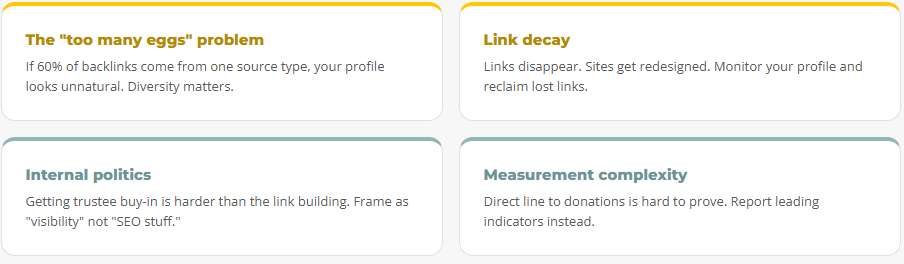
- The “too many eggs” problem. If 60% of backlinks come from one source type, your profile looks unnatural. Diversity matters.
- Link decay. Links disappear. Sites get redesigned. Pages get deleted. Monitor your profile regularly and reclaim lost links.
- Internal politics. Getting buy-in from trustees is often harder than the link building itself. Frame it as partnership development and visibility, not “SEO stuff.”
- Resource constraints. Most charity digital teams are one or two people. The free tactics require a few hours per month. The question is not whether you can afford to do it. It is whether you can afford not to.
- Measurement complexity. Proving link building caused a donation increase is hard. Report on leading indicators: new linking domains, referral traffic, citation share.
- Google dependency. If your entire strategy is designed around Google’s algorithm, you are building on rented land. A diversified visibility strategy serving Google, AI systems, and referral traffic is more resilient.
What works where: sector-specific priorities
Animal charities
Assets: Breed info, adoption stats, rescue stories, care advice. Priority: Content hubs. Publish adoption data as standalone pages. Pitch rescue stories to regional media.
Education and children’s
Assets: Welfare research, safeguarding guidelines, policy briefings. Priority: Safeguarding resources schools link to. Mission-driven content. Expert commentary on policy.
Historical and heritage
Assets: Archives, historical research, commemoration data. Priority: Digitise archives as web pages (not PDFs). Educational resources. Tie content to anniversaries.
Health and service
Assets: Safety info, health guidance, operational data, impact reports. Priority: E-E-A-T signals on all YMYL content. Statistics pages updated annually. Expert commentary.
The budget reality
Strategy | Cost | Effort |
Unlinked mention audit | Free | Low |
Directory listings | Free | Low |
Partner outreach | Free | Low |
Google Ad Grants | Free (£7,500/mo) | Medium |
Content hubs | Staff time | High |
Digital PR | Free or £2,999+ | Med-High |
Agency | From £500/mo | Low (outsourced) |
69% cite strained budgets as biggest barrier. The five highest-impact tactics are all free.
The mistakes charities make
- Copying the mattress company playbook. Guest posting on irrelevant sites carries reputational risk. You do not want your name next to crypto and weight loss supplements.
- Ignoring existing assets. Dogs Trust did not hire a link building agency. They published breed information.
- Burying data in PDFs. Publish as HTML with headings and schema. Stop hiding impact in unindexable documents.
- Treating links as separate. Weave link thinking into every partnership, event, and campaign brief.
- Quality vs quantity confusion. One NHS trust link beats fifty random directories.
- Operating without a digital strategy. Only 44% of UK charities have one. Link building without strategic context is just activity.
A realistic action plan
Month 1: Audit and claim. Unlinked mentions + directory listings. Fastest win.
Month 2: Atomise your data. Publish key statistics as standalone linkable pages.
Month 3: Activate partnerships. Check top ten partners for link opportunities.
Month 4: Google Ad Grants. If eligible, apply. £90K/year free.
Month 5: Start first content hub. The long game and most powerful.
Ongoing: Link thinking in every campaign brief. Press kit ready for reactive PR.
Quarterly: Review GSC + referral traffic + citation share. Report to trustees.
Frequently Asked Questions (FAQs):
Author information
 With 15 years of hands-on SEO and digital marketing experience, agency director Ash is the driving element behind our digital team. Ashley heads our digital execution team, delivering innovative strategic and tactical marketing initiatives and campaigns; helping propel our clients’ growth and success.
Learn more about Ashley Salek, Agency Director, Seventh Element