Short answer: A content calendar tells you when to publish. A content strategy tells you why, for whom, and what happens next. Around 60% of B2B content goes completely unused. The calendar did not prevent that. The missing strategy caused it. Here is how to tell the difference and fix it.
Your content calendar is a work of art. Every Tuesday has a title. The deadlines are colour-coded. There is a column for “pillar” and another for “persona” that has not been updated since someone left in 2023. There is a third column that says “SEO keywords” which contains whatever someone typed into Google once and thought “that’ll do.”
The spreadsheet is beautiful. The strategy behind it does not exist.
You know this. Your team knows this. The calendar has become the strategy because nobody wants to have the conversation about what the strategy actually is. That conversation involves answering questions like “who is this for?” and “is anyone searching for this?” and “why are we writing this?” and the honest answer to most of those is “because it was someone’s turn” or “because the CEO mentioned it at the all-hands.”
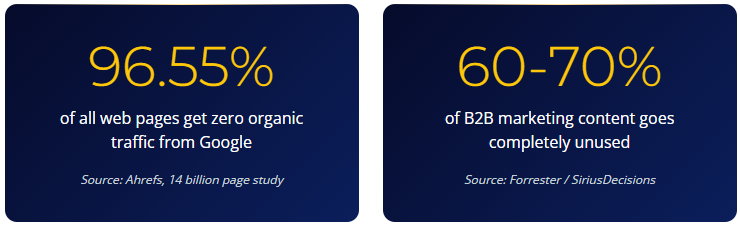
A calendar tells you WHEN. A strategy tells you WHY, FOR WHOM, and WHAT HAPPENS NEXT. Roughly 60-70% of B2B marketing content goes completely unused according to Forrester. Not underperforming. Unused. Nobody read it. The calendar was full the entire time.
A content calendar without a strategy is a publishing schedule with a mission statement stapled to the front. Everybody knows it. Nobody wants to say it.
The Difference, in Plain English
Dimension | Content Calendar | Content Strategy |
Answers | When do we publish? | Why are we publishing this? |
Horizon | Weekly to quarterly | 6-18 months |
Inputs | Deadlines, team capacity, channel slots | Audience research, search data, business objectives |
Measures | Was it published on time? | Did it drive a business outcome? |
Responds to | The editorial meeting | The buyer journey |
Failure mode | The slot is filled with whatever is easiest | Rarely, because this is what prevents failure |
The calendar is an execution tool. It organises deadlines, assigns owners, and keeps people from publishing three posts on Wednesday and nothing on Friday. It is genuinely useful. Nobody is arguing otherwise.
But it answers only the how and when. Never the why. Never the for whom. And crucially, never the “is anyone actually searching for this, or did we pick it because it was someone’s turn to suggest something in the planning meeting?” The calendar responds to whoever speaks loudest in the editorial meeting. The strategy responds to what the audience actually needs. These are almost never the same person saying the same thing.
What a Content Strategy Actually Covers
A content strategy is the decision-making framework that sits above the calendar. It defines the purpose, audience, messaging, and measurement of all content activity. If your calendar is the engine, the strategy is the sat nav. Without it, the engine is running. You are just not going anywhere specific.
A properly built strategy includes:
- Goals tied to business outcomes. Not “publish 12 blog posts per quarter.” That is a production target. It tells you nothing about whether any of those posts served a purpose. It is a confession that you are measuring activity, not impact.
- Audience research and buyer journey mapping. Who are you writing for? Not “marketing leaders” or “decision-makers.” Specific enough that you could describe their Thursday afternoon frustration. What are they Googling before they call a supplier? If you do not know, you are guessing. You are almost certainly guessing.
- Search demand validation. This is the one most teams skip because it involves telling a senior person that their pet topic has zero search volume, and nobody wants to have that conversation. More on this shortly. It is the most important section in this article.
- Content pillars and topic authority. Three to five core themes. Not 37 loosely related topics that shift every time someone reads a LinkedIn post. If a topic does not connect to something your business sells, it does not belong on your calendar. Being “thought leaders in sustainability” is not a content strategy. It is a LinkedIn bio.
- Distribution plan. How each piece reaches its audience across owned, earned, and paid channels. Publishing a blog post and sharing it once on LinkedIn is not distribution. It is the digital equivalent of printing a leaflet and leaving it on the breakroom table.
- Measurement framework. KPIs that connect content performance to revenue. Not to likes. Not to impressions. Not to “engagement rate” presented to two decimal places as though that precision means something. To pipeline. To money.
Strategy without execution is a PowerPoint. Execution without strategy is a content calendar. You have almost certainly experienced both. Possibly in the same quarter.
The Numbers Behind the Waste
The gap between strategy-led and calendar-only teams is not subtle. It is the kind of gap that, once you see the numbers, makes you wonder how the calendar-only approach survived this long. It survived because it is busy, and busy looks productive from the outside.
These are not edge cases. These are the defaults. Most content fails. The question is why.
Metric | With Documented Strategy | Without Strategy |
ROI performance | 33% higher | Lower, undirected returns |
Self-assessed effectiveness | 62% rate efforts as successful | Only 29% rate as very effective |
Content usage rate | ~40% creates measurable value | 60-70% goes unused |
Lead generation | 3x more leads than outbound | Volume without commercial direction |
Only 40% of B2B marketers have a documented content strategy (Content Marketing Institute, 2025). The other 60% have something. A deck nobody opens. A spreadsheet somebody’s predecessor built. An email chain from six months ago with “let’s revisit this in Q2” at the bottom. Q2 came and went.
The connection between documented strategy and results is not coincidental. It is causal. Companies with a documented strategy see 33% higher ROI. The ones without are spending money to fill calendar slots and then having quarterly meetings about why content is not “performing.” It is performing exactly as you would expect an unstrategised calendar to perform. Which is to say: expensively and pointlessly.
The Search Volume Problem: You Are Writing What You Want, Not What They Need
This is where most content calendars quietly go to die.
The CEO went to a conference. Heard a keynote about AI in procurement. Came back energised. Now there are three blog posts about it on the calendar. Nobody checked whether a single person in your target market has ever typed those words into a search engine. They have not. The posts will get 14 views. Nine of them will be internal.
Or the product team wants to announce a feature. Or someone read a LinkedIn post and said “we should have a take on this” in a meeting, and everybody nodded because nodding is easier than asking “does our audience care?” The topic goes on the calendar. Nobody validates demand. The blog post gets written, published, shared once on LinkedIn, liked by three colleagues, and forgotten by Wednesday.
Then it joins the 96.55%. Quietly. Without anyone noticing. Because nobody is measuring whether anyone read it. They are measuring whether it was published on time.
This is not a content failure. This is a research failure. You skipped the part where you check whether your audience wants what you are about to give them. You wrote for yourselves and called it content marketing.
The fix is not complicated. It is just unpopular. It requires telling people, sometimes senior people, that their topic idea has no search demand. That nobody is Googling “thought leadership in [your niche].” That the thing the board wants to publish about is, in terms of audience interest, a ghost town with a blog post in it.
Before anything goes on the calendar, open a keyword research tool. Look at monthly search volumes. Understand the intent behind the queries. Is anyone searching for this? How many? Are they looking for information or looking to buy? Are they searching at all, or did this topic originate in a meeting room where the audience was not invited?
70% of all search traffic comes from long-tail keywords (ResultFirst). These are the specific, detailed queries your audience types at 11pm when they have a real problem they need solved by Friday. Not “content marketing” (good luck ranking for that) but “content strategy template for B2B SaaS” or “how to measure content ROI for board reporting.” These are the topics that drive qualified traffic. They are also the topics most content calendars ignore because they are not glamorous enough for the editorial meeting. The editorial meeting, where the audience does not get a vote.
65% of B2C marketers prioritise the audience’s informational needs over their own sales messages. The other 35% are writing content for themselves and calling it thought leadership. It is not thought leadership. It is a monologue.
Search volume data tells you what your audience cares about. Ignoring it means you are guessing. And your calendar, however beautifully colour-coded, is a list of guesses with deadlines attached.
Intent matters as much as volume
A keyword with 10,000 monthly searches and purely informational intent will drive traffic but not pipeline. A keyword with 500 searches and commercial intent could be the most valuable page on your website. Most teams check volume. Almost nobody checks intent. The calendar does not distinguish between the two because the calendar does not know the difference. It does not know anything. It is a spreadsheet.
A strategy knows.
Five Ways Calendar-Only Approaches Fail
- Prioritising frequency over purpose. The goal becomes “fill the slot.” Three posts a week. Every week. Regardless of whether any of them answer a question someone actually asked. This is the content marketing equivalent of talking loudly in a crowded room and assuming someone must be listening. Publishing consistently is not the same as publishing strategically. It is just consistently publishing.
- Content becomes disposable. Published on Tuesday. Shared on LinkedIn on Tuesday afternoon. Liked by three colleagues and someone from accounts who likes everything. Forgotten by Wednesday. No internal linking plan. No repurposing. No updating. The calendar worships “new” and ignores “valuable.” HubSpot found that refreshing existing content generates 106% more leads than creating new content with the same resources. Most calendar-driven teams never look back. Looking back is not on the calendar.
- No alignment to the buyer journey. A calendar structured around arbitrary themes (promotional, educational, inspirational) misses the customer’s actual decision-making process entirely. Strategy-driven content maps every piece to awareness, consideration, or decision. Calendar-driven content maps every piece to “whose turn is it to write this week?” and “what can the intern have ready by Friday?”
- No measurement framework. Calendars track whether content was published on time. Strategies track whether content drove a business outcome. Without that connection, teams default to vanity metrics. Impressions. Likes. Newsletter open rates reported to two decimal places as though that precision means something. The posting consistency nobody outside the marketing team has ever asked about.
- The audience never gets asked. The calendar fills up with topics the organisation wants to talk about. Not topics the audience wants answers to. 66% of B2B buyers say vendors provide too much material (Forrester). 57% say much of it is useless. They are not being unkind. They are describing, with polite restraint, the output of a calendar that was never connected to their actual problems.
Three Questions Before You Touch a Calendar
Before scheduling a single post, a strategy should answer three foundational questions:
- Who is this for? Not “small business owners” or “decision-makers” or the ever-popular “marketing leaders.” Specific enough that you could describe their Thursday afternoon frustration. What are they searching for at 10pm? If the answer is “everyone,” the answer is nobody. You knew that. You wrote “everyone” because “we have not done the research” is harder to put in a strategy document.
- What makes you different? What does your brand do, say, or believe that competitors do not? If the answer is “we really care about our clients” or “we take a partnership approach,” the strategy is not sharp enough. If someone could swap your brand name with a competitor’s and the content would still make sense, you do not have a point of view. You have wallpaper.
- What are you deliberately not covering? The trends not being chased. The audiences not being served. The LinkedIn bandwagons not being jumped on. Strategy requires saying no. The calendar only ever says yes. It is pathologically agreeable. That is not a strength.
If someone can look at your content and immediately tell who you are talking to, what you stand for, and what you are choosing to ignore, that is strategy at work. If they cannot, it is a calendar keeping people busy.
Building a Strategy That Earns the Calendar
The calendar is not the enemy. It is a critical execution layer. But it should always sit downstream of strategy. Here is the order that works:
- Start with search demand. Before choosing topics, run keyword research. Identify what your audience is actually searching for. Look at monthly volumes, search intent, and competitive difficulty. Let the data choose the topics. Not the editorial meeting. Not the CEO. Not the person who read something interesting on a plane.
- Map content to the buyer journey. Every piece needs a stage: awareness, consideration, or decision. If you cannot assign one, the piece does not have a clear purpose. It has a deadline. Those are different things.
- Define content pillars. Three to five core themes your brand wants to own. Everything on the calendar should reinforce one of these pillars. If it does not fit a pillar, it does not belong on the calendar.
- Build a measurement framework. Decide what success looks like before publishing. Organic traffic? Lead generation? Pipeline contribution? Brand search lift? Pick the metrics that connect to revenue.
- Review and adapt quarterly. The strategy provides long-term direction. The calendar remains flexible enough to respond to trends, new data, and shifting audience behaviour. Strategy is the compass. The calendar is the route.
Your content calendar is full. Your pipeline is empty. The two facts are not unrelated.
The Uncomfortable Truth About Content That Works
The 20% of content that generates returns above 500% is the strategically planned portion. It was researched before it was written. It targeted a real query with real search demand. It served a specific audience at a specific stage of the buying journey. It was measured against a business outcome, not a publishing deadline.
The other 80% filled a calendar slot. Dutifully. Expensively. Pointlessly.
Content marketing generates $3 for every $1 invested, compared to $1.80 for paid advertising (DemandMetric). But that average is doing a lot of heavy lifting. It includes the strategically planned content dragging the calendar-filling content upward. Strip out the strategy-led pieces and the ROI on the rest is the kind of number you do not put in a board deck.
Two strong pieces per month that reinforce a core topic system will almost always outperform twelve mediocre posts that cover whatever the team felt like writing about. Depth compounds. Volume dilutes. Your SEO visibility depends on topical authority, and topical authority is built by a strategy that says “we are going to own this topic.” Not by a calendar that says “it is Tuesday.”
The brands seeing compounding returns from content are not publishing more. They are publishing less, with more intention. The strategy is the multiplier. The calendar is just the spreadsheet it lives in.
Your Action Plan: The Strategy vs Schedule Diagnostic
Ten questions. If you answer “no” to more than three, you have a calendar, not a strategy.
- Can you name three to five topics your content programme is designed to own?
- Have you validated your content topics against actual search volume data in the last 90 days?
- Is every piece of content mapped to a specific stage of the buyer journey?
- Do you have KPIs that connect content performance to revenue, not just traffic?
- Can someone outside marketing explain what your content programme is for?
- Do you have a documented distribution plan for each piece you publish?
- Have you audited your existing content in the last six months?
- Do you know the search intent behind your primary keywords?
- Have you said no to a content idea in the last month because it did not fit the strategy?
- Can you point to content that directly influenced pipeline in the last quarter?
Frequently Asked Questions
Need a content strategy behind the calendar?
If your content is keeping the schedule full but not driving pipeline, let’s fix that. Get in touch to build a strategy that earns its place.