Pull up your last LinkedIn post. The one that did well. Thirty-seven likes, twelve comments, a couple of reshares. Felt good. The head of content at a competitor said “great insight”. An agency founder you have never met wrote “this is exactly right”. Someone with “Growth | Strategy | Storytelling” in their headline dropped a fire emoji.
Now scroll through the names. Count the marketers. Count the agency people. Count the consultants, the freelancers, the people whose job title contains the word “digital”.
Now count the CFOs. The operations directors. The procurement leads. The people who actually sign the contracts you are trying to win.
That number is probably zero. And it has been zero for months. Maybe years. But nobody checked, because the engagement numbers looked healthy, and healthy engagement feels like it is working. It is not working. It is performing. Those are different things.
| Who Sees Your Posts | Who Controls the Budget | The Gap |
|---|---|---|
| Marketing managers and heads of digital | CFOs (79% of purchases require their approval) | Your content is in the wrong feed entirely |
| Agency founders and consultants | Procurement directors (involved from day one on 53% of deals) | They are not even on your radar |
| Fellow content strategists and SEO people | Buying committees of 10-13 stakeholders | You are reaching 1 out of 13 people in the room |
| Your network of marketing peers | Operations, finance, legal, and the end users | The algorithm serves you to people like you |
You are famous in the wrong room. The marketing echo chamber applauds your posts. The buying committee has never heard of you. That is not a reach problem. That is a strategy problem. And it is costing you pipeline every single week.
The Echo Chamber Has a Mechanism (and It Is Working Perfectly)
This is not LinkedIn’s fault. The algorithm is doing exactly what it is designed to do: show your content to people who are likely to engage with it. People who engage with marketing content are, unsurprisingly, marketers.
You post about content strategy. Marketers engage. The algorithm learns that marketers like your content. It shows your next post to more marketers. They engage. The loop tightens. Within six months, your organic reach is a closed circuit of people who will never buy from you but will happily tell you how smart you are.
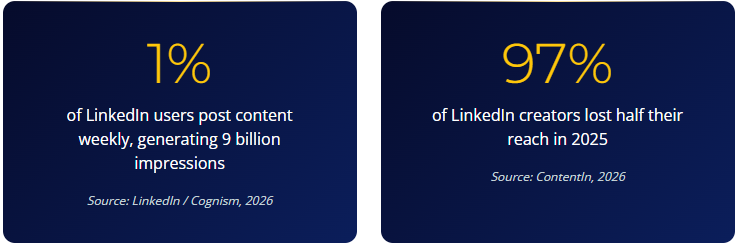
97% of LinkedIn creators lost half their reach in 2025. The ones who kept it were not posting more. They were posting to the right people. The algorithm now rewards relevance, credibility, and consistency over volume. But “relevant” means relevant to people who already engage with you. If those people are all marketers, that is the room you are locked in.
The head of content at your company posts a thoughtful piece about brand strategy. Her network is 80% marketers. The post gets 45 likes. The marketing team takes a screenshot for the monthly report. Someone puts a green arrow next to “LinkedIn engagement: up 22% MoM”. The slide goes into the board deck. The board does not care. They have never seen any of these posts. Nobody at board level uses LinkedIn the way your marketing team thinks they do.
That screenshot is not a performance metric. It is a comfort blanket.
The Buying Committee Does Not Look Like Your Feed
Here is the maths that makes the echo chamber expensive. The average B2B buying group now involves 10.1 members according to Gartner. Forrester’s 2026 State of Business Buying puts it higher: 13 internal stakeholders and 9 external ones on a typical enterprise purchase.
Your LinkedIn strategy is reaching, at best, one type of person on that committee: the marketing lead who found you because they are on LinkedIn consuming marketing content. The other 9-12 people on the buying committee? They are in finance, operations, procurement, legal, IT, and the C-suite. Most of them are not scrolling past your carousel about “5 ways to optimise your content funnel”.
| Buying Committee Role | What They Care About | What Your LinkedIn Talks About |
|---|---|---|
| CFO | Cost per acquisition, ROI timeline, budget justification | Content strategy frameworks |
| Procurement Director | Vendor risk, contract terms, compliance | Thought leadership trends |
| Operations Lead | Implementation burden, team capacity, timeline | Campaign best practices |
| CEO / MD | Competitive advantage, growth, market position | Marketing metrics dashboards |
| IT / Security | Integration, data handling, platform requirements | Creative campaign examples |
| End users | Day-to-day workflow impact, ease of use | Industry benchmarks |
79% of purchases require CFO approval (TrustRadius). Procurement is involved from day one on 53% of deals, not just at contract stage. 80% of B2B buyers enter the vendor engagement phase with a pre-evaluation favourite, and 95% ultimately buy from the shortlist they assembled before contacting anyone.
95% of B2B buyers buy from their Day One shortlist. If you are not on that list, you have an 8% chance of winning the deal. Your LinkedIn is reaching the person who suggests your name. It is not reaching the 12 people who decide whether to act on it.
If you are not on that Day One list, you have an 8% chance of winning the deal. Your LinkedIn strategy is reaching the one person on the committee who might suggest your name in a meeting. It is not reaching the 12 people who decide whether to act on that suggestion.
The Thought Leadership Trap
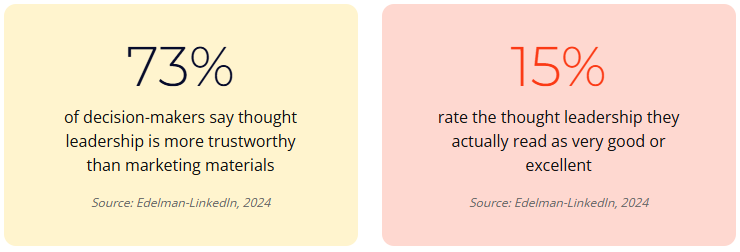
Here is the painful irony. Thought leadership actually works. 73% of decision-makers say it is more trustworthy than marketing materials and product sheets (Edelman-LinkedIn). 75% say thought leadership has led them to consider new vendors. 59% of B2B decision-makers say it is the most trustworthy way to assess a company’s capabilities.
But only 15% of decision-makers rate the thought leadership they read as very good or excellent. Eighty-five per cent of it is mediocre. And mediocre thought leadership has a very specific signature: it was written by a marketer, reviewed by a marketer, approved by a marketer, and consumed by marketers.
The content marketing lead who writes a post about “the future of B2B demand generation” is writing for an audience of other content marketing leads. The CFO does not know what demand generation is. Or, more precisely, does not call it that. The CFO calls it “the cost of getting customers” and wants to know if it is going down.
If your thought leadership reads like a conference presentation for marketers, it will perform brilliantly with marketers. It will not perform at all with the people who write the cheques. And the gap between those two outcomes is the gap between engagement metrics and pipeline.
Your thought leadership about “optimising the content funnel” is reaching people who already know what a content funnel is. The CFO who needs to approve the budget calls it “the marketing spend”. If your content does not translate into their language, it does not exist in their world.
What the Algorithm Actually Rewards Now (and Why It Hurts You)
The 2025-2026 LinkedIn algorithm changes made the echo chamber worse, not better. The algorithm now prioritises depth of engagement over reach. Sends and saves are the highest-intent signals. Comments from people in your network weigh more than reactions from strangers.
This sounds sensible until you realise what it means for a marketer posting marketing content. The people who send, save, and comment on your posts are other marketers. The algorithm sees deep engagement from marketers and serves your content to more marketers. The cycle accelerates.
- Sends and saves are the strongest signals. Marketers send your posts to other marketers.
- Comments from connections weigh more. Your connections are mostly marketers.
- Profile views after a post indicate buyer interest. But the profiles viewing you are agency people, not procurement.
- Carousel posts get 6.60% engagement, 278% more than video. But engagement from the wrong audience is just vanity at higher volume.
The person who should be seeing your content, the VP of Operations who is quietly frustrated with their current agency, will never see your post about “the state of B2B marketing in 2026”. That post was written for people who already have a strong opinion about the state of B2B marketing. The VP of Operations does not have a strong opinion about it. They have a strong opinion about whether the marketing they are paying for is generating revenue. Those are different conversations happening in different rooms.
You are famous in the wrong room. The marketing echo chamber applauds you. The buying committee has never heard of you.
The Audience Reality Check
We built this framework because “post better content” is not a strategy when the distribution is the problem. The Audience Reality Check is a diagnostic for who actually sees your LinkedIn content versus who needs to see it.
Step 1: Map your actual audience
Pull your last 10 LinkedIn posts. For each one, click on the impressions count and look at the job titles, industries, and seniority levels of the people who saw it. Categorise them:
| Audience Category | Job Titles | Value to Pipeline |
|---|---|---|
| The Echo Chamber | Marketing managers, agency founders, consultants, content strategists, SEO specialists | Near zero. They will never buy from you. They might refer you. Occasionally. |
| The Influencers | Heads of marketing, CMOs, brand directors | Medium. They recommend you. They do not sign the cheque. |
| The Decision-Makers | CFOs, CEOs, MDs, operations directors, procurement leads | High. They control the budget. They approve the vendor. |
| The End Users | Sales teams, product teams, customer success | Medium. They influence from inside. Their frustration drives the buying process. |
If more than 40% of your impressions are in the Echo Chamber category, your LinkedIn strategy is a performance piece for an audience that cannot buy from you. That is not a LinkedIn problem. That is a content problem, a targeting problem, and increasingly a revenue problem.
Step 2: Reframe your content for the buying committee
The fix is not “stop talking about marketing”. The fix is “start talking about what marketing does for the business, in the language the business uses”.
- Instead of: “How we increased organic traffic by 340%” Write: “How we reduced cost per acquisition by 62% in 9 months”
- Instead of: “The future of content marketing” Write: “Why your marketing budget is producing half the pipeline it should”
- Instead of: “5 things we learned about GEO” Write: “Your competitors are appearing in AI search results. You are not. Here is what that costs.”
The CFO does not care about your organic traffic. The CFO cares about whether marketing is worth the money. 57% of B2B buyers expect ROI within 3 months. If your content does not speak to that urgency, it will never reach the people who feel it.
Step 3: Activate employee networks
Your employees have 10 times more connections than your company page has followers (LinkedIn data). And those connections are not all marketers. Your sales team knows operations leads. Your account managers know finance people. Your CEO knows other CEOs.
The single most effective way to break out of the marketing echo chamber is to stop relying on the company page and start equipping your employees to share content with their networks. Not reshare the company post. Create or share content that is relevant to their specific audience.
Step 4: Use paid to reach the rest of the committee
Organic LinkedIn will always skew towards the people who already follow you and the people who look like them. That is the algorithm. You cannot outpost it. You can, however, buy your way past it.
LinkedIn’s paid targeting lets you reach specific job titles, seniority levels, and company sizes that your organic content will never touch. A small budget pointed at CFOs, procurement directors, and operations leads in your target industries will do more for pipeline than a year of organic posts that circulate in the marketing bubble.
The irony: most companies spend their LinkedIn ad budget boosting the same thought leadership that is already reaching the wrong audience organically. They are paying to amplify the echo.
The 95-5 Rule and Why the Echo Chamber Makes It Worse
You are building brand awareness with people who will never buy from you. The 95% of future buyers are on LinkedIn right now. The algorithm decided your content is not for them. Because you wrote it for your peers. Not for your prospects.
What the Generational Shift Means for Your Targeting
Your Action Plan: The Audience Reality Check
- Audit your audience composition. Pull your last 10 posts. Check the job titles in your impressions. If more than 40% are marketing roles, your strategy is circulating in the echo chamber.
- Map the full buying committee. For your top 5 target accounts, list every person involved in the purchase decision: finance, procurement, operations, end users, not just the marketing contact.
- Rewrite 5 posts in business language. Take your best-performing posts and rewrite them for a CFO audience. Replace marketing jargon with business outcomes.
- Launch an employee advocacy programme. Your employees have 10x more connections than your company page. Equip your sales team, account managers, and leadership to share content with their networks.
- Allocate paid budget to the buying committee. Run LinkedIn campaigns targeting CFOs, procurement, and operations leads in your target industries.
- Track pipeline attribution, not engagement. Add LinkedIn as a source field in your CRM. Track whether LinkedIn activity correlates with deals, not just impressions.
- Review quarterly. Run the audience composition audit every quarter. The echo chamber rebuilds itself.
Frequently Asked Questions
How do I know if my LinkedIn content is reaching the wrong audience?
Check your post analytics. Click on impressions and look at the job titles. If the top titles are Marketing Manager, Agency Founder, Digital Marketing Consultant, and Head of Content, you have a distribution problem. If more than 40% of your engaged audience works in marketing, your content is performing for the wrong room.
Why does my LinkedIn content get engagement but no leads?
Because engagement and pipeline are not the same thing. A marketing director liking your post about content strategy is engagement. A CFO clicking through to your case study after an employee shared it is pipeline. Most LinkedIn strategies optimise for the first. To generate leads, you need your content to reach the actual buying committee, which typically includes 10 to 13 stakeholders.
How do I reach CFOs and procurement on LinkedIn?
Three approaches work. First, employee advocacy: your employees have 10 times more connections than your company page. Second, reframe content around business outcomes, not marketing tactics. Third, use LinkedIn paid targeting to reach specific job titles and seniority levels outside your organic echo chamber.
What LinkedIn metrics actually matter for B2B?
Sends and saves are the highest-intent signals. Profile views after a post indicate buyer interest. Click-through rate to your site matters more than impressions. Ultimately, the only metric that matters is whether LinkedIn activity correlates with pipeline.
Should I stop posting thought leadership on LinkedIn?
No. Thought leadership works. 73% of decision-makers say it is more trustworthy than marketing materials. The problem is not the format. The problem is who it is written for. Rewrite it for the person who signs the cheque.
Sources
- Edelman-LinkedIn B2B Thought Leadership Impact Report (2024) – 73% of decision-makers trust thought leadership over marketing materials; only 15% rate it as very good or excellent
- Cognism / LinkedIn Statistics (2026) – 65 million decision-makers and 10 million C-level executives on LinkedIn; 4 out of 5 members drive business decisions; employees have 10x more connections than company pages
- ContentIn (2026) – 97% of LinkedIn creators lost half their reach in 2025; carousel posts achieve 6.60% engagement rate
- Corporate Visions / Forrester (2026) – Average buying group: 13 internal + 9 external stakeholders; 80% enter with a pre-evaluation favourite; 95% buy from Day One shortlist; 8% win rate if not on shortlist
- TrustRadius (2024) – 79% of purchases require CFO approval; procurement involved from day one on 53% of deals
- LinkedIn B2B Marketing Insights (2026) – 59% of decision-makers prefer creator content; 82% say it influences purchases; 75% considered new vendors after thought leadership
- Thunderbit / B2B Buying Stats (2026) – 94% of buyers use AI tools during buying; 29% start with AI before search engines; millennials make 41% faster decisions; 57% expect ROI within 3 months
- Martal Group / LinkedIn Statistics (2026) – 1.3 billion members; 310-350 million monthly active users; 50% of B2B buyers use LinkedIn as trusted source
- Hallam / LinkedIn B2B Institute (2025) – The 95-5 rule: only 5% in-market at any time
- Sopro (2025) – 90% of C-level won’t respond to cold outreach; millennials make up 50%+ of B2B decision-makers
- MartechView (2025) – Content echo chamber definition and B2B escape strategies
- Immediate Future (2026) – Why B2B marketers are getting influence wrong; treating influence like a media plan