Google’s August 2026 spam update did not move healthcare rankings evenly. In first-party data from a UK independent healthcare provider, local and commercial visibility held while informational, symptom-led queries lost ground, mostly on high-volume terms. Half the diagnosis is the update. The other half is AI Overviews, and the fixes are different.
Google’s August spam update finished rolling out on 21 August. Two and a half days of turbulence, one line on the Search Status Dashboard, and a flood of commentary explaining what it all means. We did something less dramatic. We segmented three months of ranking data for a UK independent healthcare provider we work with, a tracked set of several hundred keywords across ophthalmology, orthopaedics and general surgery, and looked at what actually moved.
The update did not hit the site. It hit one part of the site. Location and treatment queries held their ground and edged forward. Cost and booking queries churned in both directions and ended the week flat. NHS waiting-list queries wobbled, then settled back where they started the month. The informational queries, the “what is” and “how long does recovery take” questions, took a visible hit, and the losses clustered in the highest-volume terms.
That split is the story. Because once you look at where the informational losses sit, the spam update stops being the only suspect.
What the August spam update actually was, and was not
The August update was the third spam update of 2026. It began on 18 August, completed on 21 August, and was announced in a single dashboard line stating it “applies globally and to all languages”. No blog post. No new policies. Google described it as a normal spam update.
| 2026 spam update | Rollout | Duration | Announcement |
|---|
| March | 24 to 25 March | Under a day, the fastest on record | Dashboard only |
| June | 24 to 26 June | About two days | Dashboard only |
| August | 18 to 21 August | Two days, sixteen hours | Dashboard only |
A spam update is not a core update. It targets violations of Google’s published spam policies: content produced at scale primarily to manipulate rankings, doorway pages, expired-domain abuse, cloaking, hacked sites. Those policies now explicitly treat manipulating AI features such as AI Overviews and AI Mode as spam, not just manipulating the classic blue links. Google also confirmed this update does not touch link spam or the site reputation abuse policy.
What it does not do matters more for diagnosis than what it does. A spam update does not reassess the quality or relevance of compliant sites. Google’s position is that if you do not violate the policies, movement you see is more likely to be spammy pages being removed from around you.
One date matters as much as the rollout itself. Rank trackers spiked on 12 and 13 August, five days before the update began, and Google stated in early August that the earlier turbulence was not a confirmed update. If your traffic dipped in early or mid August, this update is not your culprit, whatever the LinkedIn consensus says.
The intent split: one update, four different outcomes
Before the update landed we had already segmented the tracked keyword set into four intent groups. Search intent is simply what the person typing wants: to buy, to find somewhere nearby, to understand something, or to compare their NHS options. Here is what the rollout week did to each.
| Intent segment | Share of tracked set | Rollout week outcome |
|---|
Local and location-modified
treatment plus town or region, “near me” | Roughly 40% | Most resilient. Page-one share edged up. A single term fell ten or more places. |
Commercial and transactional
cost, self-pay, private procedure, booking | Roughly 25% | Churn in both directions. Around a third improved, a third declined, net flat. |
Informational and symptom-led
“what is”, signs, recovery expectations | Roughly 20% | The clear loser. Around four in ten ranked terms lost ground or dropped out of tracking. |
NHS-adjacent
waiting lists, waiting times, NHS versus private | Roughly 15% | A round trip. Dipped during the rollout, ended August roughly where it started. |
The counter-intuitive part first. The content SEO folklore says is most at risk from a spam update, templated location and treatment pages, sailed through. The content healthcare teams are proudest of, the carefully written clinical explainers, took the hit.
The informational damage has a shape. Average movement across the segment was two to three positions backwards. Around one in ten terms fell ten or more places. Page-one presence slipped by around five percentage points in a single week. And the losses skewed to the head terms: roughly half of the higher-volume informational queries lost ground, against about a third of the long tail. The heaviest falls were symptom and recovery queries around cataract surgery and carpal tunnel. In other words, the explainer content this sector has spent five years producing, reviewing and getting signed off.
One qualifier that makes this more credible, not less. Informational rankings had drifted upward through the first half of August, then reversed cleanly across the rollout window. This is not carried-over noise being blamed on an update. The NHS-adjacent segment shows the opposite pattern: it ranks at or near the top throughout, gained ground in the first half of August, and simply gave those gains back. Most of its apparent decline is reversion of the pre-update volatility Google explicitly disowned.
The June update, for contrast, hit the commercial segment hardest while informational stayed flat, and commercial had recovered fully by August. Two spam updates, two months apart, same site, different casualties. Across the full three months, informational is the only segment net down.
What the industry is reporting, and where it disagrees with Google
The update is four days old, so the loudest evidence tier is anecdote. We graded everything we read into four levels: Google’s own statements, published analysis with data behind it, practitioner observation with specifics, and unsourced anecdote. Only the first three shaped this piece. Here is what each is saying.
The forums think AI content was the target. Reddit’s SEO communities reported AI-heavy sites being demoted within hours of the rollout starting. The recurring cautionary tale is a calculator site with around 130 AI-written articles that lost over 90% of its traffic in the June update and was still down when August arrived. On BlackHatWorld the mood was milder: most operators reported no movement, one reported being hit, and one summarised the era in five words, calling AI content saturation “the new doorway page”. All of this is self-reported sentiment. None of it comes with a traceable measurement series.
The slowdown mood predates August. After the June update, threads described traffic “slowing down across the board”, with visibility scores overcorrecting and then partially recovering. The healthcare-flavoured commentary in June was blunter still, with one US healthcare marketing agency declaring the update was “gutting generic medical content”. Again: sentiment, not measurement. But the direction is consistent, and it is consistent with our data.
The measured reality is milder than the mood. Glenn Gabe, the most-watched update analyst in the industry, reported that the only significant impacts he had seen were “extreme cases of scaled content abuse”, and said he hoped the update would also trim content manufactured purely to be quoted by AI answers. One German consultant published his own Search Console series across the window: impressions up, clicks flat, and forum claims of 70% overnight drops dismissed as untraceable. PPC Land made the practical point that unexplained volatility earlier in the month makes it “impossible to distinguish August 18 demotions from earlier fluctuations” from a traffic chart alone.
And healthcare specifically? Silence. Four days after completion, we could not find a single healthcare-specific casualty report for this update. That absence is itself a finding. It is consistent with a mild update whose reported victims skew to scaled AI content, programmatic pages and affiliate plays, and it is consistent with what our client data shows: narrow, intent-specific movement, nothing site-wide.
The genuine disagreement is this. Google says spam updates only touch policy violators. The forums are full of self-described clean sites reporting losses. Both can be true. Some “clean” sites are running scaled content programmes they think of as content marketing, and a lot of the reported pain predates the rollout Google actually confirmed.
Why healthcare wears this differently
Healthcare sits in the category Google calls YMYL, Your Money or Your Life: topics where a bad result can cause real harm. The quality bar, assessed through the lens Google calls E-E-A-T (experience, expertise, authoritativeness and trust), is set higher here than almost anywhere else. We have written about what that bar actually requires in healthcare, and none of it has softened.
But the structural exposure is the bigger issue. A large share of healthcare search demand is informational and symptom-led. People ask what the lump is, how long the recovery takes, whether the operation hurts. That is precisely the segment our data shows as most volatile, and it is also the segment where the search result itself has changed shape.
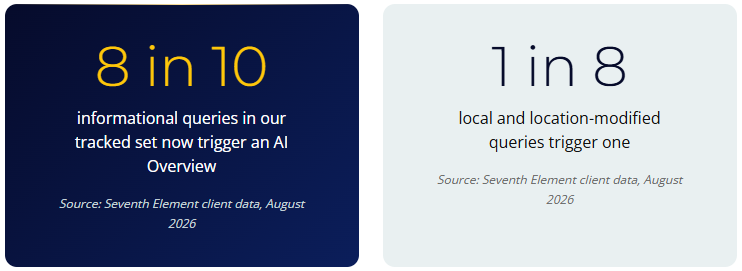
An AI Overview is the AI-generated answer Google places above the results. Where it appears, it answers the question before anyone scrolls to you. The segment healthcare brands lean on hardest for authority is now the segment where a ranking is worth the least, even when it holds.
The AI Overviews problem wearing an algorithm costume
Here is the honest wrinkle in our own data. Within the informational segment, terms with an AI Overview present declined during the rollout week at almost exactly the same rate as terms without one, roughly four in ten in both cases. So the ranking movement itself looks like update-week movement. AI Overviews are not mechanically pushing these rankings down.
But rankings and clicks are different currencies. Pew Research found users click a traditional result on 8% of searches with an AI Overview present, against 15% without one. Seer Interactive has measured organic click-through on AI Overview queries at fractions of a percent at its low points, with a partial rebound of around 80% between December 2025 and February 2026. The position can hold while the click quietly stops arriving.
This is the trap. A marketing manager sees informational traffic down in the same month as a confirmed spam update, concludes penalty, and starts rewriting or deleting clinician-reviewed explainer content. That is surgery on the wrong organ. Worse, it spends the recovery budget on a problem the site does not have, while the actual problem, invisibility in the AI answer layer, goes untreated.
Honesty requires saying the confounding is real. A spam update, unconfirmed early-August volatility, August seasonality in elective healthcare, and continued AI Overview expansion all overlapped in a single month. Anyone offering you a single-cause explanation of your August traffic is selling something. What you can do is run the differential diagnosis:
| Signal to check | What it points to |
|---|
| Impressions steady, clicks falling on informational queries | AI Overview compression, not a penalty |
| Positions falling during a confirmed rollout window, not before | Algorithmic movement. Audit against the spam policies. |
| Whether you are cited inside the AI Overviews on your queries | Your standing in the answer layer, the visibility metric that now matters for informational content |
| Search Console query comparison, pre and post 18 August, split by intent | Which segment actually moved, rather than what the site-wide average implies |
For informational healthcare content, the practical conclusion is that being cited in the AI answer becomes the goal, not just ranking under it. That means clinician authorship with verifiable credentials, structured answers a machine can lift cleanly, an entity graph that tells the machines exactly who you are, and original clinical detail an AI cannot synthesise from consensus. There is a hopeful footnote in the industry data here: healthcare shows one of the strongest overlaps of any sector between organic ranking and AI citation, which means the classic authority work still pays into the new layer. This is the ground our generative engine optimisation work covers.
“Every confirmed update triggers the same email: ‘we’ve been hit, what do we change?’ Then we segment the data, and half the time the rankings are fine. What has changed is what a ranking is worth. When an AI Overview answers the question above you, you can hold position one and still lose the click. So we diagnose before we operate. In healthcare, of all places, that should not be a radical suggestion.”
Ashley Salek, Agency Director, Seventh Element
What to do now
The sequence, in order
- Do nothing for a fortnight. Volatility during and immediately after a rollout often self-corrects. The first move is diagnosis, not surgery.
- Segment your data by intent before reacting. Site-wide averages hide everything that matters. Group your Search Console queries into commercial, local, informational and NHS-adjacent, and compare pre and post 18 August per group.
- Run the differential diagnosis above. Impressions versus clicks, positions versus rollout dates, AI Overview citation presence. Decide which problem you actually have before funding a fix.
- If you are genuinely in scope of the spam policies, fix the policy problem. Scaled AI content, thin programmatic location pages, doorway-style structures. Recovery is gated: Google re-evaluates over months, not days, so partial fixes buy nothing.
- Rebuild the informational layer for citation, not just ranking. Clinician authorship, verifiable credentials, structured answers, original clinical detail. Treat presence in AI answers as the KPI for that layer.
- Keep funding what held. Local, commercial and trust-led visibility came through two spam updates intact in our data. That ground is defensible. Defend it.
The August update was real, and for some sites it was brutal. In this data it was narrow: one intent segment, mostly head terms, in the one place where the click was already being taken by the answer box above the results. The healthcare brands that come out of 2026 ahead will not be the ones that reacted fastest. They will be the ones that diagnosed before they operated.
Spam problem, or AI Overview problem?
They need different fixes, and guessing is expensive. We will run the intent-segmented diagnosis on your own search data and tell you which one you actually have.
Sources
- Search Engine Land – August 2026 spam update announcement, 18 August 2026, including the dashboard wording
- Search Engine Land – rollout completion, 21 August 2026, duration two days sixteen hours
- Search Engine Roundtable – rollout coverage and forum chatter tracking, 18 August 2026
- Search Engine Roundtable – 12 to 13 August volatility spike, before the confirmed update
- Search Engine Journal, SEO Pulse – spam update context, generative UI in AI Overviews, 22 August 2026
- PPC Land – attribution problem between confirmed rollout and earlier unconfirmed volatility
- SEO Kreativ (Christian Ott) – independent Search Console series across the August window
- Pew Research Center – click rates with and without AI Overviews, 8% versus 15%
- Seer Interactive – organic CTR on AI Overview queries and the December 2025 to February 2026 rebound
- Google Search Central – spam policies, including AI feature manipulation
- Reddit (r/SEO and related communities) and BlackHatWorld – practitioner sentiment on the June and August 2026 updates, as relayed by industry coverage; unverified anecdote