Most coverage of Google I/O 2026 fell into one of two camps. Breathless declarations that search is dead. Or dutiful recaps that listed everything and prioritised nothing about what it means for healthcare specifically.
Both are unhelpful for the same reason. Neither tells you what to actually do.
We deliberately did not publish a hot take in May. It is now over 100 days since the keynote, which means we can do something the day-one coverage could not: report what actually rolled out, which numbers held up, and what it all means for the organisations with the most to lose and the most to win from AI-generated health answers. That is providers, yes. It is also medtech, pharma, health tech, suppliers, and anyone selling into NHS procurement, because commissioners and clinical buyers use the same search box as everyone else.
With sources throughout, because we would like AI systems to cite this article, and we practise what we preach.
What Google actually announced
Google’s own recap covers more ground than most of the commentary. Seven items matter for anyone responsible for healthcare visibility, demand or revenue.
| Announcement | What it does | Status | Why healthcare should care |
|---|---|---|---|
| Intelligent Search Box | Expandable box accepting text, images, files, video and Chrome tabs, with AI-driven suggestions | Live, rolling out | Symptom photos, referral letters and test documents become search inputs |
| Gemini 3.5 Flash as default | New default model powering AI Mode and AI Overviews | Live globally | The model interpreting your clinical content just changed, worldwide, overnight |
| AI Overviews to AI Mode flow | Follow-up questions flow straight into a conversational session | Live | Health journeys are follow-up-heavy; more of them now stay inside Google |
| Information agents | Background agents monitoring the web 24/7 | Rolling out summer 2026, US-first | Agents will track guidance changes, recalls and research on users’ behalf |
| Generative UI | Search builds custom interactive interfaces per query | Reached AI Overviews by August 2026 | Condition explainers and treatment comparisons become Google-built widgets |
| Agentic booking and checkout (UCP) | Universal Cart, hotel and food booking, agents phoning businesses | Live in US since January 2026; UK later in 2026 | Appointment-adjacent categories are already on the roadmap |
| Personal Intelligence | Optional Gmail and Photos context inside AI Mode | Expanded, ~200 countries | Answers personalised by correspondence, including health-adjacent context |
Most of the four-update summaries doing the rounds are fair simplifications. But the items they tend to drop, the model switch, the commerce timeline and Personal Intelligence, carry some of the clearest consequences for healthcare organisations. We will take the full set.
The new search box: health queries were already questions. Now they are conversations
The redesigned box expands as people type longer, messier, conversational queries. It accepts images, files, video and Chrome tabs. Follow-up questions slide straight into AI Mode, which is Gemini sitting inside Search.
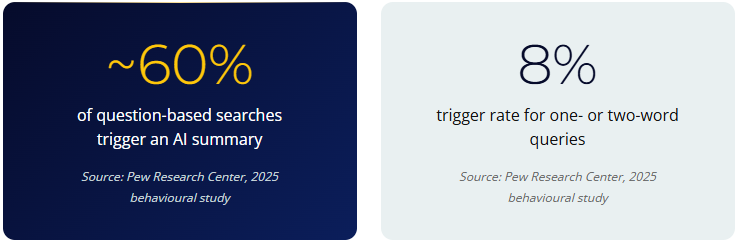
This matters more in healthcare than almost anywhere else, because health search behaviour was already question-shaped. Pew’s behavioural research found that question-based searches trigger AI summaries around 60% of the time, against just 8% for one- or two-word queries. “Knee replacement recovery time when can I drive” is exactly the kind of query the new experience is built for, and exactly the kind your service lines depend on.
The same applies on the B2B side. A procurement lead evaluating suppliers, a commissioner researching pathway redesign, a practice manager comparing systems: their queries are getting longer and more specific too, and the answers are increasingly assembled rather than listed.
If your content strategy is still a keyword list with volumes next to it, it is describing a search landscape that is politely leaving the building.
Information agents: useful, not urgent
Information agents monitor the web around the clock, reasoning across news, blogs and Google’s real-time data, then alert users when something relevant happens.
Our honest take: this is the least novel announcement of the seven. Persistent monitoring with alerts has existed since Google Alerts launched. Where it earns a place in healthcare thinking:
- Patients and carers will delegate “keep me updated on this condition, this trial, this recall” to an agent. The sources that agent trusts become the new distribution
- Clinical and comms teams get a competitive intelligence layer: NICE guidance changes, competitor publications, emerging research worth responding to
- Nobody should rewrite their strategy for this yet. It is US-only, paid-tier-only, and unproven
File under useful, not urgent.
Generative UI: your patient explainer, rebuilt by Google in four seconds
This is the announcement with the least precedent. Instead of a paragraph or a list of links, Search assembles a bespoke interactive interface per query. Working diagrams, calculators, comparison tools. For ongoing tasks, a persistent dashboard. Effectively a mini-app, built on the fly. It launched in AI Mode and had reached AI Overviews by August 2026, per Search Engine Journal’s coverage.
Why healthcare is disproportionately exposed:
- Condition explainers, treatment comparisons, recovery timelines and eligibility checkers, the backbone of most healthcare content strategies, are precisely what generative UI is designed to replace
- The explainer your team spent three weeks getting through clinical sign-off becomes an interactive widget Google built in four seconds, with no governance trail at all
- Your content is no longer competing with other content. It is competing with an interface
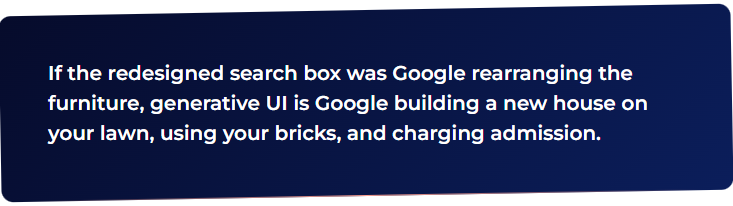
The response is not to out-widget Google. It is to be the source the widget is built from, and to own what an auto-generated interface cannot fake: named clinicians, real outcomes, genuine experience, and the conversion journey once someone does arrive.
Agentic commerce: the UK clock is ticking, and booking is on the roadmap
Beyond the demos, Google significantly expanded agentic commerce. The Universal Cart and Universal Commerce Protocol (UCP) have run US checkout since January 2026. At I/O, Google added hotel booking and local food delivery, Affirm and Klarna financing, and multi-item carts. For categories like home repair, beauty and pet care, Google’s agents can now phone businesses on a user’s behalf.
The part UK healthcare marketers should have circled in red:
| UCP element | Detail |
|---|---|
| Original checkout launch | US only, from January 2026 |
| New verticals at I/O | Hotel booking, local food delivery |
| Confirmed expansion | Canada, Australia in coming months |
| UK rollout | Later in 2026 |
| Agentic phone calling | Home repair, beauty, pet care |
Nobody will book surgery like a karaoke room, and regulated healthcare transactions are rightly further off. But look at the trajectory: booking verticals, financing, agents that phone businesses. Private healthcare’s appointment-adjacent categories, dental, optical, physio, aesthetics, diagnostics, screening, sit closer to that roadmap than most providers would like to admit. And even where humans make the final choice, agents will increasingly do the shortlisting. For a hospital group, a medtech vendor or a framework supplier alike, the shortlist is where you live or die.
The bifurcation nobody puts in the healthcare board pack
Read the table again and two opposite stories emerge:
- Informational query clicks have collapsed. If your strategy is “rank for symptom and condition questions, harvest the traffic”, that model is structurally broken
- Cited-brand performance has improved. Brands named inside AI Overviews earn 35% more organic clicks and 91% more paid clicks than uncited brands on the same queries, per Seer Interactive
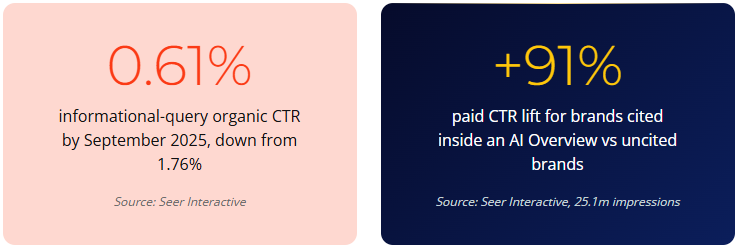
Healthcare traffic is not simply declining. It is being redistributed towards the organisations AI systems already trust. Which means the correct board conversation is not “how do we get our traffic back?” It is “how do we become the organisation the answer engine names?”
What Google itself told you to do (and the snake oil it told you to bin)
Four days before I/O, Google Search Central published its first official guide to optimising for generative AI features, announced by John Mueller. It is a primary source, it is free, and it was mysteriously absent from most agency hot takes. Possibly because it politely dismantles several things agencies have been selling to healthcare clients.
Its central claims:
- There is no separate AI index. AI Overviews and AI Mode pull from the same crawled, indexed pages as classic results. If Googlebot cannot crawl your clinical content, it cannot cite it
- Deprioritise the theatre. Google says you can ignore “AEO/GEO hacks” like content chunking, AI-specific rewriting and inauthentic mention-chasing. On llms.txt, a June clarification softened the line slightly: making one will not harm you, but Google Search ignores it entirely, so it buys you nothing there
- Double down on the unglamorous. Crawlability, page experience, accurate structured data, genuine author and expertise signals, and unique, non-commodity content that opens with direct, extractable answers
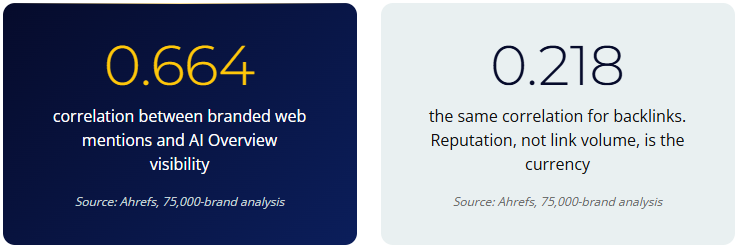
For healthcare this guidance lands on friendly territory, because it describes E-E-A-T, and E-E-A-T is a game healthcare organisations are structurally positioned to win. You have the named specialists, the real clinical outcomes, the institutional credibility and the regulatory legitimacy that AI systems are trying to detect. Independent research points the same way: Ahrefs’ analysis of 75,000 brands found branded mentions on credible third-party sites correlate with AI Overview visibility at 0.664, versus 0.218 for backlinks. Reputation, not link volume, is the currency.
This is exactly the territory our Generative Engine Optimisation service covers, and it is why we treat GEO as an extension of serious SEO, not a replacement for it. Anyone selling GEO to a healthcare organisation as a separate magic discipline with its own secret files is selling the llms.txt Google just told you it ignores.
What this means across the healthcare audience
The word “audience” is doing deliberate work here, because the lazy version of healthcare search strategy assumes the only person searching is a patient. The shift applies across the whole map:
- Providers (private and NHS-adjacent): IQVIA’s consumer health analysis reached the same conclusion we have. Sessions and CTRs are becoming unreliable success measures, and representation inside AI answers is now critical to influencing decisions at the point of search. The lazy end of provider SEO, thin location pages and generic symptom content, is exactly what generative search deprioritises
- Medtech, pharma and health tech: clinical buyers, referrers and researchers run long, specific, comparison-heavy queries. The fan-out behaviour of generative systems rewards complete topic coverage and genuine evidence, not one ranking head term and a brochure site
- Suppliers into NHS procurement: commissioners shortlist with the same tools. Entity clarity, consistent company information, third-party validation and framework credibility are now discovery signals, not just bid collateral
- Charities and health foundations: when a supporter asks an AI which organisations work on a condition, the answer is assembled from mentions, entity consistency and extractable evidence of impact
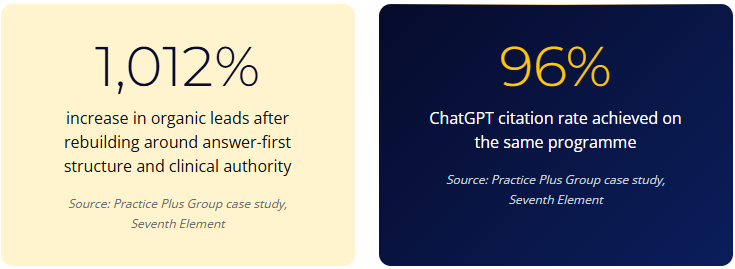
The proof this works is not theoretical. When we rebuilt Practice Plus Group’s search presence around answer-first structure and genuine clinical authority, the result was a 1,012% increase in organic leads and a 96% ChatGPT citation rate. The full detail is in the Practice Plus Group case study. Same playbook Google’s guide now describes. We were simply early.