The short answer: On 22 September 2026, Anthropic launched Claude Opus 5.5 and OpenAI launched GPT-6 Sol and Luna, all with major price cuts. For CMOs, the lesson is not “switch models”. It is this: when AI gets cheap, generic content, token-counting and loyalty to one AI provider all lose value. Proof, expertise, governance and being easy for AI to quote gain it.
On Tuesday, the two biggest AI labs launched new models within about 90 minutes of each other. Anthropic released Claude Opus 5.5, and roughly 90 minutes later OpenAI responded with GPT-6 Sol and Luna.
Somewhere, a procurement team that had just signed an annual AI contract quietly closed its laptop.
The coverage has mostly been a sports report. Who topped which leaderboard. Who undercut whom. Fun, but not especially useful if your job is to grow a charity’s donor base or fill a B2B pipeline.
So here is the version for the people who have to explain this to a board.
What actually launched (for those who skipped the livestream)
Right. Time to get geeky for a minute. We promise there is a point at the end.
| | Claude Opus 5.5 | GPT-6 Sol | GPT-6 Luna |
|---|
| Maker | Anthropic | OpenAI | OpenAI |
|---|
| Price (per 1M tokens, input/output) | $4 / $20 | $2 / $10 | $0.10 / $0.50 |
|---|
| Change vs previous version | 20% cheaper per token. Anthropic claims ~40% cheaper on typical workloads | Half the price of GPT-5.6 Sol | Roughly half the price of GPT-5.6 Luna |
|---|
| Positioning | Top-end. Matches Fable 5.1 on most work | Mid-range. Coding and automated tasks | Budget. High-volume routine jobs |
|---|
| Independent ranking | #1 on Artificial Analysis Intelligence Index (58) | Not yet independently compared like for like | Not yet independently compared like for like |
|---|
On Anthropic’s side, Opus 5.5 costs $4 per million input tokens and $20 per million output tokens, which Anthropic says comes to 40% less than Opus 5 on a typical workload. Independent tester Artificial Analysis put it top. At its maximum effort setting, Opus 5.5 scores 58 on the index, five points ahead of GPT-6 Astra and Claude Fable 5.1, which are tied on 53.
On OpenAI’s side, Sol now costs $2 per million input tokens and $10 per million output tokens, down from $4 and $20, while Luna falls to $0.10 and $0.50, down from $0.20 and $1.20. The step up in ability is modest. Both models are slightly more capable than the versions they replace, but sit well behind Astra, which is still OpenAI’s most powerful model.
If “per million tokens” made your eyes glaze over, relax. It does that to most people quoting it on LinkedIn too.
And the pace? Opus 5.5 arrives just two months after Opus 5 launched on 24 July, and Sonnet 5.5 and Haiku 5.5 are due “in the coming weeks”. OpenAI only began rolling out GPT-6 Astra on 3 September.
Three top-tier AI launches in three weeks. Any AI plan with a slide titled “our chosen model” is already a historical document.
Discounts are not generosity. They are migration pricing.
Accountants at the ready. And a light dusting of cynicism.
Price cuts at this scale are about moving customers onto new models before a rival does. One detail from developer Simon Willison makes the point neatly: GPT-5.6 has a 25% price rise scheduled for November, which makes GPT-6 half the price of the promotional rates for those older models.
Translation: the old model gets pricier, the new one gets cheaper, and you are gently herded forward. This is not a scandal. It is how software has always worked. But it does mean three things for you:
- Your AI costs are not fixed. They move every few weeks, in both directions, often without anyone approving it.
- Switching costs are the real price. Every prompt library, process and approval step built around one model is a small tax on moving.
- Test scores are marketing too. One review found that no outlet had yet published a full, independently verified comparison of GPT-6 Sol, GPT-6 Luna, Claude Opus 5.5 and DeepSeek V4.1 Flash on the same tests under the same conditions.
Take 1: Price per token is the cost-per-click of AI
We have seen this movie. Marketing spent a decade optimising cost per click, then discovered that cheap clicks were often the most expensive way to not make money.
Token pricing is the same trap. The number that matters is cost per useful outcome.
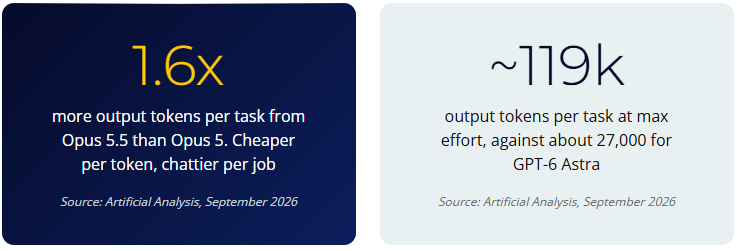
Artificial Analysis spotted exactly this with Opus 5.5. It costs roughly the same per task as Opus 5, despite producing 1.6 times as many output tokens. At max effort it uses around 119,000 output tokens per task, against about 27,000 for GPT-6 Astra. Cheaper per token. Chattier per job. The maths cuts both ways.
What to measure instead
- Cost per approved asset. Not per draft. Per thing that survives your editors and compliance.
- Revision cycles per asset. A model that is 50% cheaper but needs three extra rounds is not cheaper.
- Time to publish. Speed is where most of the real saving hides.
- Error rate reaching review. In regulated sectors, this is the only number your legal team cares about.
If your AI report leads with “tokens saved”, it is a vanity metric wearing a lanyard.
Take 2: Cheap AI makes average content worthless
Here is the uncomfortable economics. When anyone can produce competent content for fractions of a penny, competent content stops being an advantage. It becomes the floor.
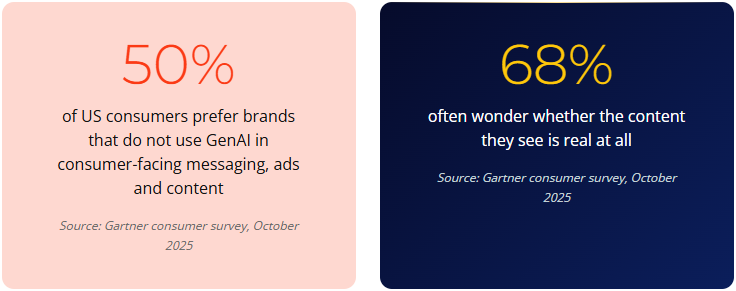
And audiences are already suspicious. A Gartner survey found half of US consumers would rather buy from brands that do not use GenAI in their consumer-facing messages, advertising and content. It also found 61% often question whether the information behind their everyday decisions is reliable, and 68% often wonder whether the content they see is real.
Awkward, given the industry spent most of 2025 bolting a chatbot onto anything with a login screen.
So the price war creates a paradox. Production gets cheaper. Trust gets more expensive.
The things a cheaper model cannot copy:
- First-hand expertise. Named people who have actually done the thing.
- Original evidence. Your data, your outcomes, your case studies.
- Point of view. A model can summarise the consensus. It cannot hold your opinion for you.
- Accountability. Someone whose name is on it and who will answer for it.
We made this argument in AI content just made your experts priceless. This week’s discounts just made it more true.
Take 3: The model war is not your strategy
Every time a leaderboard changes, someone asks us whether they should switch. We have learned to answer with a cup of tea and a long pause. Occasionally the answer is yes. Usually the problem is not the software.
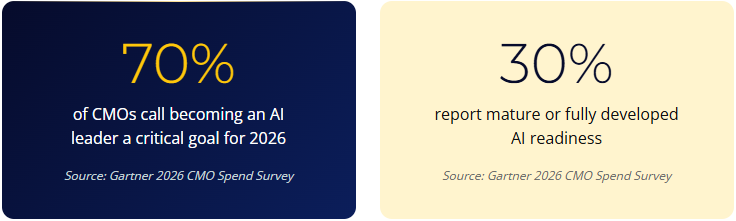
The data backs this up. Gartner’s 2026 CMO Spend Survey found CMOs put an average of 15.3% of their marketing budgets into AI. Seventy per cent call becoming an AI leader a critical goal for 2026, yet only 30% report mature or fully developed AI readiness. Meanwhile, 56% of CMOs say their marketing team lacks the budget to deliver its 2026 strategy.
BCG found a similar gap. Almost every CMO it surveyed (96%) said AI is driving end-to-end transformation of their function, but only around a third have actually done the work.
Cheaper engines do not help if you have not built the road. Price cuts remove the budget excuse. They do not remove the process problem.
How to avoid getting stuck with one AI provider
- Own the process, rent the model. Your briefs, style rules, source libraries and approval steps are the asset. The model is a component.
- Match the model to the job. Budget models for tagging and summaries. Top-end models for reasoning, strategy and anything client-facing.
- Avoid long lock-ins. Two-month release cycles make three-year commitments look brave.
- Test quarterly, switch rarely. Run the same real tasks through new models. Move only when outcomes improve.
This is the thinking behind our AI-powered content systems work, and why we keep saying you need a better content system, not better content.
Take 4: Your next reader is a cheap model
This is the take we think most CMOs are missing.
OpenAI has priced Luna for scale. Luna is aimed at high-volume routine jobs such as summarising and extracting information, while Sol handles recurring coding and automated tasks. AI is also getting good at using software the way a person would. On one such test, GPT-6 Sol almost matched Claude Opus 5’s medium-effort score, 60.5% to 60.3%, at around 80% less cost, according to OpenAI’s own figures.
Read that list again. Summarising. Pulling out key facts. Clicking around software on someone’s behalf. That is exactly what AI search tools and assistants do to your website.
When that work costs a tenth of a dollar per million tokens, more of your audience’s research will be done by AI on their behalf. The first reader of your content is increasingly not a person. It is a model deciding whether you are worth quoting.
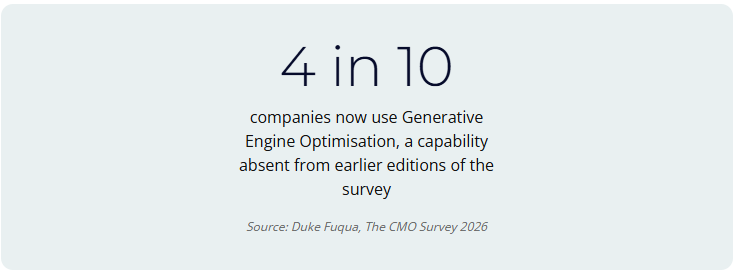
Marketers are catching on. Duke’s CMO Survey found 4 in 10 companies now use Generative Engine Optimisation, a capability that did not even feature in earlier editions of the survey.
What makes content easy for AI to use well:
- Answer-first structure. The point up top, not after four paragraphs of throat-clearing.
- Facts that are easy to lift. Tables, specs, prices, eligibility criteria, dates.
- A clear identity. Who you are, what you do, who vouches for you.
- Consistent claims everywhere. Contradictions between your site, directories and press confuse machines as much as people.
This is where SEO, GEO and AEO work as one system, not three retainers. And no, SEO is still not dead. It just has more readers now, and some of them are robots.
Take 5: “Sounds like AI” is no longer a quality test
A small detail in Anthropic’s announcement has big implications for content teams. Anthropic says Opus 5.5 leads with the most important information, avoids jargon and odd phrasing, and sticks to the writing rules you set. Earlier Claude models were widely criticised for formulaic, convoluted writing, sometimes nicknamed “Claudish”.
For two years, a lot of editorial quality control has quietly been “does it sound like a robot?”. Hunting for tell-tale phrases. Squinting at suspicious punctuation. (We banned em dashes from our house style years ago. We remain smug about it.)
Rest in peace, the “delve” detector. You served us well.
That test is expiring. When the machine writes cleanly and follows your style guide, the giveaway is no longer how it sounds. It is what is missing:
- No evidence you cannot find anywhere else
- No named expert
- No opinion that could get you into mild trouble
- No detail only someone who was in the room would know
The new quality bar is not “does it sound human?”. It is “could only we have written this?”
So what does this mean for you, specifically?
The price war lands differently depending on who you are. Find your row. Skip the others. We won’t be offended.
| Sector | The opportunity | The risk | What we would do now |
|---|
| B2B technology | Buyers use AI assistants to shortlist suppliers | Your comparison and pricing pages get summarised without context | Publish honest, structured specs, integrations and proof. Make them easy for AI tools to quote |
| Charities and NGOs | Cheap models make archive tagging, grant research and impact summaries affordable | AI-written appeals erode donor trust | Automate the back office. Keep donor-facing storytelling human-led |
| Healthcare and education | Faster evidence summaries for commissioners, procurement teams, referrers and learners | Speed outruns clinical and editorial governance | Treat supplier safety claims as inputs to risk assessment, not substitutes for it |
| Professional services | Faster research and drafting | Generic advice becomes free | Publish your own frameworks with named experts attached |
| Publishers | Cheaper production of new formats and spin-offs | More of your content consumed without a visit | Invest in distinctive formats, licensing strategy and brand recall |
| Platforms and marketplaces | AI assistants can compare and book at scale | Poor product data means you are skipped | Clean feeds, availability, pricing and schema. Treat AI assistants as a channel |
A note for regulated and mission-led organisations
Both labs leaned hard on safety this week. Anthropic says that across an automated behavioural audit of nearly 2,000 scenarios, Opus 5.5 outperformed every recent Claude model on almost every measure of misaligned behaviour. OpenAI says its internal rate of deceptive behaviour in coding tasks dropped to 1.3% for Sol and 2.8% for Luna, well below the 10.4% recorded for GPT-5.6 Sol.
Compliance colleagues, you may exhale. Slightly.
Genuinely encouraging. Also, both are self-reported. Your governance still needs to answer: who approves outputs, what gets logged, what never goes near a model, and how you prove it. If you want a starting point, see E-E-A-T in healthcare: why trust signals matter most where getting it wrong costs most.
For charities specifically, we covered the wider shift in your charity’s digital presence was built for 2019.
Hype vs reality: what to stop and start
One for your next board meeting. Screenshot responsibly.
| The hype says | The reality is | So stop | So start |
|---|
| “Pick the winning model” | Leaders change every few weeks | Annual model debates | Quarterly testing on real tasks |
| “AI costs are collapsing” | Per-token prices fell. Per-task costs vary | Reporting tokens saved | Reporting cost per approved asset |
| “Now we can make 10x the content” | Average content just lost its value | Volume targets | Evidence and expertise targets |
| “AI writing is finally human” | Sounding human is now the floor | “Does it sound like AI?” reviews | “Could only we have written this?” reviews |
| “Traffic is what matters” | More research happens through AI assistants | Treating clicks as the only proof | Tracking citations and brand presence in AI answers |
What to do before the next model drops (so, roughly Thursday)
Enough opinions. Here is the homework.
The homework, in order
- Audit your AI spend by outcome. List every AI tool and model in use. Tie each to a business result, not a usage number.
- Separate the process from the model. Document your briefs, style rules, sources and approvals so they work on any model.
- Match the model to the job. Budget models for tagging and summaries. Top-end models for reasoning and anything public-facing.
- Raise the editorial bar. Every public piece needs one of: original data, a named expert, or a clear point of view.
- Make your key pages easy for AI to read and quote. Answer-first, structured, consistent. Start with your top 20 commercial or mission-critical pages.
- Start tracking AI visibility. Where are you cited, mentioned or missing in AI answers for your priority questions?
- Write down your governance. Especially if you are regulated. What never goes near a model, and who signs off what does.
FAQs
The questions we expect in our inbox by Friday.
The AI labs will keep racing. That is their job. Yours is to make sure the race works for you, not the other way round.
About the author
Ashley Salek
Ash is Agency Director at Seventh Element, where he leads SEO, GEO and AEO strategy for B2B, charity, healthcare and education clients, including the search rebuild for
Practice Plus Group that delivered a 1,012% increase in organic leads. Connect on
LinkedIn or read
what fuels Ash.
Sources
- Anthropic: Introducing Claude Opus 5.5 – alignment audit results, pricing and pacing context
- Artificial Analysis: Claude Opus 5.5 takes the top spot – Intelligence Index score, output tokens per task
- OfficeChai: Opus 5.5 creates 5-point lead – index comparison with Fable 5.1 and GPT-6 Astra
- SiliconANGLE: Anthropic releases Claude Opus 5.5 and OpenAI counters – pricing, Sol and Luna positioning, Astra launch date
- TechCrunch: Anthropic releases Opus 5.5 – Opus 5 release date, upcoming Sonnet and Haiku 5.5
- Decrypt: OpenAI launches GPT-6 Sol and Luna – computer-use test results (OpenAI-reported), previous and new Sol and Luna pricing, OpenAI deception rates
- 9to5Google: Opus 5.5 and GPT-6 Sol and Luna launch – Sol and Luna ability relative to Astra
- Simon Willison: Claude Opus 5.5, GPT-6 Sol, GPT-6 Luna, and a new price war – scheduled GPT-5.6 price increase
- Tech Insider: GPT-6 Sol and Luna pricing – absence of independent like-for-like comparisons
- The Neuron: GPT-6 Sol/Luna vs Claude Opus 5.5 – launch timing
- Gizmodo: Anthropic is back with another AI model – Anthropic’s writing-style claims
- The Decoder: Opus 5.5 promises less “Claudish” writing – “Claudish” criticism
- Gartner: 2026 CMO Spend Survey – AI budget share and readiness
- Business Wire: Gartner 2026 CMO Spend Survey – budget shortfall figures
- Gartner: 50% of consumers prefer brands that avoid GenAI – consumer trust data (survey conducted October 2025)
- Duke Fuqua: The CMO Survey 2026 – GEO adoption
- BCG: Moving the agentic marketing transformation from illusion to reality – CMO transformation claims vs delivery