Health information shapes real decisions: treatment choices, provider selection, and whether someone seeks care at all. Google applies its strictest quality standard to it. But much of what the marketing industry sells as the fix for healthcare E-E-A-T is unevidenced, and some of it is now obsolete. This is what the primary sources actually say, and what genuinely demonstrates trust.
Most content marketing operates at low stakes. A weak B2B post wastes an afternoon. A vague thought leadership piece bores a few hundred people. The cost is measured in wasted budget and mild professional embarrassment.
Healthcare content does not work like that. Someone searching at 11pm about a symptom, a lump, a medication interaction or a waiting list is not browsing. They are making a decision, often a frightened one, frequently with no clinician available to ask. What they read shapes whether they seek care, which provider they approach, and sometimes whether they follow advice they were already given.
That is the reason health content is held to a higher standard. Not because Google is being awkward. Because the consequences of confident, wrong, unaccountable health information are real.
The internet is full of confident health advice. Confidence is not a credential. This article is about the difference, and about which of the things the marketing industry sells you actually prove it.
In most sectors, weak content wastes time. In healthcare, it misleads people making decisions about their health. E-E-A-T is not Google being difficult. It is the bar being exactly where it should be.
Ashley Salek, Agency Director, Seventh Element
The Stakes, With Numbers Attached
The UK evidence on where people go for health information, and what happens when they get it wrong, has become considerably sharper in the last eighteen months.
Research from the Policy Institute at King’s College London, King’s Health Partners and Responsible AI UK, published in May 2026, found that 15% of UK adults have used AI chatbots for health advice instead of contacting a GP or NHS service. More striking: 21% said they had decided against seeking professional healthcare advice because of something an AI chatbot told them. One in five.
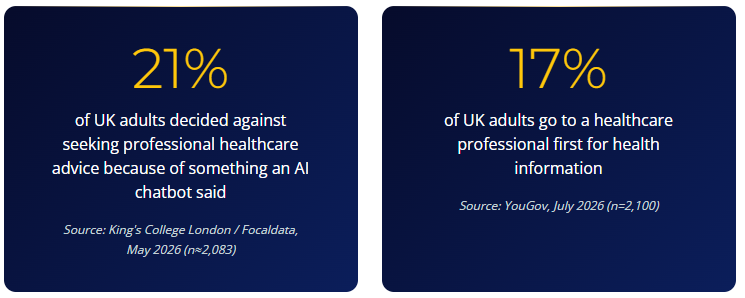
The second figure needs the full context. A YouGov survey of 2,100 UK adults in July 2026 asked where people go first for health information. Search engines came top at 26%, health websites second at 23%, and healthcare professionals third at 17%. Roughly half of UK adults start with a screen. Fewer than one in five start with a person.
Which is remarkable set against the Ipsos Veracity Index 2025, where nurses are trusted to tell the truth by 92% of people and doctors by 85% – the two most trusted professions measured. Social media influencers entered the index for the first time in 2025 and debuted last, at 6%.
So the most trusted people in the country are not who most people ask first. That gap is the entire commercial and clinical opportunity in healthcare content, and it is also the risk.
On the risk: a study from Oxford researchers, published in Nature Medicine, tested 1,298 participants across ten medical scenarios. The large language models, working alone, identified the correct condition in 94.9% of cases. The participants using those same models identified relevant conditions in under 34.5% of cases, and the correct course of action in under 44.2% – no better than the control group who had no AI at all. The model knew. The patient still got it wrong.
Benchmark performance tells you nothing about real-world safety. A separate Mount Sinai evaluation of ChatGPT Health across 960 responses to clinician-authored vignettes found it under-triaged 52% of emergency scenarios and over-triaged nearly 65% of non-urgent ones, with safety alerts firing more reliably for low-risk cases than high-risk ones. This is the information environment your content is competing in.
What Google Actually Says (and What the Industry Says It Says)
Google’s Search Quality Rater Guidelines run to 182 pages in the current version, dated 11 September 2025. Almost everything the SEO industry asserts about healthcare E-E-A-T is a paraphrase of that document. It is worth reading what it actually says, because several widely repeated claims are not in it.
YMYL is a spectrum, not a category
The guidelines define YMYL by types of harm rather than a topic list. The test they give raters:
“Would a careful person seek out experts or highly trusted sources to prevent harm? Could even minor inaccuracies cause harm? If yes, then the topic is likely YMYL.”
Google Search Quality Rater Guidelines, September 2025
Not all health content is clear YMYL. The guidelines’ own worked examples place “when to go to the emergency room” as clear YMYL, but “how often to replace a toothbrush” as only possibly YMYL, described as “a casual health topic people commonly discuss with friends”. Treating every page on a health site as maximum-scrutiny YMYL is a common and expensive misreading.
Credentials do not exempt you from accuracy
This is the passage that should be on the wall of every healthcare content team, and it is the sharpest possible statement of the article’s own thesis:
“Harmfully Misleading Information can occur from any websites or content creators — even seemingly ‘expert’, ‘authoritative’ or ‘official’ ones. Any type of page with Harmfully Misleading Information should be rated Lowest, regardless of the source.”
Google Search Quality Rater Guidelines, September 2025
Google’s own example of a harmful claim contradicting expert consensus: “Claims that lemons cure cancer.” And the accuracy standard is explicit — for YMYL topics, raters assess “the extent to which the content is accurate and consistent with well-established expert consensus”, with the guidelines noting that “consistency with well-established expert consensus is important for medical advice”.
Equally important, in the other direction: the guidelines state that YMYL pages with “absolutely no information about the website or content creator should be rated Lowest”. Anonymity on medical content is not a neutral choice.
But E-E-A-T is not a ranking factor, and Google says so
Here the industry consistently overstates. Google’s public documentation is unambiguous:
“While E-E-A-T itself isn’t a specific ranking factor, using a mix of factors that can identify content with good E-E-A-T is useful. For example, our systems give even more weight to content that aligns with strong E-E-A-T for topics that could significantly impact the health, financial stability, or safety of people.”
Google, Creating helpful, reliable, people-first content
And on the rater guidelines themselves: “Search raters have no control over how pages rank. Rater data is not used directly in our ranking algorithms.” E-E-A-T is a description of what good looks like. It is not a scoring mechanism you can optimise into. The distinction matters because it determines where budget should go.
Experience and Expertise Are Not the Same Thing
The most useful passage in the guidelines for healthcare is §3.4.1, which addresses exactly the question every health content team argues about: when is patient experience valuable, and when must content come from a clinician?
“Pages that share first-hand life experience on clear YMYL topics may be considered to have high E-E-A-T as long as the content is trustworthy, safe, and consistent with well-established expert consensus. In contrast, some types of YMYL information and advice must come from experts.”
Google Search Quality Rater Guidelines, September 2025
Google’s own worked examples make the line concrete:
| Topic | Valuable as lived Experience | Must come from Experts |
|---|
| Liver cancer treatment | “A sincere and respectful forum discussion where people are describing how they’re coping with liver cancer treatment” | “Different treatment options for liver cancer and the associated life expectancies under each treatment” |
| Sleep in late pregnancy | Non-medical tips from people who have struggled with it, such as using pillows to sleep comfortably and safely | “Sleep medications that are safe during pregnancy” |
Two hard limits apply. The guidelines state that harm assessment “happens before and overrides other considerations such as the life experience or expertise of the content creator”, and that if a page is harmful, untrustworthy or spammy, “expertise and experience doesn’t matter. It should be rated Lowest.”
The practical implication for a health site: publish both, label which is which, and never let a patient story drift into implied clinical guidance. That is not just a quality-rating consideration. As we will come to, it is also an advertising-regulation one.
The Uncomfortable Mirror
Before recommending anything, an example of how easily this goes wrong, from an organisation with more clinical authority than any of us.
The NHS digital service manual has a page on health literacy. It states that “more than 4 in 10 adults struggle with health content for the public” and “more than 6 in 10 adults struggle with health content that includes numbers and statistics”.
Those figures are almost certainly drawn from Rowlands et al., published in the British Journal of General Practice in 2015, which found 43% of participants below a text-only comprehension threshold and 61% below a text-plus-numeracy threshold. Good study, properly peer-reviewed.
Two things. First, the NHS page cites no source and carries no date for either figure. Second, the underlying skills data was not collected by that study – it came from the 2011 Skills for Life Survey, whose fieldwork ran from May 2010 to February 2011. The most widely quoted health literacy statistics in UK healthcare communications rest on data gathered over fifteen years ago, republished without attribution on the page that sets content standards for the NHS.
This is not a criticism of the NHS, whose content standards are otherwise excellent and whose reading-age guidance (aim for 9 to 11, sentences under 20 words) is the best in UK healthcare. It is an illustration of how easily uncited, undated figures propagate — including through organisations with genuine authority. If it can happen there, it is happening on your site.
We applied the same test to ourselves while writing this article, and it removed several statistics we had intended to use. More on that below.
What Actually Demonstrates Trust
Now the build. Four things carry genuine weight, and it is worth being precise about why each one matters, because the reasons are not the ones usually given.
1. Named clinical authorship — for readers and raters, not rankings
Every piece of clinical content should carry a named human with verifiable credentials: full name, role, qualifications, specialty, and professional registration where relevant. Where the clinician has no time to write, a named clinical reviewer with a real review date carries most of the same weight.
Be clear about what this does and does not do. Google’s SearchLiaison has stated publicly, twice, that bylines are not a ranking signal — in November 2023 that Google does not check for author pages “and rank content better for having it (we don’t)”, and in January 2024 that “author bylines aren’t something you do for Google, and they don’t help you rank better”. The only published controlled A/B test of adding authorship signals, run by SearchPilot, found no detectable traffic impact.
What named authorship genuinely does: it satisfies the guidelines’ trustworthiness criteria, which explicitly penalise YMYL content with no identifiable creator. It helps a reader judge credibility. And in UK healthcare it is close to a regulatory expectation, as the next section covers. Those are three good reasons. Ranking is not a fourth.
E-E-A-T assessments should be based on the content, reputation research and verifiable credentials — “not just website or content creator claims of ‘I’m an expert!'”
Google Search Quality Rater Guidelines, September 2025
Which is why a “medically reviewed by” label attached to a review that did not meaningfully happen is worse than no label. The guidelines treat falsely claimed medical credentials as grounds for the Lowest rating. The label is a claim. Make sure it is a true one.
2. Review and update trails
Clinical guidance changes. Content accurate in 2023 may be wrong now, and neither reader nor machine can tell without a visible trail. Every clinical page should carry a publication date, a last-reviewed date, and the name and credentials of whoever performed the review.
Set cadence by clinical risk rather than a blanket rule. The NHS content standard puts it well: create content from high-quality clinical evidence, have clinical and subject-matter experts review and approve it, check the evidence at every review, and operate a planned review cycle. A date with nobody’s name attached tells a reader that a CMS field changed, not that a qualified person checked the medicine.
3. Evidence and sourcing standards
Clinical claims need traceable sources: peer-reviewed literature, national clinical guidance, recognised professional bodies. Link them. Name them in the text. Two failure patterns are endemic: “studies show”, which is a citation-shaped object containing no citation, and sourcing a clinical claim to another marketing page, which produces a chain of confident assertions with no primary evidence at the end.
4. Structured data – with honest expectations
Use MedicalWebPage with lastReviewed and reviewedBy, Physician for named clinicians, MedicalOrganization for the organisation, and Person with sameAs links to verifiable external profiles.
Then set expectations honestly, because this is where the healthcare marketing industry is furthest ahead of the evidence.
The Schema Reality Check
Four facts, each from a primary source, that should reframe how structured data is sold into healthcare.
Google supports no medical rich result types. MedicalWebPage, MedicalOrganization, Physician, Hospital and MedicalCondition appear nowhere in Google’s structured data search gallery. Marking up a condition page produces no visual search feature, because no feature exists for it to trigger.
Google says no schema is needed for AI features. Its AI features documentation states plainly that there are “no additional requirements to appear in AI Overviews or AI Mode”, and that there is “no special schema.org structured data that you need to add”.
The FAQ carve-out is gone. Google restricted FAQ rich results to authoritative government and health sites in August 2023 — health was the last vertical holding eligibility. FAQ rich results stopped appearing entirely in May 2026, and Google removed the FAQPage documentation in June 2026. Any advice to add FAQPage schema for healthcare search visibility is now obsolete. Keep FAQs for readers; they are genuinely useful. Do not expect a rich result.
Medical schema adoption is very low. Web Data Commons data from the October 2024 Common Crawl, covering 11.5 million domains using schema.org in JSON-LD, records MedicalWebPage on 6,738 domains and Recipe on 28,996.
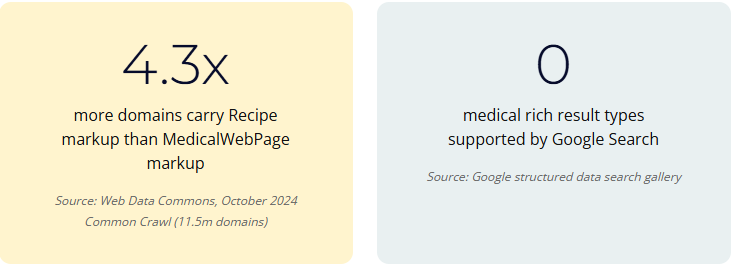
More of the web is machine-readable about dinner than about disease. That is a genuine opportunity — but the right framing is entity disambiguation, not visibility. Structured data helps machines correctly identify who your clinicians are, which organisation they belong to, and what a page is about. In a sector where names, specialties and institutions are easily confused, that is worth doing. It is not a ranking lever, and the one published controlled test of schema’s effect on AI citations found no positive effect.
The Regulatory Layer Is Already an E-E-A-T Framework
UK healthcare marketers often treat regulation as friction. Read properly, the CAP Code contains a definition of demonstrable expertise that is stricter and more specific than anything Google publishes.
Rule 12.2 requires that marketers must not offer advice, diagnosis or treatment for conditions requiring medical supervision unless conducted under the supervision of a suitably qualified health professional. And it defines “suitably qualified”:
“Health professionals will be deemed suitably qualified only if they can provide suitable credentials, for example, evidence of: relevant professional expertise or qualifications; systems for regular review of members’ skills and competencies and suitable professional indemnity insurance covering all services provided; accreditation by a professional or regulatory body that has systems for dealing with complaints and taking disciplinary action…”
CAP Code, Section 12.2
That is an E-E-A-T standard written into UK advertising law, and it predates the acronym.
The enforcement context has also changed sharply. In the ASA’s 2025 annual data, health and beauty became the most complained-about advertising sector in the UK, with 9,323 complaints — up 64% year on year — across 4,380 ads, a rise of just 2%. Far more people complaining about roughly the same number of ads. The ASA also scanned 60 million ads in 2025 using automated monitoring, having shifted from 5% proactive work in 2012 to 45% today. Nobody needs to complain for you to be found.
Other layers worth knowing precisely:
- Prescription-only medicines cannot be advertised to the public (CAP 12.12, underpinned by Regulation 284 of the Human Medicines Regulations 2012). Recent ASA rulings have turned on brand names and landing pages, not just ad copy.
- Health professionals must not be used to endorse medicines (CAP 12.18) — a genuine constraint on clinician-fronted pharmaceutical content.
- Testimonials do not launder claims. A patient testimonial making an objective health claim is caught by both the testimonial rules and the substantiation requirement in 12.1.
- ABPI Clause 8 requires promotional material to be certified by one named person who must be a UK-registered doctor or pharmacist — personal accountability, not committee sign-off. Clause 8.3 extends this to patient education material that is not promotional.
- CQC ratings must be displayed under Regulation 20A, within 21 days of publication, on every website and at every premises. CQC is explicit that registration “is not in itself an indication of quality” and that “Regulated by” must not be altered to “accredited” or “endorsed”.
None of this is friction. It is externally validated proof that unregulated sectors cannot produce, and most healthcare organisations bury it in a footer.
Provider-Facing: Where the Evidence Bar Moves
A large share of healthcare marketing is not patient-facing. Medtech selling to trusts, diagnostics addressing clinical buyers, services marketed to commissioners. The principle holds; the evidence changes.
The most important thing to understand is procedural. Under the NHS Provider Selection Regime, in force since January 2024, one of the five available routes is the most suitable provider process. NHS England’s statutory guidance describes it as a route where the authority “makes a judgement on the suitability of the provider… based on its knowledge of the market”, and states that “relevant authorities are expected to develop and maintain sufficiently detailed knowledge of the provider landscape.”
Read that again. There is a legitimate NHS procurement route in which a contract can be awarded without a competition, on the basis of what the buyer already knows about the market. Your published evidence is that market knowledge. Content is not adjacent to that process. It is the input to it.
The five key criteria under Regulation 5 are quality and innovation; value; integration, collaboration and service sustainability; improving access, reducing health inequalities and facilitating choice; and social value. Notably, NHS England’s guidance states that authorities decide their own weighting — so content addressing all five is more defensible than content optimised for one.
The friction is real and worth acknowledging. The ABHI’s 2025 industry survey found 27% of companies chose not to bid on a tender because of NHS procurement requirements. On time to adoption after regulatory approval, 30% said three to five years and a further 29% said more than seven. The Health Tech Alliance’s 2025 workshop report captured the inconsistency memorably: the same solution taking “two weeks at one hospital to two years at another”.
| Signal | Patient-facing | Provider-facing / B2B |
|---|
| Authorship | Named clinician, accessible explanation | Named clinical or scientific author the buyer’s own clinicians would recognise |
| Evidence | National clinical guidance, plain-language sourcing | Peer-reviewed publication, real-world evidence, health economics |
| Frameworks | NHS content standard, CAP Code | NICE evidence standards framework, DTAC, MHRA registration |
| Trust | Review trails, transparency, contactability | Transparent evidence limitations, procurement-ready documentation |
| Failure mode | Confident claims with no clinical author | “Trusted by clinicians” with no clinician named and no published evidence |
Two currency notes, because both are frequently got wrong: NICE’s Early Value Assessment was renamed early-use HealthTech guidance in 2025, and there are now 36 integrated care boards in England, not 42. Anything in your materials still saying “EVA” or “42 ICSs” is dated.
What We Removed From This Article
In the spirit of the standard being described, some disclosure.
An earlier draft of this article cited a widely circulated figure that 67% of YMYL sites suffered ranking declines in a recent core update. We could not trace it to a primary source, and it is contradicted by the visibility data we could verify. It is gone.
We also intended to cite the frequently quoted claim that a Google core update removed 45% of low-quality content. What Google actually published was a forecast of 40%, later revised to 45%, covering “the combination of this update and our previous efforts” — cumulative, with no published methodology. That is a materially weaker claim than the one in circulation, so we have framed it accordingly rather than repeating the shorthand.
Several healthcare schema statistics, various “medically reviewed content ranks X% better” figures, and a much-quoted statistic about the share of Google searches that are health-related all failed source-tracing and were removed. The last one traces to a verbal remark at a conference in 2019, reported second-hand, predating AI search entirely.
We are documenting this because a YMYL article about evidence standards that repeated unsourced vendor statistics would be self-refuting. For the general business case beyond healthcare, see E-E-A-T is a business problem, not a buzzword; for the search and AI visibility side, our generative engine optimisation services and SEO services, and the wider Fuel Room.
Scoring Your Own Content
Take ten clinical pages. Score each out of ten, one point per check. Under 5 means you are carrying expertise you cannot prove. Between 5 and 7 means the foundations exist and the signals are missing. Above 8 means you are demonstrating rather than describing.
- Named author with visible clinical credentials, or a named clinical reviewer
- Reviewer credentials and registration visible, not just a name
- Visible publication date
- Visible last-reviewed date tied to a named person
- Clinical claims sourced to named, linked primary sources
- Patient experience and clinical guidance clearly distinguished
MedicalWebPage schema with reviewedBy and lastReviewedPhysician and MedicalOrganization schema implemented correctly- Author linked via
sameAs to a verifiable external profile - Reading age appropriate to audience (NHS guidance: 9–11, sentences under 20 words)
The exercise usually produces the same finding: clinical quality is high, and the trust infrastructure around it is missing. That is a good problem, because it is solvable. You are not trying to manufacture credibility. You are trying to stop hiding it.
The Healthcare E-E-A-T Build Checklist
✓ Score ten clinical pages before commissioning anything new. The result tells you whether you have a content problem or a trust-infrastructure problem. It is almost always the second.
✓ Replace anonymous clinical bylines. Named author, or named clinical reviewer with credentials and registration. Do it for readers, raters and regulators — not for rankings, which it will not move.
✓ Never publish a review label without a real review. Falsely claimed medical credentials are grounds for the Lowest quality rating. The label is a claim; make it a true one.
✓ Set review cadence by clinical risk. Annual minimum for treatments, medication and diagnostic guidance; immediate review when relevant guidance changes. Publish the reviewer’s name and the date.
✓ Separate patient experience from clinical guidance, visibly. Both belong on the site. Google’s guidelines value lived experience on YMYL topics — but only when it is not presented as clinical advice.
✓ Implement medical schema for disambiguation, not visibility. MedicalWebPage, Physician, MedicalOrganization, Person with sameAs. Roughly a day of work. Do not let anyone sell it to you as a ranking or AI-citation lever.
✓ Retire FAQPage schema from your visibility plan. FAQ rich results ended in May 2026 and the documentation was withdrawn in June. Keep the FAQs for readers; remove the expectation.
✓ Eliminate “studies show”. Name the study, name the body, link the source. Never source a clinical claim to another marketing page.
✓ Surface your regulatory proof points. CQC rating (legally required within 21 days), registrations, MHRA status, accreditations. Externally validated evidence, routinely buried in a footer.
✓ For B2B, write for the “most suitable provider” route. An NHS buyer can award without competition based on knowledge of the market. Publish the evidence that becomes that knowledge, against all five PSR criteria.
Frequently Asked Questions
Sources
Every figure here was traced to a primary source. Where a widely circulated statistic could not be traced, it was removed rather than repeated — see “What We Removed From This Article” above.
- Google Search Quality Rater Guidelines, 11 September 2025 (182pp) – YMYL definition and harm framework (§2.3); accuracy and expert consensus (§3.2); Experience vs Expertise on YMYL topics (§3.4.1); Harmfully Misleading Information “regardless of the source” (§4.4); untrustworthy YMYL pages (§4.5); verifiable credentials (§5.6)
- Google, Creating helpful, reliable, people-first content – “While E-E-A-T itself isn’t a specific ranking factor…”; authorship guidance
- Google Search Central Blog, 15 December 2022 – “Experience” added to E-A-T; “these guidelines… don’t directly influence ranking”
- Google SearchLiaison, Mastodon, 16 November 2023 – Google does not check for author pages “and rank content better for having it (we don’t)”
- Google SearchLiaison via Search Engine Journal, January 2024 – “Author bylines aren’t something you do for Google, and they don’t help you rank better”
- SearchPilot A/B test – No detectable organic traffic impact from adding authorship signals. Note: published 2022; non-health site; sample size undisclosed
- Google, AI features and your website – “no special schema.org structured data that you need to add”
- Google structured data search gallery – No medical rich result types supported
- Google, FAQPage documentation (withdrawn June 2026) – FAQ rich results ceased May 2026
- Web Data Commons, October 2024 Common Crawl – MedicalWebPage on 6,738 domains vs Recipe on 28,996, of 11,554,664 domains using schema.org JSON-LD
- King’s College London / Focaldata, May 2026 – 15% used AI chatbots instead of contacting a GP; 21% decided against seeking professional healthcare advice because of an AI chatbot. Research by the Policy Institute at King’s, King’s Health Partners and Responsible AI UK
- YouGov, July 2026 (n=2,100 UK adults) – First stop for health information: search engines 26%, health websites 23%, healthcare professionals 17%
- Ipsos Veracity Index 2025 (n=1,022, Great Britain, November 2025) – Nurses trusted by 92%, doctors 85%, social media influencers 6%
- Bean et al., “Clinical knowledge in LLMs does not translate to human interactions” (Oxford; Nature Medicine) – n=1,298; LLMs alone 94.9% correct, participants using them under 34.5%
- Mount Sinai, ChatGPT Health triage evaluation (Nature Medicine, 2026) – 960 responses to clinician-authored vignettes; 52% of emergency scenarios under-triaged. Note: primary article paywalled; figures verified via multiple secondary reports
- NHS digital service manual, health literacy – “more than 4 in 10 adults struggle with health content”; no source or date given on the page
- Rowlands G et al., British Journal of General Practice, 2015 – 43% below text-only threshold, 61% below text-plus-numeracy. Skills data drawn from the 2011 Skills for Life Survey, fieldwork May 2010 – February 2011
- NHS digital service manual, how we write – Reading age 9–11; sentences up to 20 words
- CAP Code, Section 12 – 12.1 substantiation; 12.2 “suitably qualified” definition; 12.12 prescription-only medicines; 12.18 health professional endorsement
- ASA, Complaints and Cases in Context 2025 – Health and beauty 9,323 complaints (+64%) across 4,380 ads (+2%); rank #1 of 23 sectors. Figures are complaints resolved
- ASA & CAP Annual Report 2025 – 60 million ads scanned by Active Ad Monitoring; 45% proactive resourcing
- Human Medicines Regulations 2012, Regulation 284 – Prohibition on advertising prescription-only medicines to the public
- ABPI Code of Practice 2024, Clause 8 – Certification by one named UK-registered doctor or pharmacist; Clause 8.3 covers non-promotional patient education
- Health and Social Care Act 2008 (Regulated Activities) Regulations 2014, Regulation 20A – Legal duty to display CQC performance ratings
- CQC, use of logo and promotion of ratings – 21-day display requirement; “Regulated by” must not be altered to “accredited” or “endorsed”
- Health Care Services (Provider Selection Regime) Regulations 2023, Regulation 5 – The five key criteria
- NHS England, Provider Selection Regime statutory guidance – Most suitable provider process “based on its knowledge of the market”; authorities decide their own criteria weighting
- ABHI, Pulse of the Sector 2025 Business Survey – 27% chose not to bid on a tender due to NHS procurement requirements; time to adoption after regulatory approval. Note: sample size and fieldwork window not stated in the report
- Health Tech Alliance, Unlocking Innovation, July 2025 – Same solution implemented in “two weeks at one hospital to two years at another”. Note: qualitative workshop findings, not survey data
- NICE HealthTech programme manual (PMG48) – Early value assessment renamed “early-use HealthTech guidance”
- NHS England, Integrated care boards in England – 36 ICBs as of 1 April 2026