Yes, you can. The question is whether you want to, once you understand what it costs you. Use AI for ad copy variants, banner iterations, drafting structures and analysing ranking data, and it earns its keep daily. Use it to replace the expertise, experience and human voice that E-E-A-T, AI citation and LinkedIn now reward, and you are automating away the only part of your content that still has value. Here is the conversation we have with clients, in full, from an agency that builds AI content systems for a living.
We have this conversation more often than any other now. It arrives in different costumes. Sometimes it is the CFO, mid-budget-review: “Can’t we just use AI for the content?” Sometimes it is a marketing manager who has been handed a headcount freeze and a bigger target. Sometimes it is the CEO, freshly returned from a conference, with the particular energy of someone who has seen a demo.
The question deserves a straight answer, and the straight answer is yes. You can. The tools are good. They are getting better. Anyone who tells you AI cannot produce competent marketing content in 2026 has not used it recently, or is selling something that depends on you not using it.
One thing to establish before the advice, because it changes how you should read it. We are not AI sceptics writing from the sidelines. We build AI-powered content systems for clients. We run generative engine optimisation programmes that get brands cited by the same engines everyone is worried about. AI sits inside almost every workflow in this agency. What follows is not “be careful with the robots”. It is the practitioner’s version: we use this all day, we know exactly where it creates value, and we know exactly where it destroys it.
So we say yes. And then we say the thing the demo did not mention: the question is whether you want to, once you understand what it costs you. Because “use AI” is not one decision. It is two very different decisions wearing the same coat. One of them is the smartest efficiency play available to your team. The other quietly liquidates the only asset that still separates you from every competitor with the same subscription.
This article is the conversation in full. What the question is really asking, where the honest yes lives, where the honest no lives, and the one-line version to take back to the board.
If I had a pound for every time a client asked whether we can just do more content with AI, I could fund their content budget myself. The answer is always the same: quality over quantity. Google and the AI engines are scoring experience, expertise, authority and trust. Volume gives you none of the four. Use AI to move faster. Use your experts to be worth finding.
Ashley Salek, Agency Director, Seventh Element
What the Question Is Really Asking
“Can’t we just use AI?” is rarely a question about technology. Listen carefully and it decodes to one of three things. Can we cut the cost of content? Can we cut the time content takes? Or, occasionally, the honest version: is content actually a commodity now, and if so why are we paying craft prices for it?
All three are reasonable. And the third one deserves a proper answer, because it is half right. A great deal of content did just become a commodity. Roughly 52% of all new articles published online are now AI-generated, up from around 10% in late 2022 (Graphite, 2025). Generic, competent, on-topic content is now free and infinite, which means its market value is zero. If your content programme was producing that kind of content, the board’s instinct is correct: you should not be paying craft prices for it. You should not be producing it at all.
But the same shift that made generic content worthless made the other kind priceless. The only content with defensible value left is the kind AI cannot produce: first-hand experience, named expertise, original opinion, a voice a reader can recognise. The commodity crashed. The premium moved. The question is which side of that line your content sits on, and most organisations have never audited it.
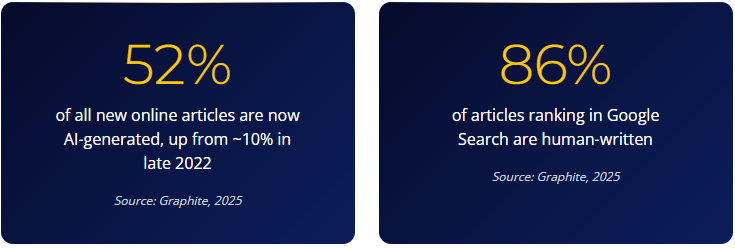
Read those two numbers together. The internet is now majority machine-written, and the systems that decide visibility are overwhelmingly choosing humans anyway. The slop is being produced at scale and filtered at scale. “Can’t we just use AI?” is really asking “can we join the 52% that gets filtered out?” You can. We would rather you did not.
The Honest Yes: Where We Tell Clients to Use AI
Here is the part of the conversation that surprises people, because they expect an agency to defend the billable word. We recommend AI to every client, for a specific set of jobs, and we use it ourselves for the same ones. The pattern across all of them: high-volume, low-differentiation work where speed matters and nobody expects a named human voice.
| Use AI for this | Why it works |
|---|
| Ad copy variants (paid search RSAs, paid social) | Nobody expects a byline on a headline. Volume and testing speed win. AI produces 40 variants in the time a human writes 4. |
| Banner and display copy iterations | Same logic. Constrained formats, high variant count, performance decided by testing, not craft. |
| Meta titles and descriptions at scale | Hundreds of pages need serviceable metadata. Draft with AI, human-review the commercially critical ones. |
| Drafting structures and outlines | AI is genuinely good at proposing article architecture, section logic and coverage gaps. The blank page problem, solved for pennies. |
| Analysing ranking and performance data | Feed it Search Console exports, rank tracking, content decay data. It finds patterns in an afternoon that took an analyst a week. |
| Keyword and intent clustering | Grouping thousands of queries by intent is exactly the tedious, pattern-matching work machines should own. |
| Repurposing expert material | One interview transcript becomes an article draft, social posts and an FAQ block. AI handles the format shifts; the expertise stays human. |
| Summarising research and briefs | Condensing ten sources into a working brief is a reading task, not a thinking task. Delegate it. |
Notice what every row has in common. None of it is the content your audience judges you by. It is the production scaffolding around that content. AI as infrastructure. This is where the efficiency the CFO wants actually lives, and it is substantial: faster testing cycles on paid, faster analysis, faster production, less time lost to formatting and first drafts. Take all of it. We do.
The one-line version for the board: AI is infrastructure, not a content strategy. It should be running underneath your marketing operation everywhere speed and volume matter. It should not be the voice your audience hears, because the voice is the only part they were ever paying attention to.
The Honest No: Where AI Quietly Costs You
Now the other half of the conversation. There are four places we tell clients not to use AI as the author, and all four trace back to the same root: every channel that decides your visibility has converged on rewarding demonstrable human expertise.
1. SEO: the algorithm is explicitly hunting for the humans
Google added “Experience” to E-E-A-T in December 2022, instructing its quality raters to assess whether content creators have genuine first-hand experience and to identify who is responsible for content. Every major update since has pushed the same direction. The March 2024 core update removed roughly 45% more unoriginal content and introduced a scaled content abuse policy. The June 2025 core update rewarded original, helpful content. The August 2025 spam update used SpamBrain to specifically target auto-generated content with no human value.
That is four updates, one direction. The result shows in the ranking data: 86% of what ranks is human-written, and AI articles that do rank tend to rank lower (Graphite, 2025). Publishing anonymous AI content into this environment is not a neutral cost-saving. It is feeding the exact pattern the algorithm was trained to remove. We wrote the full case in E-E-A-T is a business problem, not a buzzword.
2. AI citation: the machines cite humans, not each other
The irony nobody mentions in the demo: AI answer engines do not cite AI content. 82% of articles cited by ChatGPT and Perplexity are human-written (Graphite, 2025). The engines cite recognisable entities with clear authorship, which is why anonymous content rarely appears in an AI answer regardless of how well optimised it is. If part of your strategy is being recommended by the tools your buyers now ask, and it should be, then generating your content with those same tools is a strange way to get there. This is the foundation our generative engine optimisation services are built on: the citation goes to the named human source.
3. Thought leadership: the quality bar is embarrassingly visible
The Edelman-LinkedIn B2B research puts numbers on what everyone privately knows. Only 15% of decision-makers rate the thought leadership they read as very good or excellent. Roughly a third rate it mediocre. And mediocre thought leadership has a signature: assembled rather than known, opinion-free, could have been written by anyone. Which, increasingly, it was.
The upside for the minority who clear the bar is enormous. 75% of decision-makers say strong thought leadership led them to research a vendor they were not considering. 79% of buyers are more likely to advocate for a vendor in the RFP process because of it. That value is only available to content carrying something an AI could not have written. The moment your thought leadership reads like everyone else’s, it stops doing the one job it exists for.
4. LinkedIn and social: the feed can smell it
LinkedIn rewards people, not logos. Personal profiles routinely out-reach and out-engage company pages by several multiples, and the feed’s currency is recognisably human voice: specific stories, actual opinions, the texture of someone who was in the room. AI-generated posts pretending to be a person are the fastest way to spend that currency down to nothing. Your audience scrolls past a hundred of them a day. They know. The wince when a known human posts obvious AI text under their own name is real, and it transfers directly to the brand.
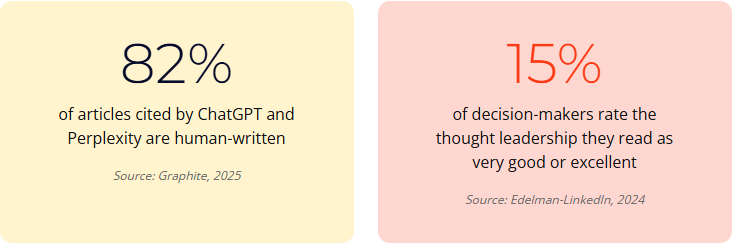
Yes, you can use AI for everything. The channels will let you publish. They just will not let you win.
The Line That Decides Every Case
Clients ask for a rule, so here is ours. Before any content task goes to AI, ask one question: does this work carry our expertise, or does it carry our output?
Output is volume work. Ad variants, metadata, structures, analysis, summaries, repurposing. Nobody judges your organisation’s credibility by a responsive search ad. Hand it to the machine and bank the hours.
Expertise is judgment work. The opinion in the article. The experience in the case story. The named specialist explaining what they actually know. This is what E-E-A-T scores, what AI engines cite, what buyers trust and what LinkedIn amplifies. It cannot be delegated to a system trained on everyone else’s published output, because its entire value is that it is not everyone else’s.
| | Output work → AI | Expertise work → humans |
|---|
| SEO | Metadata, structures, intent clustering, decay analysis | Bylined articles, first-hand experience, named authorship |
| Content | Outlines, first-draft scaffolding, repurposing formats | Opinion, argument, original data, the actual point of view |
| LinkedIn / social | Scheduling, format adaptation, drafting from interview transcripts | The expert’s voice, posted as the expert, sounding like the expert |
| Paid | Ad copy variants, banner iterations, testing matrices | The proposition and offer the variants are testing |
| Data | Rankings analysis, Search Console patterns, reporting drafts | The decision about what the data means and what to do next |
The humanising point matters more than teams expect. The organisations winning right now are not the ones producing the most content. They are the ones whose content sounds unmistakably like someone. A named person, with a track record, who talks like a human because they are one. AI can support that person brilliantly. It cannot be that person. And every attempt to fake it gets easier to spot as audiences calibrate, which they are doing at speed.
AI made your content cheaper to produce and your expertise more valuable to own. The clients who hear that as a contradiction are the ones still asking the wrong question. It is the same fact, seen from both sides.
What This Looks Like in Practice
The working model we set up with clients is simple enough to describe in a paragraph. Experts talk; they do not write. A recorded thirty-minute interview becomes the raw material. AI does the production: transcribing, structuring, drafting the article, adapting the formats, proposing the social cuts. Humans do the judgment: the expert reviews for accuracy and adds the opinion only they hold, the editor enforces voice, the named byline goes on with a real bio and Person schema behind it.
The output is content that passes every test in this article. It carries first-hand experience, so E-E-A-T rewards it. It has a named, recognisable author, so AI engines can cite it. It says something specific, so it clears the thought leadership bar the 85% miss. And it sounds like a person on LinkedIn, because it started as one talking. AI did most of the hours. Humans did all of the value. That is the whole model, and it is why AI-powered content systems is the name of the service rather than “AI content”. The system is artificial. The content is not.
That distinction is the entire discipline. The organisations winning AI search are not the ones using the most AI. They are the ones whose systems point the AI at production and the humans at value. A system built to do more is a slop factory with good branding. A system built to compound the value of your expertise, across search, citation and social at once, is the thing everyone thinks they are buying when they buy an AI tool. The tool is not the system. Building the system is the work.
The alternative, publishing at volume with nobody’s name on it, has a well-documented ending. We covered it in why 200 pieces of content a month is not a strategy: sites that scaled unedited AI content saw traffic drops of 40-90%, while sites pairing AI production with human editing and expertise grew. Same tools. Opposite outcomes. The variable was never the AI.
The AI Decision Checklist (Steal This for Your Next Board Meeting)
- Split every content task into output work and expertise work. Output work (variants, structures, analysis, repurposing) goes to AI without apology. Expertise work (opinion, experience, named authorship) stays human. One question decides: does this carry our expertise or our output?
- Move AI into paid immediately. Ad copy variants, banner iterations, testing matrices. This is the fastest, safest ROI on AI in your marketing operation and most teams still underuse it.
- Put AI on your data. Rankings, Search Console exports, content decay, intent clustering. Analysis is where AI saves the most hours with zero brand risk.
- Never publish expertise content without a named human author. Real byline, real bio, Person schema. This is what E-E-A-T scores and AI engines cite. Anonymous is now a structural disadvantage.
- Capture experts by interview, not by commission. Thirty recorded minutes becomes an article, social posts and an FAQ block. AI does the format work. The expertise stays human and visible.
- Keep LinkedIn voices human. AI can draft from a transcript of what the expert actually said. It should never impersonate. The feed’s entire currency is recognisable humanity, and audiences are calibrating fast.
- Audit what you already publish against the line. Anything anonymous, generic and interchangeable is in the 52% the channels are filtering out. Rework it with named expertise or retire it.
- Reframe the budget conversation. The question is not “can AI replace the writers?” It is “are we using AI to make our experts impossible to ignore?” Same tools, opposite strategies, very different endings.
Turn your expertise into content AI wants to cite.
Free AI-use audit. We will show you where AI belongs in your marketing operation, and where it is quietly costing you authority.
Frequently Asked Questions
Sources