Why This Happened: Generic Content Just Went to Zero
To understand why every channel converged on expertise at once, you have to understand what happened to the price of everything else.
Generic content used to cost something. Time, a writer, a brief, a few hours of research. That cost created a floor. If your content was competent and slightly better than the next organisation’s, you had an edge worth something. AI removed the floor. Competent, generic, on-topic content is now free and infinite. Roughly 52% of all new articles published online are now AI-generated, up from around 10% in late 2022 (Graphite, 2025). The internet is filling with serviceable, forgettable, technically-fine content faster than anyone can read it.
When something becomes free and infinite, its value goes to zero. That is not a moral judgment. It is arithmetic. And it means the only content with defensible value left is the content AI cannot generate: the stuff that carries first-hand experience, specific judgment, and knowledge that exists in exactly one place. Your experts’ heads. Not in a prompt. Not in a training set. In the building.
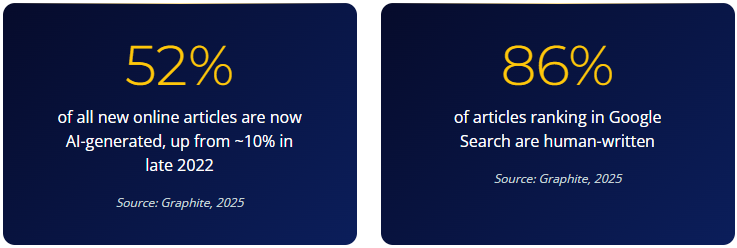
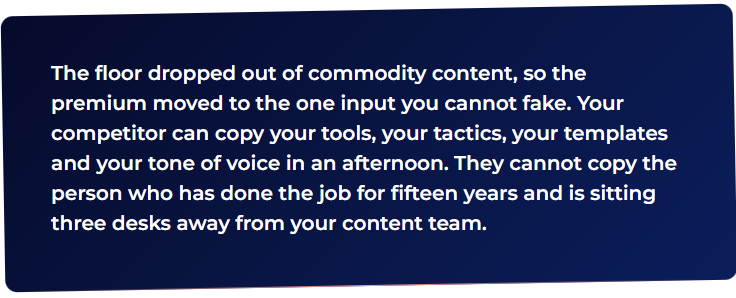
Read those two numbers together. The internet is now majority AI-generated, and the systems that decide visibility are overwhelmingly choosing humans anyway. The slop is being produced at scale and filtered out at scale. The premium did not disappear. It moved. It moved to the one input you cannot fake, and most organisations have not repriced their experts to match.
Channel One: Google Made Experience a Ranking Question
In December 2022, Google added a second “E” to E-A-T. The new one is Experience, and its definition is pointed: the extent to which the content creator has the necessary first-hand or life experience for the topic. Google’s quality raters are now instructed to ask, in effect, has the person who wrote this actually done the thing they are writing about?
This is a quiet but profound change. It moved authorship from a nice-to-have to an assessment criterion. Anonymous, authorless content, the kind a “content team” byline produces, now sits at a structural disadvantage against content visibly written by a named person with demonstrable experience. Then the March 2024 core update sharpened the point, removing roughly 45% more low-quality, unoriginal content and introducing a “scaled content abuse” policy explicitly targeting mass-produced content made to manipulate rankings, whether produced by AI, humans, or both.
The trajectory has not slowed since. Google’s two most recent algorithm updates point in exactly the same direction. The June 2025 core update, which rolled out from 30 June to 17 July 2025, again rewarded original, genuinely helpful content over thin or derivative pages. Then the August 2025 spam update, which ran from 26 August to 22 September 2025 and was Google’s first dedicated spam update since December 2024, used its SpamBrain detection system to target scaled content abuse and auto-generated content with no human value. Read the sequence in order: the 2022 Experience addition, the 2024 scaled-content policy, the 2025 core update, the 2025 spam update. The direction of travel is not subtle. As AI-generated content floods the web, every recent update has rewarded the human signal harder and demoted the machine-generated filler faster. E-E-A-T is not softening under the weight of AI content. It is hardening.
This is the territory generative engine optimisation services operate in: making your organisation, and the named humans inside it, the source the AI reaches for. It is impossible to do well with anonymous content, and straightforward to do well with expert-led content.
Channel Three: LinkedIn Rewards People, Not Logos
LinkedIn made its preference clear, and then made it expensive to ignore. The feed rewards people. Personal profiles routinely out-reach and out-engage company pages by several multiples, with personal posts commonly earning around five times the engagement of equivalent company-page posts. Meanwhile, company-page organic reach has collapsed. Many brand pages now reach only a low single-digit percentage of their own followers.
The implication is uncomfortable for any organisation whose entire LinkedIn presence is a logo posting on a schedule. If your best expert’s insight only ever appears on the company page, you are publishing it into the channel’s deadest surface. The same insight, posted by the expert from their own account, in their own voice, reaches dramatically more of the right people. The brand page is a noticeboard in an empty corridor. The expert’s account is a conversation in a room full of buyers.
None of this requires the expert to become an influencer or post daily. It requires the organisation to stop treating its experts’ personal channels as a threat to the brand and start treating them as the brand’s most effective distribution layer. For the structured version of this, our piece on turning specialists into recognised voices covers the seven-step path from expert to influence.
Channel Four: Video Is Credibility AI Cannot Fake Cheaply
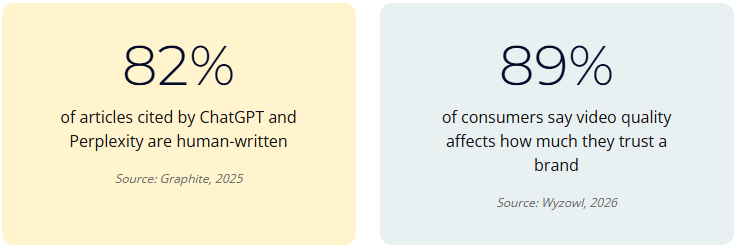
Video is the format that exposes who actually knows their subject. A named expert on camera, explaining something they genuinely understand, communicates competence in a way text cannot, and in a way AI cannot cheaply replicate. 89% of consumers say the quality of a brand’s video affects how much they trust it (Wyzowl, 2026). The overwhelming majority of businesses now use video and report that it builds both awareness and genuine understanding of what they do.
Here is the telling detail. When organisations explain why they do not do more video, the top reasons are cost and time (Wyzowl, 2026). Which is precisely the same reason experts give for not writing articles, and precisely the same reason leadership gives for not freeing the expert up. The barrier is identical across every channel. It is never the expertise. It is always the format of the ask and the assumption that capturing it is expensive.
The Thought Leadership You Already Produce Is Mostly Forgettable
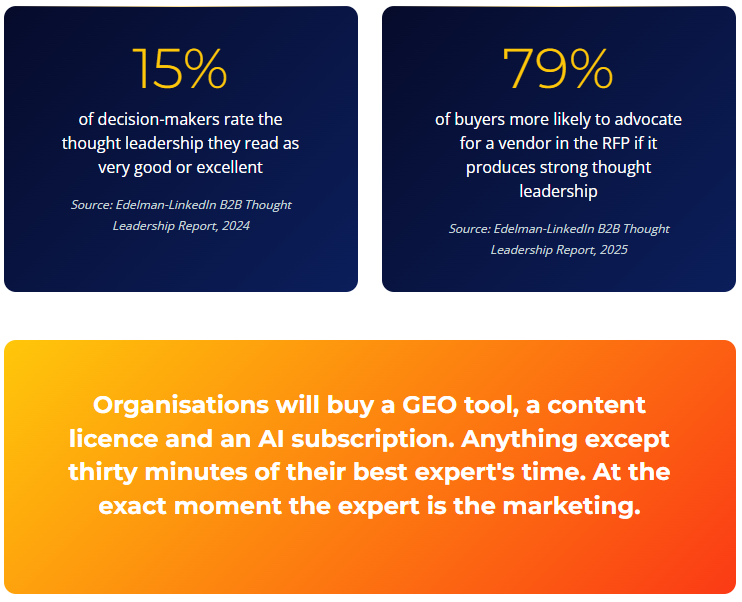
Before anyone protests that they already do thought leadership: yes, and that is the problem. Most organisations already publish it, and most of it lands with a thud. The Edelman-LinkedIn B2B Thought Leadership research is unsparing here. Less than half of decision-makers rate the thought leadership they read as good, and only 15% rate it as very good or excellent. Roughly a third rate it as mediocre.
That is not a volume problem. Those organisations are already spending the time and money to produce the content. It is a sourcing problem. Mediocre thought leadership has a very specific signature: it was written by someone who does not have the experience, reviewed by someone who does not have the time, and stripped of any actual point of view in the approval process. It reads like it was assembled rather than known. Because it was.
The same research shows what good thought leadership does when it is grounded in real expertise. 75% of decision-makers say a piece of thought leadership led them to research a product or service they were not previously considering. 70% say it made them question whether to stay with an existing supplier. In the 2025 edition, 79% of buyers said they were more likely to advocate for a vendor during the RFP process if that vendor consistently produces high-quality thought leadership. The upside is enormous. It is also only available to the organisations whose content carries something an AI could not have written.
The Real Reason Experts Do Not Contribute (It Is Not Laziness)
The standard explanation for why experts do not produce content is that they are too busy, or not interested, or “not writers”. All three are real. None of them is the actual problem. The actual problem is that the ask is wrong.
“Write us 800 words by Friday” is a terrible request to put in front of a senior specialist. It asks them to do a thing they are not good at (writing for marketing), in a format they find painful (the blank page), on a deadline that competes with their actual job (the one they are senior in). So they do the rational thing. They ignore it. And marketing, with a content calendar to fill and no expert input, fills the gap with exactly the generic content that fails every test in this article.
This is the loop that produces the mediocre thought leadership the data describes. The expertise exists. The willingness, often, exists. The request is built to fail. Change the request, and the entire problem dissolves.
The Fix: Interview, Do Not Commission
The model change is small and it changes everything. Stop asking experts to produce content. Start capturing what they already know. Interview, do not commission. Capture, do not request.
A busy specialist who would never write 800 words will happily talk for thirty minutes about a subject they know cold. Talking is not a chore for them. It is what they do all day. So you record a structured thirty-minute conversation, and the marketing team turns that single recording into a whole portfolio of assets.
| One 30-minute recorded conversation becomes | Which channel it serves |
|---|---|
| A bylined, expert-attributed article | Google / E-E-A-T |
| A structured Q&A block answering real questions | AI answer engines / GEO citation |
| Three LinkedIn posts in the expert’s voice, from their account | |
| A short clip of the expert on camera | Video / trust |
| Source material for sales enablement and FAQs | Pipeline and stewardship |
The expert spends thirty minutes doing the one thing they find easy. The marketing team does everything that follows: the writing, the editing, the structuring, the schema, the posting, the clipping. The division of labour finally matches the division of skill. The expert supplies the one input nobody else can. The marketing team supplies the production nobody expected the expert to do. This is also where AI-powered content systems earn their keep honestly: AI is genuinely excellent at turning a transcript into five formats. It is genuinely poor at having the conversation in the first place. Use it for the second job, not the first.