Answer first: asking an AI chatbot a simple question uses roughly 10 times more electricity than a Google search, and research suggests a 100-word AI reply can consume around 519ml of water. For quick facts, local searches and real-time information, traditional search is faster, free, more accurate and far less resource-hungry. AI earns its keep on genuinely complex, multi-source work. The smart move is not “AI or search”. It is using the right tool for the right task, and knowing what each one costs the planet.
There is a question we keep hearing in client meetings, usually delivered with the confidence of someone who has just discovered fire. “Should we just put everything into AI now?”
It is a fair question. AI assistants are genuinely useful. They draft, summarise, reason, and occasionally hallucinate a legal precedent that does not exist. But somewhere along the way, a lot of people quietly swapped “search the web” for “ask the chatbot” as their default reflex for everything, including questions that Google answers in a quarter of a second for a fraction of the energy.
This piece is not an anti-AI sermon. We use AI every day. It is about a quieter point that most marketing decks skip entirely: every query you send has a physical cost. And for the boring, everyday lookups that make up most of what people search for, that cost is wildly out of proportion to the job. So let us talk about the bit nobody puts on the slide.
The Energy Maths: Search Versus AI
The difference between a traditional search and an AI query is not a tweak. It is a different machine doing a different job.
A Google search is, at heart, a lookup. Google has already crawled and indexed the web, so answering you is closer to finding a word in the back of a book than writing the book from scratch. It runs on standard processors and is brutally efficient.
An AI chatbot does not look anything up. It generates a reply one token at a time, running billions of calculations across specialised, power-hungry chips to predict each next word. Generation is expensive. Retrieval is cheap. That is the whole story in one sentence.
| Query type | Energy per query (approx.) | Relative cost | Everyday equivalent |
|---|---|---|---|
| Traditional Google search | ~0.0003 kWh (0.3 Wh) | 1× (baseline) | LED bulb for ~10 seconds |
| Standard AI chatbot (text) | ~3 Wh | ~10× | LED bulb for ~2 minutes |
| AI reasoning model (long query) | ~29–39 Wh | ~100–130× | LED bulb for ~20 minutes |
The 10× rule. As a working rule of thumb, a single standard AI text query uses roughly ten times the electricity of a Google search. Ask it to reason hard, and that gap balloons. It is a heuristic, not a law of physics, but the order of magnitude is consistent across multiple analyses.
That order of magnitude is not just our reading. When the British Standards Institution published its Technical Report on sustainable AI in March 2025, it pointed to research finding that generative AI might use some 33 times more energy than software built for a specific task. Different method, same uncomfortable direction of travel.
A few honest caveats before anyone screenshots that table for a hit piece. These figures are estimates. They vary by model, query length, and how clean the local electricity grid is. The point is not the decimal places. It is the scale. We are not comparing 1.0 to 1.2. We are comparing 1 to 10, and sometimes 1 to 130.
Why is AI so much thirstier?
Three architectural reasons, none of them controversial.
- Retrieval versus generation. Search finds a page that already exists. AI builds the answer from nothing, calculating across billions of parameters for every token it produces.
- The hardware demands. Web indexing runs happily on standard processors. AI needs specialised accelerator chips clustered into server farms that run hot and draw constant, heavy power.
- The cooling tax. Those chips throw off serious heat. Cooling alone can account for a large share of a data centre’s total energy use, which is why liquid cooling went from exotic to standard kit in 2025.
When the people who write the standards are paying attention, it is not hype. BSI, the UK’s national standards body, now publishes formulae to help organisations measure their AI carbon footprint. Its Global Digital Director, Mark Thirlwell, framed the issue as nuanced: AI has enormous potential to support the path to net zero, and at the same time it is, in his words, “extremely resource hungry.” When the cost is being written into formal guidance, it has stopped being theoretical.
The Cost Nobody Mentions: Water
Energy gets the headlines. Water barely gets a footnote, which is odd, because it might be the more visceral number.
Cooling those overheating chips takes water. A lot of it. And unlike the electricity argument, the water story is harder to wave away with “but the grid is getting greener”, because evaporated water does not come back when you switch to solar.
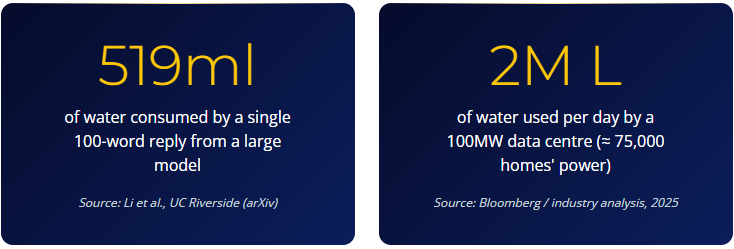
- Globally, data centres consume an estimated 560 billion litres of water annually, projected to climb towards 1,200 billion litres by 2030.
- Roughly 80% of on-site cooling water evaporates and cannot be recovered.
- A Bloomberg analysis found that around two thirds of new US data centres built since 2022 sit in areas already under high water stress.
BSI’s own guidance flags water use, pollution, hardware and data centres as factors organisations should be measuring, not assuming. So this is not a future problem confined to a spreadsheet. It is happening in places that were short of water to begin with.
The Reasoning Model Escalation Nobody Opted Into
Here is the part that should worry anyone watching their AI tooling costs and footprint creep up without explanation. Standard AI queries are already expensive. But “reasoning” models, the ones that visibly think step by step before answering, are a different order of cost entirely. And AI products are quietly defaulting users into them.
| Model behaviour | Energy / emissions impact | What drives it |
|---|---|---|
| Concise text-generation mode | Baseline | Most efficient |
| Reasoning mode activated | Up to ~6× more CO₂ for the same model | “Thinking tokens” |
| Reasoning vs efficient models | Up to ~50× more CO₂ for the same questions | Same answer, far higher cost |
A few concrete numbers to make that real, drawn from a 2025 infrastructure-aware benchmark of AI energy use. One open reasoning model was measured at around 29 Wh per long query, roughly 65 times the most efficient models tested. Another leading reasoning model came in at around 39 Wh per long prompt. Answering 60,000 questions with a heavyweight reasoning model was estimated to produce CO₂ equivalent to a round-trip flight between New York and London.
The kicker: a lot of this is happening by default. Products keep nudging users towards more powerful reasoning modes for tasks that never needed them. You ask for the capital of France and a model burns through a chain of thought to produce an answer Google would have served instantly.
So When Should You Actually Use Each One?
This is where the tongue-in-cheek bit gives way to something genuinely useful. Because the honest answer is not “never use AI”. It is “stop using a sledgehammer to open envelopes”. Here is the framework we use ourselves.
Use traditional search when:
- You need a verifiable fact with a source you can check (statistics, legal references, official data).
- You need real-time or breaking information (news, scores, stock prices, weather).
- The query has local intent (restaurants, shops, services near you).
- You are navigating to a specific site or brand you already know.
- You are doing transactional research (prices, product comparisons, buying).
- It is a simple lookup (capital cities, definitions, dates, conversions).
Use AI when:
- You are synthesising a complex topic that would otherwise mean reading ten-plus articles.
- You are drafting, editing, or generating structured content.
- You need comparative reasoning across several dimensions at once.
- You are refining iteratively, where follow-up questions genuinely add value.
- The task is complex enough that extended manual browsing would cost comparable energy anyway.
The Honest Counter-Argument
A one-sided green argument is a weak one, so here is the strongest case against blanket AI avoidance, made properly rather than buried in a footnote.
The net-neutral threshold. If a research task would genuinely take you 15-plus source visits over 20-plus minutes, the cumulative energy of all that browsing, your device, the network, dozens of page loads, may approach the cost of a single AI synthesis. In that scenario, AI can be roughly net-neutral, sometimes even the greener shortcut.
But notice the conditions. Genuinely complex. Many sources. Sustained effort. That describes a small minority of queries. It does not describe “what time does the post office shut”, which is the kind of thing people now ask a reasoning model while it spins up a chain of thought worthy of a philosophy viva.
The efficiency picture is also moving fast, in AI’s favour. Google reports its Gemini energy per query improved 33-fold year on year, with carbon per query down 44-fold, and says its median query now sits below a traditional search on energy. Grid mix matters enormously too: the same query can produce far less CO₂ on a renewable-heavy grid than a fossil-heavy one. The responsible position is not “AI bad”. It is “know what each tool costs, and choose accordingly”.
What We're Seeing in the Wild
We run search and visibility programmes for organisations in regulated and mission-led sectors, so we get to watch this shift in live dashboards rather than in think-pieces. A few patterns we keep seeing, that the headline panic tends to miss:
- Falling traffic does not always mean falling performance. We regularly see organic sessions dip while branded search, direct visits and actual conversions hold steady or climb. The answer moved onto the results page. The interest did not disappear.
- Being cited is the new being clicked. When a client’s content gets pulled into an AI Overview or quoted by an assistant, we often see knock-on lifts in branded search and direct traffic, even when the click never happens. The content did its job; the dashboard just measured the wrong thing.
- The panic spend is real. The most expensive mistake we see is teams reacting to a traffic chart by throwing budget at the wrong problem. Usually the fix is measurement, not money.
None of that is an argument against AI. It is an argument for understanding what your numbers are actually telling you before you act on them.
Where This Touches the Open Web (Without the Sales Pitch)
We are a search and growth agency, so you might reasonably expect this to pivot into “and that is why you should buy SEO”. It will not. But there is a genuine connection worth naming, because the sustainability story and the open-web story are the same story.
The same shift that makes AI energy-hungry is also reshaping how people find things, and the data is striking.
| Metric | Figure | Source |
|---|---|---|
| Searches ending without a click (US) | ~58–60% | SparkToro / Bain & Company |
| Zero-click rate when an AI Overview is present | ~83% | Similarweb, 2025 |
| Organic CTR drop with AI Overviews present | 1.76% → 0.61% (a 61% fall) | Seer Interactive, 2025 |
| Traffic gap: search engines vs AI chatbots | ~34× more from search | OneLittleWeb, 24-month study |
| Chatbot share of publisher page-view referrals | Under 1% | Chartbeat (via Axios) |
Read those last two rows again. For all the noise, traditional search still sends roughly 34 times more traffic to the open web than AI chatbots do. Chatbot referrals have grown fast, more than 200% in a year by some measures, and still account for under 1% of publisher referrals.
Here is the sustainability link people miss. AI models are trained on, and increasingly cite, the open web. The crawlable, well-structured, credible web is the raw material the chatbots depend on. Every time you use search for a query that did not need generating, you are leaning on the efficient layer of the internet and keeping the thing the AI summarises alive and worth summarising. Investing in good content is, among other things, investing in the green corner of the web. It is also the foundation of answer engine optimisation and generative engine optimisation services: the disciplines that decide whether the AI cites you or someone else.
The Caveats, Because We Are Not Zealots
A balanced argument names its own limits, so here is the rest of the other hand.
- Benchmarks vary wildly. Per-query emissions estimates range from about 0.03g to 14g of CO₂e depending on model, length and method. The 10× rule is a useful heuristic, not gospel.
- Training dwarfs inference. Much of the footprint is in training the model once, then spread across billions of queries. The per-query number is only part of the ledger.
- Total demand is still rising. Even as each query gets more efficient, there are vastly more of them. The IEA projects data centre electricity use will roughly double by 2030. Per-query efficiency and total consumption are moving in opposite directions, which is exactly why conscious use matters.
None of this dissolves the core point. It sharpens it. The responsible position is not “AI bad”. It is “know what each tool costs, and choose accordingly”. For the search side of that equation, our SEO services and the wider Fuel Room cover how to stay visible without the panic spend.
Action Plan: Conscious Search in Practice
✓ Set search as your reflex for simple lookups. Facts, definitions, navigation, local, real-time. Make Google the muscle memory, not the chatbot.
✓ Reserve AI for synthesis and creation. Complex research, drafting, comparison, iterative reasoning. That is where it earns its energy.
✓ Check your default model. If your tools quietly default to a reasoning mode, switch to a lighter model for everyday tasks. You will save energy, money and waiting time.
✓ Batch your AI work. One well-structured prompt beats ten scattered ones. Fewer, better queries cut both cost and footprint.
✓ For teams: audit your AI spend. API web-search calls and reasoning tokens add up. Track which workflows actually need generation versus a cheap index lookup.
✓ Keep investing in the open web. If you publish, structured, credible, citable content is what both search and AI feed on. It is the efficient layer worth protecting.
The goal is not purity. It is proportion. Use the expensive tool when the job is expensive. Use the cheap one when it is not. Your dashboard, your budget, and a reservoir somewhere will all thank you.
Frequently Asked Questions
Does asking AI really use ten times more energy than a Google search?
Is it ever greener to use AI than to search?
How much water does AI actually use?
If AI is the future of search, why does the open web still matter?
Are these energy figures going to stay this high?
Falling traffic is not always falling performance. We can tell you which.
Sources
International Energy Agency – Energy and AI – data centre electricity consumption projected to roughly double by 2030
BSI – Guidance on AI sustainability (Technical Report PD CEN/CLC TR 18145:2025) – 33× energy figure; Mark Thirlwell quote
Google Cloud – Measuring the environmental impact of AI inference – per-query energy figures and efficiency gains for Gemini
How Hungry is AI? Benchmarking Energy, Water and Carbon (arXiv) – infrastructure-aware benchmark of reasoning model energy and emissions
Li et al., Making AI Less “Thirsty” (UC Riverside, arXiv) – ~519ml water per 100-word AI reply
Bloomberg – AI Is Draining Water From Areas That Need It Most – two thirds of new US data centres in high water-stress areas
Bain & Company – Goodbye Clicks, Hello AI – zero-click reliance; organic traffic down 15–25%
Similarweb / The Digital Bloom – Zero-click search analysis 2025 – ~83% zero-click rate with AI Overviews
Seer Interactive – AI Overviews CTR impact – organic CTR falling from 1.76% to 0.61%
OneLittleWeb – AI Chatbots vs Search Engines 24-Month Study – search drives ~34× more traffic than AI chatbots
Axios / Chartbeat – Search traffic declines and AI referrals – chatbots under 1% of publisher referrals