The instinct when content is not performing is to make the content better. Sharper headline. Longer guide. More SEO. New byline. Another round of edits. Another retainer with a new agency promising a new angle. The team works harder, the writing gets nicer, the pageviews wobble back up for a week, and then the same plateau arrives in the next quarterly review.
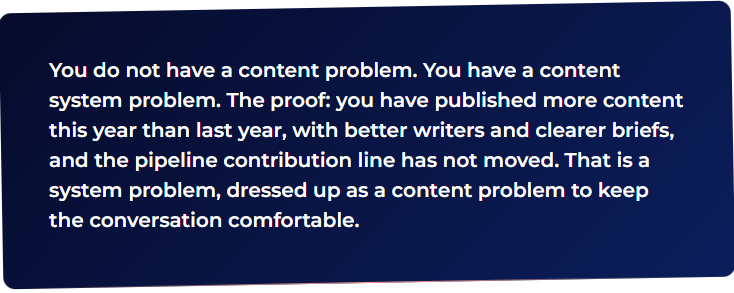
This is the wrong diagnosis. Not always, but more often than the industry is willing to admit. The content is rarely the bottleneck. The bottleneck is almost always the system that produces, distributes, governs and measures the content. Most marketing teams do not have a content problem. They have a content-system problem dressed up as a content problem.
The symptoms are unmistakable. Rankings that plateau despite regular publishing. Traffic that arrives but does not convert. Writers who spend more time firefighting briefs than doing strategic work. A backlog stacked with pieces that nobody can quite explain the commercial purpose of. A monthly review that celebrates “engagement up 14%” while the pipeline contribution line sits stubbornly at “we will follow up”. And, every nine months or so, a senior leader asking “are we sure content is working for us?” while looking out of the window in a way that suggests they have already made up their mind.
This article is the case for the system. Not better writing. Better infrastructure. The thing that turns individual quality into compounding outcomes.
| The Production Line | The Growth System | What Changes |
|---|
| “Random acts of content” — disconnected briefs each fighting alone | Topic clusters where every piece reinforces the others | Authority compounds across the topic, not asset by asset |
| One pillar piece → one published asset | One pillar piece → 8 derived assets across channels | ~15 hours/week saved per client (1:8 model) |
| “Engagement up 14%” in the monthly review | Pipeline contribution, citation rate, conversion attribution | The CFO can read the report |
| Approval chain decided per piece, ad hoc | Documented governance with named owners and timings | “Done” stops being a negotiation |
| No documented “what next and why” without a meeting | The editorial calendar and cluster map answer it on sight | Decisions happen in seconds, not days |
| Performance measured by output volume | Performance measured per asset with named owner at 90 days | Underperformers get fixed, not buried |
Random acts of content. That is the term practitioners use for the thing most teams are actually doing. A blog post here, a landing page there, a social campaign in between, each trying to earn its keep independently of the others, none of them compounding into anything an algorithm or a buyer can recognise as authority. The cure is not a better blog post. The cure is connecting the blog post to the system underneath it.
Why Content Teams Plateau (It Is Usually Not the Talent)
Marketing teams do not implode. They erode. The pattern repeats across SaaS, healthcare, professional services and DTC: smart people producing competent work that does not move the business, in an operating model that was never designed for compounding. Practitioners working inside the failure mode describe it consistently: content teams do not fail because of a talent problem. They fail because of a decision-making and process problem.
This is not a comfortable framing for marketing leaders. It is more flattering to attribute the plateau to “we need better writers” or “we need a fresh creative platform”. Both can be true, and neither is usually what is actually broken. The decision-making is broken. The intake is broken. The cluster mapping is missing. The repurposing plan does not exist. The governance is informal. The measurement framework reports pageviews to a finance team that wants to talk about cost per qualified lead. The brand voice slips a little further every month because nobody documented what it was. The team is brilliant, on paper, and the system underneath is held together with shared Google Docs and the institutional memory of two people, one of whom is on their notice period.
Content operations research is unambiguous about the cost. Without strong operational infrastructure, organisations suffer duplicated effort, missed deadlines, inconsistent messaging and wasted budget, regardless of the talent in individual writers. Only 31% of B2B marketers say their organisation has the right content management technology in place. The other 69% are running on informal, ad hoc governance, which is to say they are running on luck.
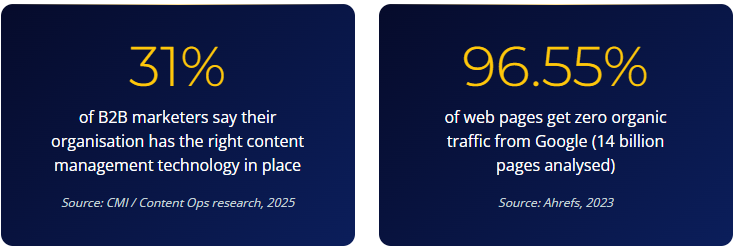
Read those two numbers next to each other. The vast majority of content gets no traffic. The vast majority of teams have no operational infrastructure. The relationship between the two is not coincidental. It is causal. Content that exists outside a system tends to perform like a Tuesday in January.
What a Content System Actually Is (and What It Is Not)
A content system is the combination of people, processes and technology that moves content from idea to measurable result. It is distinct from content strategy, which is the “what” and “why”. The system is the operational layer that determines how the strategy actually gets executed.
The film-making analogy is useful here. Strategy is the director’s creative vision: the audiences, the topics, the tone, the editorial mandate. The content system is the producer: the production schedule, the call sheet, the budget reconciliation, the assistant who actually knows which van the camera equipment is in. Without the producer, even the best script does not make it to screen. Most content teams are over-invested in directors and under-invested in producers, and then surprised when their excellent scripts arrive two months late, off-budget and in three different aspect ratios.
Four components make a system functional. None of them are optional. Most teams have one or two, sometimes three, almost never all four working at once.
1. Planning infrastructure
Editorial calendar, topic cluster maps, keyword-to-intent alignment, named owners. The question the planning layer must answer is: what are we publishing next, and why, and who decided? If the answer requires a meeting to retrieve, planning is not working. The cluster map is the artefact that makes planning visible. If you do not have one, you are not planning. You are reacting to whoever shouted loudest in the last campaign retro.
2. Creation workflows
Brief templates, style guides, approval chains, role clarity. The creation layer is where most “we have a content problem” complaints actually live, because it is the most visible layer. Briefs without intent. Pieces approved by four stakeholders who all want different things. Style guides that exist as PDFs nobody opens. The creation layer is also where AI content systems either compound the problem (drafts produced faster than humans can review) or solve it (drafts structured around intent, with human editing focused on expertise and judgment). The variable is the workflow, not the tool.
3. Distribution loops
Repurposing protocols, channel sequencing, scheduling automation. Most content is “published” rather than “distributed”, which is to say it lands on a website and then waits, politely, for visitors. The distribution layer is where the same piece earns multiple lives across LinkedIn, email, sales enablement, paid amplification and search. Without it, every piece is a single use of a long production cycle.
4. Measurement feedback
Performance tracking tied to business goals, not vanity metrics. The measurement layer feeds back into the planning layer, or it should. Most measurement systems report numbers nobody acts on. A working measurement layer answers: which pieces are compounding, which are decaying, which need refreshing, which should be archived? The feedback closes the loop. Without it, the system is a production line, not a system.
Strategy decides the what and why. The system delivers the how. A team with a strong strategy and a broken system underperforms a team with a thinner strategy and a working system, every single time. The system is the part most teams skip because it does not look like “content work” on a project plan. It looks like spreadsheets, role definitions, and decisions about who owns what. Glamorous, no. Decisive, yes.
Pillar-and-Cluster: The Most Durable Pattern
The most durable content-system architecture for organic search is the pillar-and-cluster model. Instead of publishing isolated articles that each try to rank independently, the framework treats a topic as an interconnected system: one comprehensive pillar page covers the broad topic, and a set of cluster pages cover specific subtopics, all connected through deliberate internal linking.
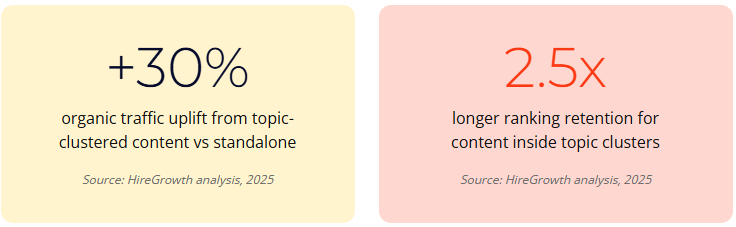
The result is a web of related content that signals topical authority. Topic-clustered content drives approximately 30% more organic traffic than standalone content and holds rankings 2.5 times longer (HireGrowth, 2025). Businesses using topic clusters effectively report up to 97% organic traffic uplift (Conductor). Pillar rollouts have driven 53% traffic lifts within three weeks when the cluster architecture is clean (Niumatrix, 2026). The architecture is not new. The discipline of actually applying it across a content estate is.
For agencies managing multiple clients, the implication is significant. Applying this architecture to a SaaS client means mapping every piece of content to product use cases, pain points and buyer journey stages, producing what amounts to an always-on content engine rather than a blog. The same logic applies to healthcare, logistics or professional services. Structured clusters replace ad-hoc publishing. Topical authority compounds over time. The agency stops being a content vendor and starts being the operator of a content system.
The 2026 version of the model is shorter at the cluster level than the 2019 version. AI engines reward extractable chunks, not 5,000-word ultimate guides. The architecture survives. The size of the pieces inside it has changed. Cluster pages of 600 to 900 words, with answer-first paragraphs near the top, perform better in both Google and AI citation than monolithic essays. The model evolves. It does not retire. See our work on SEO services and generative engine optimisation services for the version of this model that runs today.
The 1:8 Repurposing Principle (Where Distribution Actually Lives)
The most efficient B2B content operations in 2025-2026 are not creating more content. They are repurposing more cleverly. The 1:8 content model is the cleanest articulation of the principle: create one high-value pillar asset, then derive eight additional formats from it, each reimagined for a specific channel and audience mindset. Estimated saving: 15+ hours per week per client.
A single long-form asset — a detailed guide, a research report, a webinar — can yield:
- A series of targeted blog posts breaking out specific sections
- A LinkedIn article or carousel distilling the core insight
- An email newsletter sequence nurturing leads through the funnel
- Short-form social posts adapted per platform
- Infographics, audiogram clips, video extracts
- A sales enablement asset or case study narrative
- Paid amplification ad copy and creative variants
- A podcast outline or speaking submission
The key distinction is that repurposing is not reformatting. Reformatting takes the same words and pastes them into a new container. Repurposing reimagines the content for each specific platform context, audience mindset and intent stage. The three operational modes inside this workflow are: repost (republish the same content over time), reuse (apply minor edits for a new platform or audience), and repurpose (create new content using an existing piece as the source). Each has a different ROI profile. Most teams do exclusively the first or the second and call it the third.
Governance: The Layer That Quietly Determines Everything
Content governance is the layer most agencies and in-house teams skip, and it is usually what causes quality to degrade as volume scales. Governance is the daily regulation of content elements: style and tone, delivery standards, approval workflows, role responsibilities, and brand alignment.
Without governance, more stakeholders means more inconsistencies. Product teams, sales reps, marketing managers and client contacts all pull content in different directions, none of which were the original strategic direction. A governance framework prevents this by clarifying four things:
- Who owns each content type and what “done” looks like for that type
- What the approval chain is, and how long each stage is allowed to take
- How brand voice, accuracy standards and formatting rules are enforced
- What happens when content becomes outdated or underperforms (the refresh and decay workflow)
For regulated sectors — healthcare, financial services, public sector, legal — governance is not optional. The accuracy and regulatory compliance requirements mean an undocumented governance model is not a small risk. It is a regulatory exposure. For SaaS and B2B clients, governance is what allows volume to scale without quality collapse. For agencies, governance is the deliverable clients did not know they were going to need until they hit the third cycle of “wait, who approved this?”.
Measurement: From Pageviews to Pipeline
A content system without measurement is just organised output. The final component, and the one that ties everything back to commercial accountability, is tracking the right signals. Most content teams default to pageviews, impressions and social engagement. These are valid signals operationally. They are insufficient for business accountability.
| Metric Tier | What to Measure | Why It Matters |
|---|
| Traffic quality | Organic search visits, time on page, bounce rate | Signals whether content attracts and holds the right audience |
| Engagement depth | Scroll depth, internal link clicks, return visits | Reveals whether content architecture is working |
| Conversion contribution | Form fills, demo requests, trial signups, donations | Connects content to pipeline activity |
| Content ROI | Cost per asset vs. leads / revenue attributed | Justifies system investment to clients and stakeholders |
| Content decay | Drop in organic traffic / citation over time | Drives refresh and update workflow |
| AI citation | Brand mentions in ChatGPT, Perplexity, Gemini, AIO | Tracks visibility in the surfaces where discovery is moving |
The shift from “traffic” to “pipeline” is what separates content operations that generate real business outcomes from those that simply produce volume. Performance should be owned per asset, not diffused across a team. If content ROI lives nowhere, it dies everywhere. Marketers who can calculate content ROI are 1.6 times more likely to receive higher budgets (MarketingProfs, 2025). The teams that can measure get the resources. The teams that cannot get the redundancy package.
The Content System Audit (Production Line vs Growth System)
This is the audit framework. Eight tests, scored zero to two. Score above twelve, you are running a system. Score eight to twelve, you have a system on paper that is partially functioning. Score below eight, you are operating a production line.
| Test | Production Line (0) | Partial (1) | Growth System (2) |
|---|
| The “what next” test | Requires a meeting | Editorial calendar exists but not aligned to clusters | Cluster map + calendar answer it instantly |
| The cluster test | Articles stand alone | Some topic grouping exists | Every piece sits inside a documented cluster |
| The repurposing test | One piece, one channel | Manual reformatting for one or two channels | 1:8 model with documented repurposing queue per pillar |
| The brief test | “Write something on [topic]” | Templated brief, inconsistent quality | Briefs include intent, cluster placement, commercial purpose, success metric |
| The governance test | Approval chain ad hoc | Documented but not enforced | Documented, enforced, with named owners and SLAs |
| The measurement test | Reports pageviews to the board | Mix of vanity and pipeline metrics | Pipeline contribution by asset; decay and refresh tracked |
| The decay test | No refresh workflow | Ad-hoc updates when noticed | Quarterly content decay audit with refresh queue |
| The ownership test | “The marketing team” owns it | Team lead owns it in aggregate | Each asset has a named owner accountable at 90 days |
The audit is deliberately diagnostic, not aspirational. The point is to make the gap legible to the team, the senior leadership and the board. Most operations score between four and ten on first audit. The ones that score above twelve are the ones competitors quietly study while pretending not to.
The Honest Counterpoint: When Better Writing Is Actually the Issue
The argument so far has been that the system is usually the bottleneck. That is not the same as “writing never matters”. Three cases where the writing genuinely is the variable to fix.
First, when the content has no expert opinion. AI engines and human readers both reward content that says something an algorithm could not generate. If your writing is a competent summary of what is already on the first page of Google, the system underneath it cannot save it. The fix is not better operations. It is named expert authors with named opinions.
Second, when the content is genuinely off-brand. A weak system can publish on-brand content. A strong system cannot rescue content that has slipped voice and is being recognised as such by an audience that used to trust the publisher. Voice is upstream of system. If the voice has eroded, that is a documented voice-guide problem, not a workflow problem.
Third, when the topical relevance has slipped. If the team is producing competent content about topics that have nothing to do with the commercial proposition (HubSpot’s famous collapse, ranking for “famous sales quotes” while selling CRMs), the system is irrelevant. The diagnostic is the content’s strategic fit, not the operational scaffolding around it.
For agencies that have read this far: the content system is itself a client deliverable, not just an internal operating model. Presenting a client with a documented content operations framework, not just an editorial calendar, elevates the engagement from production vendor to strategic partner. Production-line agencies sell pieces. Growth-system agencies sell infrastructure. The retainers price very differently. So do the renewals.
Systems As the Moat (Why This Matters Now)
The argument is sharper in 2026 than it was in 2022. AI has lowered the production cost of any individual piece of content to approximately nothing. The quality of any individual piece is commoditising rapidly. What remains differentiated is the system behind it: the architecture that decides which topics to cover, how content compounds across formats, how distribution is orchestrated, and how performance feeds back into planning.
Put more bluntly: when everyone has access to the same AI drafting tools, the team that has a working content system out-publishes, out-clusters and out-distributes the team that does not. Same tools. Different outcome. The differentiator is the operating model, not the writing assistant.
This is true across sectors but particularly visible in the agency context. Agencies running production-line operations are competing on speed and price, both of which AI has commoditised. Agencies running growth-system operations are competing on infrastructure that cannot be ChatGPT’d in an afternoon: cluster maps, repurposing queues, governance frameworks, measurement systems tied to client pipeline. The market is splitting accordingly. The agencies that survive the next twenty-four months are the ones that built the system while the production-line agencies were debating prompt engineering.
Browse the Fuel Room for our broader work on how this is playing out in practice, and our AI-powered content systems for the version of this framework we run for clients.
Where to Start (If You Have Read This Far and Recognised Yourself)
The first action is not “redesign the operation”. It is the audit. Use the eight-test framework above. Score honestly. Identify the two lowest scores. Those are the two leverage points where work this quarter delivers the largest compounding return.
The second action is to pick one pillar. Rebuild the system around one topic before trying to apply it across the whole estate. A working cluster on one topic, with one repurposing queue, one governance model and one measurement spec, demonstrates the system in a quarter. A simultaneous rebuild of the whole content operation takes a year and stalls in the seventh meeting about taxonomy. Pick one. Prove it. Then scale.
The third action is to make the system visible. The cluster map, the repurposing queue, the governance doc and the measurement spec should sit on a Notion page or a shared Drive folder that the team, the agency and the senior leadership can read in fifteen minutes. Systems that live in one person’s head are not systems. They are tribal knowledge with a single point of failure. The system has to be legible to everyone who needs to operate inside it, or it does not exist.
Your 10-Step Content System Audit
- Run the eight-test audit. Score yourself honestly across the “what next”, cluster, repurposing, brief, governance, measurement, decay and ownership tests. Total out of 16. Anything under 8 is a production line.
- Map your existing content into clusters. Pull the last 50 published pieces. Group by intended topic. If you cannot complete the exercise without inventing categories on the spot, the cluster layer does not exist yet.
- Pick one pillar to rebuild around the four components. Planning, creation, distribution, measurement. Demonstrating the system on one topic is significantly easier than redesigning the operation.
- Build a documented brief template with intent, cluster, commercial purpose and success metric. No piece commissioned without one. The brief is the contract between strategy and execution.
- Document the 1:8 repurposing queue for each pillar. Pre-plan the eight derived assets at the same time you commission the pillar. Distribution starts before the piece is written, not after.
- Write the governance doc. Approval chains with SLAs, brand voice rules, accuracy standards, regulatory protocols for sensitive content. One page is enough. One sentence is not.
- Replace pageviews with pipeline in the board pack. Cost per asset, leads attributed, revenue contribution, citation rate. Pageviews stay in the team dashboard, not in front of the CFO.
- Audit content decay quarterly. Pull the underperforming back half of the estate. Refresh, consolidate, redirect or delete. Underperforming content damages site-wide authority. Letting it sit there is an active cost.
- Name an owner per asset, accountable at 90 days. If ownership is “the team”, nobody is responsible. If ownership is a named person, the work gets evaluated, refined and improved. Pick the person.
- Make the system visible to everyone who needs to operate inside it. One shared page with the cluster map, repurposing queue, governance doc and measurement spec. If new starters cannot understand the operating model in fifteen minutes, the system is not yet a system.
Frequently Asked Questions
Stop publishing. Start building a content engine.
Free Content System Audit. We will tell you whether your operation is a production line or a growth system, and which fix unlocks the most.
Sources
Content Marketing Institute / Content Ops research (2025) – Only 31% of B2B marketers say their organisation has the right content management technology in place
Ahrefs (2023, 14 billion pages analysed) – 96.55% of web pages get zero organic traffic from Google
HireGrowth / BuckleyPlanet (2025) – Topic-clustered content drives ~30% more organic traffic and holds rankings 2.5x longer than standalone pieces
Conductor – Businesses using topic clusters effectively report up to 97% organic search traffic uplift
Niumatrix (2026) – Pillar rollouts can drive 53% traffic lift in three weeks with clean cluster architecture
Ahrefs (2025, 560,346 AI Overviews analysed) – 53.4% of AI Overview citations come from pages under 1,000 words; the cluster-page format that performs in AI search is shorter than the 2019 ultimate guide
Geneo (2025) – Pages with 120-180 word sections between headings receive 70% more ChatGPT citations
MarketingProfs (2025) – Marketers who can calculate ROI are 1.6x more likely to receive higher budgets
Revenue Zen / Genesys Growth (2025) – Content marketing generates $3 per $1 invested vs $1.80 for paid advertising; only 36% of marketers can accurately measure content ROI
Internal Seventh Element research / supplied client research document (2026) – The 1:8 content model framework; the Repost / Reuse / Repurpose distinction; the four-component content operations definition (planning, creation, distribution, measurement); the agency-context framing for SaaS, healthcare and logistics clients