Social media was going to kill SEO. Voice search was going to kill SEO. Featured snippets, mobile, Pinterest, TikTok and ChatGPT were all going to kill SEO. Across the same period the global SEO industry grew to $75 billion. Google’s search volume rose 21.64% in 2024 alone. The corpse keeps showing up to work. Here is the full Obituary Timeline.
In May 1897, the New York Journal mistakenly reported that Mark Twain had died. Twain, who had not, sent a note to the reporter from London. The note read, in part: “The report of my death was an exaggeration.” Twain wrote the line. He did not say it, despite what every memorial wall plaque in the English-speaking world insists. The “greatly exaggerated” version arrived in a 1912 biography, two years after Twain actually had died. Even the famous quote about misreported deaths was itself misreported, embellished, and recycled until it became the version everyone knows.
This is the right frame for an article about SEO obituaries. Because for the last twenty-nine years, with admirable consistency, the marketing industry has held a funeral for SEO. Each funeral is well attended. Each features a different cause of death. Each is reported by serious commentators in respectable publications. And each is, in the gentlest possible terms, an exaggeration that grew somewhat larger every time the story was retold.
The first recorded SEO death notice we can find dates from November 1997. Richard Hoy, posting to an online discussion group, declared: “I’m beginning to believe that search engines are a dead-end technology.” His advice was to add some meta tags, submit your site, and then, in his words, “forget it”. Google launched the following year. That is the level of forecasting accuracy we are dealing with across this entire body of work.
| Year | Cause of Death (Predicted) | What Actually Happened |
|---|---|---|
| 1997 | Search engines are a “dead-end technology” | Google launches 10 months later |
| 2003 | Florida update “destroys” the industry | Keyword stuffing dies; SEO pivots to quality |
| 2005 | “Short-term rankings will be corrected” | Industry keeps growing |
| 2009 | Caffeine update means “SEO isn’t important any more” | SEO industry doubles in size |
| 2011 | Panda update is “the end of SEO” | Content farms die; quality content rewarded |
| 2012 | Forbes: SEO will be “dead in 2 years” | SEO industry tripled by 2024 |
| 2014 | Pinterest is “the new search engine” | Pinterest remains adjacent visual discovery |
| 2015 | Mobilegeddon will “end SEO as we know it” | Actual ranking impact: 0.2-1.3 positions |
| 2016 | “50% of search will be voice by 2020” | Voice in 2025: 12-15% of search |
| 2017-18 | Featured snippets and AMP kill clicks | Snippets take 8.6% of clicks; AMP retired 2021 |
| 2022 | “40% of Gen Z replaces Google with TikTok” | Quote was specifically about lunch spots |
| 2022-23 | ChatGPT “kills” Google and SEO | Google grew 21.64% in 2024; 373x more searches than ChatGPT |
| 2024 | Gartner: search volume “drops 25% by 2026” | Their prior 50%-by-2025 prediction was quietly retracted |
The 1997 Prediction (Made Just Before Google Launched)
Richard Hoy’s November 1997 forum post is, as far as we have been able to trace, the first published “SEO is dead” prediction in the modern internet era. The argument was reasonable for its time. Search engines in 1997 were genuinely awful. AltaVista returned 12,000 irrelevant results for any query that mattered. Yahoo was a hand-curated directory. The prediction was not that “search would become more sophisticated and reward better practices”. The prediction was that the entire technology category was a dead end.
Larry Page and Sergey Brin registered google.com on September 15, 1997. PageRank, the patent that would change everything, was filed January 1998. Google Inc. was formed September 1998. The “dead-end technology” launched its commercial form the year after Hoy declared search a write-off, and proceeded to become one of the largest companies in human history. The forum post survives in archived form. Hoy’s later career was, by his own account, in email marketing.
The lesson is not that Hoy was unusually foolish. He was not. The lesson is that “this technology category is finished” is the prediction least likely to be correct in technology. The thing that looks like a dying category from inside the category is almost always a category that is about to be reinvented by an outsider with different assumptions.
The 2003-2011 Wave: Florida, Penguin, ShoeMoney and Panda
Google’s Florida update launched in November 2003. It killed keyword stuffing and hidden text in a single weekend. WebmasterWorld forums lit up with declarations that “SEO is dead. Google just destroyed the industry.” The industry, observably, was not destroyed. Sites that depended on keyword density manipulation were destroyed. The two are different things. SEO pivoted to focus on content quality and natural linking, which is what Florida was designed to reward. The funeral was for a tactic. The mourners assumed it was for a discipline.
Jeremy “ShoeMoney” Schoemaker declared SEO dead in 2005, on the basis that search engines were improving fast enough that any short-term ranking advantage would be corrected. He was correct about the improvement. He was wrong about the implication. The improvement created a demand for SEO professionals who could keep up, not for a discipline that quietly retired.
The Panda update of February 2011 affected 11.8% of English-language search queries (Google’s own figure). Content farms that built their business on producing thousands of thin articles for high-volume keywords were dismantled within a quarter. Demand Media’s eHow, Suite101 and AssociatedContent saw their traffic collapse. The “SEO is dead” articles arrived on schedule. The actual outcome: SEO consulting fees rose, because suddenly every brand on the internet needed help recovering from Panda or proving they would not be hit by the next iteration.
2012: The Forbes Funeral (and the Two-Year Deadline)
Of all the SEO obituaries on record, the most ambitious is Ken Krogue’s “The Death of SEO: The Rise of Social, PR, and Real Content”, published in Forbes in July 2012. The article quotes SEO consultant Adam Torkildson, who states with confidence that “Google is in the process of making the SEO industry obsolete. SEO will be dead in 2 years.”
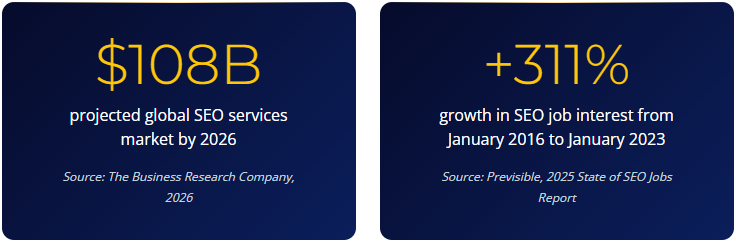
The two-year deadline was 2014. By 2014, the global SEO industry was estimated at the low billions in annual spend. By 2025, that figure is approximately $75 billion. By 2026, projections sit at $108 billion at a compound annual growth rate of 16.8% (The Business Research Company). The industry that was supposed to be dead by 2014 is now growing at a rate that would make most “alive” industries jealous.
The same year, Google’s Penguin update launched (April 2012), affecting approximately 3.1% of queries initially and another 10% across subsequent iterations. The Knowledge Graph launched in May 2012, with predictions that “zero-click search will kill SEO”. The exact-match-domain update arrived in September 2012, killing the practice of buying domains like best-cheap-flights-uk.com to rank for “best cheap flights UK”. By the end of 2012, three different Google updates had been declared the death of SEO. The industry did not die. The funeral home, frankly, was running out of black bunting.
2014-2016: Pinterest, Mobilegeddon, and the Voice Search Prediction That Aged Like Milk
In April 2014, Pinterest launched Guided Search and was promptly hailed as “the next Google” by a wave of marketing commentators. Visual discovery was going to replace text search. Pinterest’s user base would overtake search engines. The mood was, again, that SEO was finished. Pinterest in 2026 is a substantial platform with around 500 million monthly active users. Google has approximately 4.5 billion. Pinterest did not become the new Google. It became Pinterest, which is genuinely valuable for visual discovery and a fraction of search volume.
“Mobilegeddon” arrived on April 21, 2015. Google rolled out a mobile-friendly update that was confidently predicted to cause catastrophic ranking losses for non-mobile-friendly sites. Search Engine Land ran a feature on what to expect. Some commentators called it the end of SEO. The actual measured impact, per Searchmetrics and Moz: non-mobile-friendly sites dropped on average between 0.2 and 1.3 ranking positions. A statistical blip. The funeral organisers refunded the catering deposit and went home.
The voice search prediction is the one that has aged worst. In 2014, Andrew Ng (then Chief Scientist at Baidu) told Fast Company that “in five years time at least 50% of all searches are going to be either through images or speech.” The forecast was about Baidu specifically. It was misattributed to comScore. It was repeated, year after year, by marketing publications who never quite checked the source. “50% of all searches will be voice by 2020” became the most quoted statistic in voice search content marketing. Voice search in 2025 sits at approximately 12-15% of total search traffic globally. Smart speaker-driven voice search is roughly 0.75% of total search. The prediction was off by a factor of three to four, depending on which definition of voice search you use.
The voice search prediction was off by a factor of three to four. The TikTok-as-search-engine claim was about lunch spots specifically. The Gartner 25% search decline prediction is the replacement for an earlier 50%-by-2025 prediction that was quietly retracted. The industry’s forecasting record is not encouraging.
2017-2019: Position Zero, Zero-Click, and the AMP Disappointment
Featured snippets arrived in earnest from 2014 onward but became the dominant SEO panic in 2017-2018. “Position zero” was going to eat all clicks. The featured snippet would answer every question and nobody would scroll further. Ahrefs’ 2017 study found that the snippet captured 8.6% of clicks on the queries it appeared in. The result directly below the snippet got 19.6%. The “position zero kills clicks” narrative was technically accurate for the snippet itself and entirely wrong about the page beneath it. Pages whose content earned the snippet typically saw an overall traffic increase, not decrease.
AMP (Accelerated Mobile Pages) was Google’s mobile-speed initiative from 2015-2016 onward, made effectively mandatory for Top Stories carousel placement. Publishers grudgingly implemented it. AMP was supposed to be the future of mobile content. In April 2021, Google quietly removed AMP as a requirement for Top Stories. By the end of 2021, Twitter, the New York Times, CNN and Vox had all dropped AMP. The format that was going to reshape mobile SEO was retired by Google itself.
The zero-click data, however, is real. By August 2019, SparkToro and Jumpshot data showed 50.33% of Google searches ended without a click. By 2020, it was 64.82% (5.1 trillion query sample). The trend was real, the implication was not. Zero-click queries are typically queries where the user wants a quick fact (weather, time, sports score, definition). The queries that drive pipeline, donations, conversions and transactions still produce clicks. The zero-click trend is a story about Google answering more “what is the capital of Slovenia” queries directly. It is not a story about commercial intent queries collapsing.
2022-2024: ChatGPT, Gartner, and the AI Overviews Era
In November 2022, OpenAI released ChatGPT to the public. Within two weeks, marketing publications began running “ChatGPT will kill Google” articles. By early 2023, the genre was crowded. Opollo published “Google and ChatGPT Just Killed SEO”. Tability ran “ChatGPT might have killed your SEO strategy”. The volume of articles declaring SEO dead reached a level not seen since the 2012 Forbes piece.
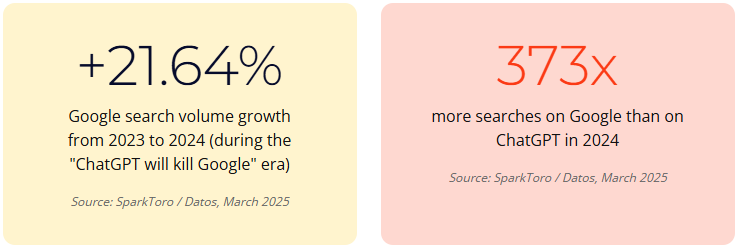
The data on what actually happened is unambiguous. SparkToro and Datos, analysing trillions of clickstream events, found that Google search volume grew 21.64% from 2023 to 2024. Google received 373 times more searches than ChatGPT in 2024. ChatGPT did add 0.25% to total global search volume, which is real but not transformative. 95% of ChatGPT users still use Google. The “Google killer” had a perfectly reasonable launch quarter, but did not kill Google. Google had its best year in a decade.
Gartner’s contribution is worth noting separately. In February 2024, Gartner issued a press release predicting that “traditional search engine volume will drop 25% by 2026” due to AI chatbots. The headline was widely shared. Less widely shared: Gartner had earlier predicted 50% organic search decline by 2025 (Search Engine Land), a prediction that was quietly retracted and replaced with the 2026 prediction. The current 25% number sits in the space where the 50% prediction used to sit, and will presumably be revised again when 2026 ends with Google search volume continuing to grow.
This is not a critique of Gartner specifically. It is a critique of forecasting a category death using the same methodology that failed every previous time. The category does not die. The category restructures. The forecast keeps assuming it will die.
The HubSpot Story, Properly Told
The single case most frequently cited as proof that AI Overviews killed SEO is HubSpot. Their organic traffic fell from approximately 13.5 million monthly visits in November 2024 to under 7 million by December 2024. A 70-80% collapse in a single month. The story is widely shared. It is genuinely a useful warning. It is also routinely misattributed.
The aleydasolis.com analysis (a respected SEO analyst’s deep dive into the HubSpot collapse) is unambiguous. HubSpot ranked for queries like “famous sales quotes”, “cover letter examples”, “resignation letter templates” and many others with essentially zero commercial relevance to their CRM product. Google’s March 2024 core update specifically targeted topical irrelevance — sites ranking for queries unrelated to their actual product or service. HubSpot had built a content empire on this exact pattern. The pattern was always strategically weak. Google’s update made it commercially unsustainable.
If you remove AI Overviews from the analysis entirely, HubSpot’s collapse still happens. The relevant variable is not AI. It is the topical irrelevance penalty. Citing HubSpot as proof of AI’s destruction of SEO is roughly equivalent to citing a particular restaurant’s closure as proof that all restaurants are doomed, while quietly omitting the food safety inspection results.
But Look at the Industry (the punchline)
The global SEO industry was estimated at $46-79 billion in 2020 (figures vary by methodology). It grew to roughly $75-92 billion by 2025. It is projected to reach $108 billion by 2026, $171 billion by 2030 (MarknTel Advisors), and $295 billion in software alone by 2035 (Precedence Research). The compound annual growth rate sits at 13-17% depending on the segment. Searches for SEO jobs on Google have risen 311% from January 2016 to January 2023 (Previsible). Marketing-related employment has grown 12% in two years. AI-related skills now appear in 21% more SEO job descriptions year on year.
An industry that has been declared dead in 1997, 2003, 2005, 2009, 2011, 2012, 2014, 2015, 2016, 2017, 2019, 2022, 2024 and 2025 has tripled in size since the most confident “dead in two years” prediction. The funeral home, however, remains open. Bookings are taken. Catering is provided. Mourners turn up and post pictures.
What Actually Died (the honest list)
Lest the article be accused of dismissing genuine change, here is the list of SEO tactics that genuinely have died in the last twenty years. Buried respectfully. No flowers required.
- Keyword stuffing (killed by Florida, 2003; reinforced by Panda, 2011)
- Hidden text and cloaking (Florida, 2003)
- Content farms producing thin articles at scale (Panda, February 2011)
- Exact match domain ranking advantage (EMD update, September 2012)
- Manipulative anchor text link schemes (Penguin, April 2012)
- Most private blog networks (Penguin iterations, 2012-2014)
- Guest posting purely for backlinks (multiple Penguin refinements)
- Doorway pages (Doorway update, March 2015)
- AMP as a ranking advantage (Page Experience update, April 2021)
- Keyword research as the only research (gradual replacement by intent and entity research from 2015 onward)
Each of those was, in its time, the basis of a thriving SEO sub-industry. Each is now firmly extinct. None of them constituted “SEO” in any sensible definition of the term. They were the tactics SEO professionals deployed before better ones replaced them. The discipline of helping search systems understand, trust and recommend content has never died. The tactics within the discipline change every few years.
Is THIS Time Different? (the honest counterpoint)
The article so far is mockingly cheerful about the SEO funeral cycle. The honest counterweight is required, because three things about the current AI search era are genuinely different from previous cycles, and pretending otherwise would betray the reader.
First, zero-click search rose from 56% to 69% between May 2024 and May 2025 (Similarweb). That is the fastest behavioural shift in search history. Even allowing for measurement noise, the trajectory is real and accelerating.
Second, the publisher impact is real. News sites lost 26% of traffic in twelve months after AI Overviews launched (Similarweb). Small publishers have lost 60% of referral traffic over two years (Chartbeat). Business Insider has lost 55% of organic visits in three years. HuffPost has lost half its search referrals. The collapse of ad-supported open-web informational content is structural, not just algorithmic.
Third, AI-cited brands earn 35% more organic clicks and 91% more paid clicks than non-cited brands (Seer Interactive, 2025). The benefit of being cited by AI is real and measurable. The cost of not being cited is also real and growing.
The honest middle position: informational search and ad-supported content models are under genuine pressure. Commercial intent search, brand-driven SEO, and discipline-broadening into generative engine optimisation services are not collapsing. “SEO” as a job category is consolidating and specialising, not vanishing. The change is real. The death announcement is, as ever, premature.
What This Actually Means for Your SEO Strategy
If you have read this far without panicking and without dismissing the AI shift, you are already in the small percentile of marketers who will adapt successfully. The practical implications, in plain terms:
- Treat AI search as the next chapter, not the end of the book. The discipline broadens. It does not retire.
- Maintain technical SEO fundamentals. AI systems are largely trained on what ranks. The site that wins Google still has the best shot at being cited by ChatGPT, Perplexity and Gemini.
- Invest in E-E-A-T signals. Author credentials, schema markup, organisational identity, transparent authority. Both Google and AI engines use the same authority signals to decide what to cite.
- Build content AI cannot generate easily. Original data, expert opinion, specific case work, named experience. The 86% of articles ranking in Google are still human-written (Graphite, 2025). AI rewards what only humans can produce.
- Measure citation, not just traffic. AI-cited brands earn measurable downstream benefit. Track who is citing you, and on what queries, alongside traditional search metrics.
- Stop reading “SEO is dead” articles. The 1997 prediction has now been wrong continuously for twenty-nine years. The pattern is not breaking in 2026.
For the broader practical playbook, see our work on SEO services and our AI-powered content systems. Browse the Fuel Room for the longer arc of how the discipline is evolving rather than expiring.
Your 10-Step Anti-Panic Checklist
- Audit your technical SEO fundamentals. Crawlability, indexing, site speed, schema markup. AI systems are trained on what ranks; the technical base matters more, not less.
- Add author credentials and Person schema to every content page. 72% of top-ranking sites now have detailed author bios with verifiable credentials. The signal is now eligibility, not bonus.
- Audit content for topical relevance. The HubSpot collapse was about ranking for queries unrelated to the business. If you rank for things that have no commercial connection to what you sell, prepare to lose those rankings to the next core update.
- Measure AI citation, not just traffic. Track brand mentions in ChatGPT, Perplexity, Gemini and AI Overviews. The new visibility metric is citation, not click.
- Invest in original research and data. AI cannot cite what does not exist. Proprietary data, original surveys, expert opinion are the moat. They are also what every previous SEO funeral failed to kill.
- Separate informational from commercial intent content. Informational queries are being eaten by AI. Commercial intent queries still produce clicks. Rebalance your content portfolio accordingly.
- Add FAQPage and HowTo schema where relevant. 3.2x more likely to appear in AI Overviews when schema is in place. The structural signals matter as much as the content.
- Earn third-party authority signals. Mentions on authoritative sector publications, regulator listings, Wikipedia, awards. PR is now a search function.
- Stop chasing tactics that died years ago. If your agency is still building PBNs, optimising for exact-match domains, or running keyword density checks, you have hired a tribute act.
- Ignore the next “SEO is dead” article. The prediction has been wrong for 29 consecutive years. The pattern is not breaking. Re-read the funeral timeline whenever the next one arrives.
Frequently Asked Questions
Is SEO actually dead this time?
No. SEO is changing rapidly, which is not the same thing. Google’s search volume grew 21.64% in 2024 (SparkToro/Datos), with 373 times more searches than ChatGPT. The global SEO industry is projected to grow from approximately $75 billion in 2025 to $108 billion in 2026 at a 16.8% CAGR. Demand for SEO professionals continues to rise. What is dying is not SEO. It is a particular subset of SEO tactics that depended on click-through traffic for informational queries. The discipline of getting recommended by search systems — algorithmic or AI — is not in decline. It is broadening.
Why does the 'SEO is dead' headline keep appearing?
Because it gets clicks, and because each major Google update or new platform launch genuinely changes which tactics work. The cycle since at least 1997 has been: new technology arrives, industry commentators predict the death of SEO, the industry adapts, SEO carries on, the cycle repeats. The 1997 prediction was made the year before Google launched. The 2012 Forbes article confidently predicted SEO would be dead by 2014. The 2016 prediction that 50% of search would be voice by 2020 actually came in at 12-15%. The pattern is consistent. The funeral keeps being held. The corpse keeps showing up to work.
What is the most-cited proof that AI killed SEO, and is it accurate?
HubSpot. Their organic traffic fell from approximately 13.5 million monthly visits to under 7 million between November and December 2024. The case has been cited as proof AI Overviews destroyed SEO. The analysis tells a different story. HubSpot ranked for queries like “famous sales quotes”, “cover letter examples” and “resignation letter templates”. These had near-zero commercial relevance to their CRM product. Google’s March 2024 core update penalised this kind of topical irrelevance specifically. The HubSpot collapse is a story about content that was always strategically weak, not a story about AI killing SEO. It is the most-cited case for the AI-killed-SEO narrative and the worst supported by the actual data.
What has actually died in SEO over the last 20 years?
Several specific tactics. Keyword stuffing (killed by Florida, 2003). Hidden text and cloaking (Florida, 2003). Content farms (Panda, 2011). Exact match domain ranking advantages (EMD update, 2012). Manipulative link schemes and most private blog networks (Penguin, 2012-2014). Doorway pages (Doorway update, 2015). AMP as a ranking advantage (Page Experience update, 2021). What never died is the underlying discipline of helping search systems understand, trust and recommend your content. Every funeral has been for a tactic. None has been for the discipline.
What should we do differently if we are not in a panic about AI?
Treat AI search as the next chapter, not the end of the book. Maintain technical SEO fundamentals because AI systems are trained on what ranks. Invest in E-E-A-T signals — author credentials, schema markup, transparent organisational identity — because both Google and AI engines use the same authority signals to decide what to cite. Build content that AI cannot generate easily: original data, expert opinion, specific case work. Measure citation, not just traffic. The teams adapting calmly to the AI shift are the ones who watched the previous seven funerals and noticed the deceased keeps coming back to work.
Future-proof your search visibility before AI rewrites the rules.
Free SEO and GEO audit. We will show you what is working, what is broken, and what every previous SEO funeral got wrong about your sector.
Sources
- Aira / Every Time SEO Has Died (historic timeline aggregator) – 1997 Hoy prediction, Scoble 2010, ShoeMoney 2005
- Search Engine Journal, “The Many Deaths of SEO” (2015) – Compiled SEO obituaries 2005-2015
- Forbes / Krogue, “The Death of SEO” (July 2012) – “SEO will be dead in 2 years” Torkildson quote
- Google Panda Update (Wikipedia) – 11.8% of English-language search queries affected (Feb 2011)
- Search Engine Journal Penguin Update History – April 2012 launch, 3.1% queries affected initially
- Mobilegeddon (Wikipedia) – April 21, 2015 update; non-mobile-friendly sites dropped just 0.2-1.3 positions on average
- Brodie Clark, “Stop Using comScore’s 2020 Voice Search Stat” – The 50%-by-2020 prediction was Andrew Ng (Baidu), misattributed to comScore
- Econsultancy on the Voice Search prediction – Voice search actually 12-15% of search in 2025; smart speakers ~0.75%
- SparkToro, “Two Thirds of Google Searches Ended Without a Click” (2020) – 64.82% zero-click in 2020; 50.33% in 2019
- Ahrefs / TheeDigital on featured snippet CTRs – Featured snippet earned 8.6% of clicks vs 19.6% for position 1 (2017 Ahrefs study)
- Econsultancy on the Raghavan 2022 quote – “40% of Gen Z use TikTok over Google” was specifically about lunch spots, not all search
- SparkToro / Datos, “Google Search Grew 20% in 2024” (March 2025) – Google +21.64% YoY; Google received 373x more searches than ChatGPT
- Gartner Press Release (February 19, 2024) – “Traditional search engine volume will drop 25% by 2026” (this replaced an earlier 50%-by-2025 prediction)
- The Business Research Company – Global SEO services market projected to reach $108B in 2026 at 16.8% CAGR
- Previsible 2025 State of SEO Jobs Report – SEO job interest grew 311% from January 2016 to January 2023
- Aleyda Solis HubSpot Analysis – HubSpot’s collapse caused by topical irrelevance (ranking for “famous sales quotes”, “cover letter examples”), not AI Overviews
- Seer Interactive (2025) – AI-cited brands earn 35% more organic and 91% more paid clicks
- Quote Investigator on the Mark Twain “death exaggeration” line – Twain wrote it (didn’t say it); the “greatly exaggerated” version came from a 1912 biography embellishment