Nobody’s favourite topic just became the most important one
Let’s be honest. Schema markup has never been the thing that gets people excited in a strategy meeting.
It is not a rebrand. It is not a campaign. It does not come with a mood board. Nobody has ever stood up at a conference and said “structured data changed my life” without getting a polite but distant look from the audience.
And yet.
While everyone has been arguing about whether SEO is dead (it is not), whether GEO is real (it is), and whether AI will replace content teams (it will not, but it will replace complacent ones), schema markup has been quietly deciding which brands get cited by AI and which get ignored.
That is the inconvenient truth. The boring technical thing you have been putting off is now the reason ChatGPT keeps recommending your competitor instead of you.
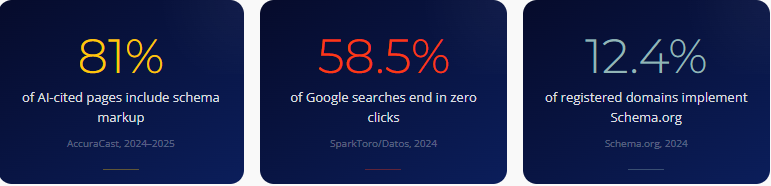
The uncomfortable maths: 81% of web pages receiving AI citations include schema markup. Only 12.4% of registered domains implement Schema.org vocabulary. That is an enormous gap between who is getting cited and who is not even in the conversation.
— AccuraCast study, 2024–2025; Schema.org, 2024
What schema markup actually does (the 60-second version)
Schema markup is code you add to your website that tells machines what your content means, not just what it says.
Your page might say “Dr Sarah Chen, Cardiology, London.” A human reads that and understands it is a doctor, a specialism, and a location. A search engine or AI model sees text. Schema markup translates it into structured, machine-readable data that says: this is a Person, who is a Physician, with a MedicalSpecialty of Cardiology, operating in London.
The format that matters is JSON-LD. It sits in your page’s <head> section. Google recommends it. Microsoft confirmed in March 2025 that it helps their LLMs understand content. ChatGPT confirmed it uses structured data for shopping results in May 2025.
Three platforms. All confirmed. Schema is not optional infrastructure any more. It is the language machines use to decide if you are worth citing.
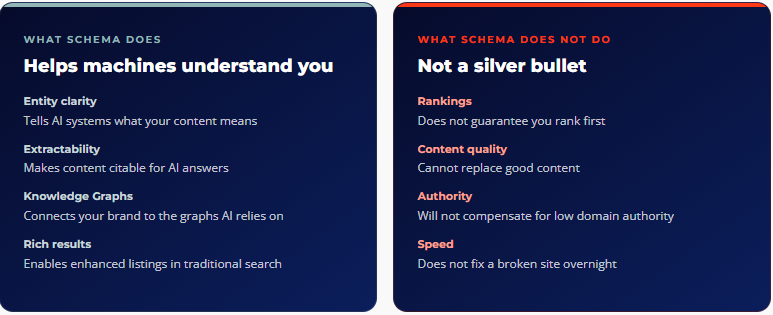
| What schema does | What it does not do |
| Tells AI systems what your content means | Guarantee you rank first |
| Makes your content extractable for AI answers | Replace good content |
| Connects your brand to knowledge graphs | Work if the underlying content is thin |
| Enables rich results in traditional search | Compensate for low authority |
| Feeds the entity relationships AI uses for citations | Fix a broken site overnight |
The AI citation landscape: who gets quoted and why
The question is no longer just “do we rank?” It is “do AI systems trust us enough to cite us?”
That distinction matters because the economics of search have fundamentally shifted. Ahrefs’ December 2025 study found AI Overviews correlate with a 58% reduction in click-through rates for position one. Pew Research found users click traditional results only 8% of the time when AI summaries appear, compared to 15% without them.
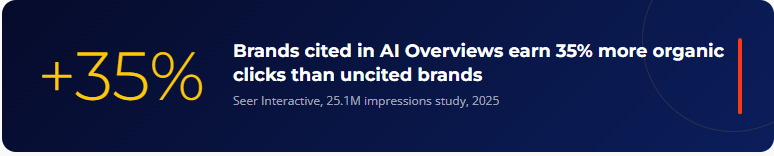
But here is the critical finding. Seer Interactive’s study of 25.1 million impressions across 42 organisations found that brands cited within AI Overviews earned 35% more organic clicks and 91% more paid clicks than uncited brands.
The new dividing line is not rankings. It is citations. Being on page one without being cited in the AI Overview is like having a shop on the high street while an invisible wall redirects all foot traffic to the shop next door.
How each platform selects sources
Each AI platform works differently. But structured data consistently helps across all of them.
| Platform | How it selects sources | Schema’s role | Key stat |
| Google AI Overviews | Draws from Knowledge Graph + top organic results | Schema feeds the Knowledge Graph directly | 80% of citations from top 3 (seoClarity) |
| ChatGPT | 60% from training data; browses Bing for 3–10 sources | Evaluates semantic HTML and structured data | 87% of citations match Bing top 10 (Seer Interactive) |
| Perplexity | Real-time search against 200+ billion URLs | FAQPage schema shows 3.4x more citations | Only 11% of domains cited by both ChatGPT and Perplexity |
| Gemini | Uses Google infrastructure including Knowledge Graph | Google confirmed structured data important for Gemini | Critical for authoritative/regulatory data |
That last row deserves attention. Google said, on the record, that structured data continues to be important for Gemini. Not “might be useful.” Not “we’re looking into it.” Important.
The evidence: does schema actually improve AI visibility?
We are not going to pretend the evidence is simple. It is not. But it is consistent enough to act on.
The studies that support the connection
- AccuraCast (2024–2025): Analysed 2,000+ prompts across ChatGPT, Google AI Overviews, and Perplexity. Found 81% of AI-cited web pages included schema markup. The researchers acknowledged correlation does not equal causation. We appreciate the honesty.
- Search Engine Land controlled experiment (September 2025): Built three near-identical single-page sites. One with strong schema. One with poor schema. One with none. Only the page with well-implemented schema appeared in an AI Overview AND achieved the best organic ranking.
- Schema App entity linking study (October 2025): Implemented entity linking across their own website. Result: 19.72% increase in AI Overview visibility. Client InSinkErator saw a 69% increase in clicks for non-branded queries.
- BrightEdge 16-month study (May 2024–September 2025): AI Overview citation overlap with organic rankings grew from 32.3% to 54.5%. For YMYL content like healthcare and insurance, overlap reached 68–75%.
- Data World benchmark study (published ACM, 2025): LLM accuracy on enterprise questions improved from 16.7% to 54.2% when a Knowledge Graph was used instead of raw databases. For schema-intensive questions, the LLM scored 0% accuracy without a knowledge graph. Zero.

The study that challenges the connection
We would be doing you a disservice if we only shared the good news.
AuthorityTech analysed 500+ brands and found zero correlation between schema completeness and AI citation rates. But they found a 94% correlation between Tier 1 earned media coverage and AI visibility.
Their framing is useful: “Schema tells AI what you’re saying. Earned media tells AI whether you’re worth listening to.”
Our take: Schema is necessary infrastructure. It is not sufficient on its own. Think of it like a well-organised shop. The layout makes it easy for customers to find what they want. But if nobody knows the shop exists, the layout does not matter. You need both. Schema without authority is a beautifully organised library nobody visits. Authority without schema is a respected expert mumbling into their sleeve.
Traditional SEO schema vs AI discovery schema: what has changed
This is where most guides fall short. They treat schema as one thing. It is not.
Traditional SEO schema was about earning rich results. Stars under your product listing. FAQ dropdowns on the SERP. Event dates showing in search. Useful, but decorative. The goal was visual enhancement.
AI discovery schema is about something fundamentally different. It is about making your content understandable, extractable, and citable by machines that are synthesising answers from multiple sources.
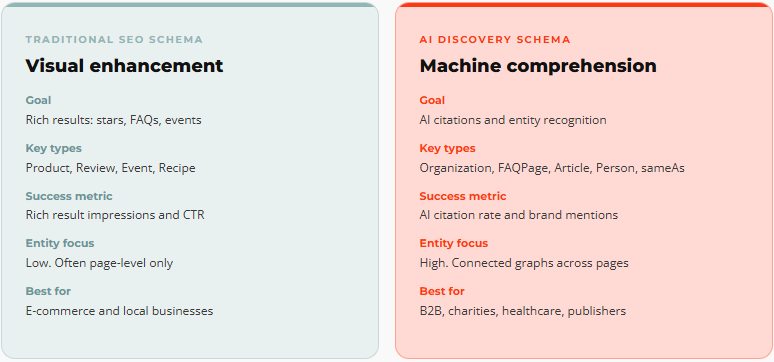
| Dimension | Traditional SEO schema | AI discovery schema |
| Primary goal | Rich results (stars, FAQs, events) | AI citations and entity recognition |
| What it optimises for | Visual enhancement on SERPs | Machine comprehension and extractability |
| Key schema types | Product, Review, Event, Recipe | Organization, FAQPage, Article, Person, sameAs |
| Success metric | Rich result impressions and CTR | AI citation rate and brand mentions |
| Entity focus | Low. Often page-level only | High. Connected entity graphs across pages |
| Knowledge Graph impact | Indirect | Direct. Feeds the graphs AI relies on |
| sameAs usage | Rare | Critical. Links to Wikipedia, Wikidata, LinkedIn |
| Who benefits most | E-commerce and local businesses | B2B, charities, healthcare, publishers |
The shift is not about abandoning traditional schema. Rich results still drive a 20-40% CTR improvement according to multiple studies. Rotten Tomatoes saw 25% higher CTR on pages with structured data. Nestlé saw 82% higher CTR for rich result pages. These are real numbers from Google’s own case studies.
But the additional layer, the AI discovery layer, is where the competitive advantage is compounding. And most organisations have not started building it.
The schema types that matter most for AI citation
Not all schema types are created equal when it comes to AI visibility.
- FAQPage – Pages with FAQ schema are 3.2x more likely to appear in Google AI Overviews (Frase.io) and see 3.4x more Perplexity citations. The optimal answer length for AI extraction is 40-60 words. This is the single highest-impact schema type for answer engine optimisation.
- Organization – Establishes your entity identity. The sameAs property linking to Wikipedia, Wikidata, LinkedIn, and Crunchbase feeds the knowledge graphs AI systems use to assess authority.
- Article / BlogPosting – Provides publication dates, author information, and publisher details. AI systems use datePublished and dateModified to assess recency. 65% of AI bot hits target content published within the past year (Averi.ai).
- Person – Critical for E-E-A-T. Links authors to their credentials, publications, and professional profiles. Only 6.8% of personal branding sites use Person schema.
- HowTo – Structures step-by-step content that AI frequently surfaces for procedural queries. Underused on tutorial pages (only 11% adoption).
Schema by sector: what to implement first
Schema priorities vary by sector. A healthcare trust has different needs from a B2B SaaS platform. Here is what matters most for the sectors we work with.
Charities and non-profits
Adoption is described as “very low” across multiple guides. Which is both the problem and the opportunity.
- Organization (with NGO subtype and NonprofitType enumeration)
- DonateAction – Schema.org has a dedicated type. Almost nobody uses it.
- Event – For fundraisers, galas, and awareness campaigns
- FAQPage – For cause-related questions that donors and supporters search for
- ItemList – For programme listings and beneficiary statistics
B2B technology
SAP partnered with Schema App to scale markup across 4+ million pages and saw 400% growth in rich result organic traffic. That is the benchmark.
- Organization (sitewide, with sameAs to Crunchbase, LinkedIn, Wikipedia)
- SoftwareApplication / WebApplication — With features, pricing, and reviews
- FAQPage – On service pages and product documentation
- Service – Describing what you actually do in structured format
- Person – For thought leaders and technical authors
Healthcare
Google added IndividualPhysician and PhysiciansOffice as new schema subtypes with a unique usNPI property. Only 810 U.S. websites used MedicalCondition schema as of January 2024. The competitive gap in healthcare schema is astonishing.
- MedicalClinic / Hospital – For location and service information
- IndividualPhysician – With credentials, specialisms, and NPI identifiers
- FAQPage – Generated 3,600 clicks and 129,000 impressions in 6 months for one provider
- AggregateRating / Review – Sharp Healthcare saw 119% CTR increase on physician pages
Publishers
- Article / NewsArticle – Eligible for Discover and Top Stories
- Person – Author schema is now essential for E-E-A-T compliance
- Speakable – Beta schema identifying sections suited for text-to-speech
The common thread across every sector: FAQPage schema consistently delivers the highest measurable impact for AI citation. If you implement one new schema type this quarter, make it that one.
The entity graph: why connected schema beats isolated markup
Here is where schema gets genuinely strategic. And where most implementations fall short.
Individual schema types are useful. Connected entity graphs are transformative.
An entity graph links your Organisation to your People, your People to their expertise, your expertise to your content, and your content to external authorities via sameAs and @id properties. This creates a web of machine-readable relationships that AI systems can traverse.
Think of it this way. Isolated schema is like giving someone your business card. An entity graph is like giving them your business card, your CV, your publication history, your professional references, and a map of every expert who has ever cited your work. Which one makes it easier to decide whether to trust you?
The three properties that build your entity graph
- sameAs – Links your brand to Wikipedia, Wikidata, Crunchbase, LinkedIn, and social profiles. This disambiguates entities.
- @id – Creates unique resource identifiers that make your entities referenceable across your entire site and beyond.
- about – Links specific content to Wikidata entity IDs, connecting your articles to the broader knowledge graph.
Schema App measured a 19.72% increase in AI Overview visibility after implementing entity linking. Marshfield Clinic Health System achieved a 32% increase in CTR on physician pages after the same approach. Location-based testing showed a 46% increase in impressions and 42% increase in clicks for non-branded queries.
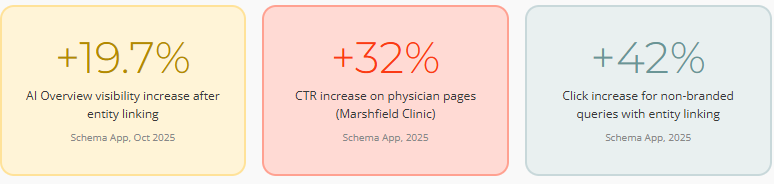
These are not marginal improvements. These are competitive advantages that compound over time.
The zero-click reality and why schema matters more, not less
A reasonable objection: if clicks are declining anyway, why bother with schema?
Because the decline in clicks makes schema more important, not less.
The numbers are stark. SparkToro’s Q1 2025 data shows U.S. organic click rates dropped to 40.3%, down from 44.2% in March 2024. EU/UK organic click rates dropped to 43.5%. Searches triggering AI Overviews show a zero-click rate of approximately 83%.
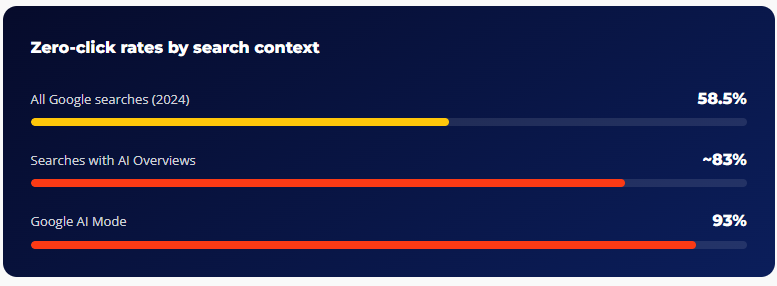
| Search context | Zero-click rate | What schema enables |
| All Google searches (2024) | 58.5% (SparkToro/Datos) | Rich results capture 58% of remaining clicks vs 41% for non-rich |
| Searches with AI Overviews | ~83% (Click-Vision) | Cited brands earn 35% more organic clicks (Seer Interactive) |
| Google AI Mode | 93% (Exposure Ninja) | Entity recognition and Knowledge Graph presence |
Reframe the metric. If you are still measuring schema success purely by organic clicks, you are using yesterday’s scoreboard. Track AI citations, brand mentions in AI responses, Knowledge Panel accuracy, and rich result impressions alongside traditional traffic.
The GEO connection: why schema is foundational to generative engine optimisation
If you are thinking about generative engine optimisation, schema is not a nice-to-have bolt-on. It is foundational infrastructure.
The Princeton GEO research paper (published at KDD 2024, 10,000 queries) found that GEO methods can boost visibility by up to 40% in generative engine responses. The “Cite Sources” method produced a 115.1% increase for sites ranked 5th. Keyword stuffing was counterproductive, performing 10% worse than baseline.
Schema supports GEO in three specific ways:
- Entity disambiguation – AI systems need to know exactly what you are and what you do. Organization, Person, and Service schema provide that clarity. Without it, you are relying on the AI to figure it out from unstructured text. Which is like hoping someone reads your handwriting correctly on a prescription. Possible. Not ideal.
- Content extractability – FAQPage, HowTo, and Article schema structure your content into formats AI can easily extract and cite. The optimal answer snippet length is 40–60 words. Schema tells the AI exactly where those snippets are.
- Authority signalling – sameAs properties connecting to Wikipedia, Wikidata, and professional databases feed the knowledge graphs that AI uses to assess credibility.
This is equally true for traditional SEO. Schema does not replace your SEO strategy. It strengthens it. Google’s own data shows rich results drive 25–82% higher CTR depending on implementation. The two disciplines are complementary, not competing. Which is exactly why we argue SEO and GEO work better together.
Common mistakes: what goes wrong with schema implementation
Most schema implementations fail not because the concept is wrong but because the execution is sloppy. Here are the mistakes we see most often.
- Markup that does not match visible content. Schema referencing hidden or collapsed content. Google may issue manual actions for this.
- Missing required properties. No name or price for Product schema. No startDate for Event schema. Validation tools catch this instantly, yet it persists.
- Conflicting or duplicate markup. CMS plugins auto-generating schema that conflicts with manually added markup. Two versions of Organization schema arguing about who you are.
- Wrong schema types. Using Article for Product pages. Using generic Organization instead of industry subtypes like NGO, Hospital, or SoftwareApplication.
- No entity connections. Isolated schema with no sameAs, @id, or about properties. Individual pages talking about themselves but never connecting to the broader knowledge graph. This is the most common and most costly mistake.
- Implementing once and forgetting. Schema is not a one-time deployment. Google deprecated FAQ rich results for most sites in 2023. Dataset rich results retire in January 2026. John Mueller confirmed schema types “come and go.” Ongoing maintenance is essential.
Your schema action plan: what to do this quarter
Enough theory. Here is what to actually do.
Phase 1: Audit and fix (Weeks 1-2)
- Run your top 20 pages through Google’s Rich Results Test and Schema Markup Validator
- Fix all errors and warnings in existing schema
- Check for duplicate or conflicting markup from CMS plugins
- Ensure Organization schema is consistent across your entire site
- Verify all required properties are present for each schema type
Phase 2: Build your entity foundation (Weeks 3-4)
- Implement or update Organization schema with sameAs links to Wikipedia, Wikidata, LinkedIn, Crunchbase, and social profiles
- Add Person schema for key authors and leaders, linking to professional profiles and credentials
- Create @id identifiers for your primary entities (organisation, people, services)
- Link content pages to entity IDs using the about property
Phase 3: Expand for AI citation (Weeks 5-8)
- Add FAQPage schema to your top 10 service and content pages. Keep answers to 40-60 words.
- Implement Article/BlogPosting schema with datePublished, dateModified, and author references
- Add sector-specific schema types (MedicalOrganization, NGO, SoftwareApplication) as appropriate
- Build HowTo schema for any step-by-step or process content
- Request indexing via Google Search Console URL Inspection for updated pages
Phase 4: Monitor and iterate (Ongoing)
- Review Google Search Console Enhancement Reports monthly
- Track AI citations using tools like Siftly, AirOps, or manual prompt testing
- Monitor Knowledge Panel accuracy and completeness
- Update schema when Google adds or deprecates types
- Expand to new pages as content is published
Frequently Asked Questions (FAQs)
Author information
 With 15 years of hands-on SEO and digital marketing experience, agency director Ash is the driving element behind our digital team. Ashley heads our digital execution team, delivering innovative strategic and tactical marketing initiatives and campaigns; helping propel our clients’ growth and success.
Learn more about Ashley Salek, Agency Director, Seventh Element