Open ChatGPT and ask it: “What is the best UK charity supporting young people leaving care?” Then try the same question in Gemini, Perplexity and Claude. Notice three things. First, each gives a different answer. Second, the answers contain real charities, hallucinated charities, and outdated information in roughly equal measure. Third, your charity might be in the answer. It might not. There is no obvious pattern explaining which is which.
Now do the same exercise for “UK youth charity with lowest admin costs”. And “best UK food bank to donate to”. And “small UK mental health charity making a real difference”. These are not edge-case queries. They are exactly the questions a thoughtful donor types into the box when they have £20 to give and want to think about it for ten minutes before they do.
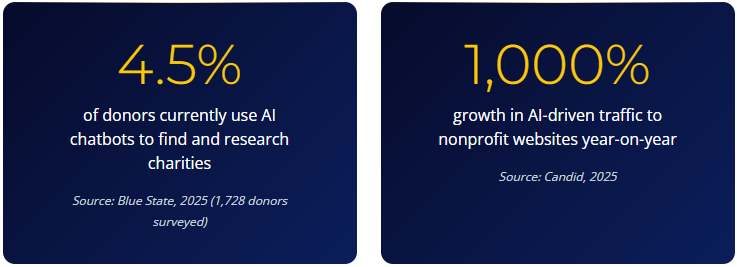
Today, that thoughtful donor mostly does not type those questions into ChatGPT. Today, they type them into Google. The volume of donors using AI to research causes is small. Blue State’s 2025 study put it at 4.5%. The trajectory, however, has stopped being theoretical. AI-referred traffic to nonprofit websites grew 1,000% year-on-year between 2024 and 2025. The growth rate is the part charities should be planning around. Not the absolute number today.
| Donor Research, Pre-LLM | Donor Research, LLM-Era | What Changes |
|---|
| “Best UK youth charity” Google search, 10 blue links | “Best UK youth charity” ChatGPT prompt, one synthesised answer | You are no longer competing for clicks. You are competing for citation. |
| Donor reads 3-4 charity websites, decides | Donor reads one AI summary, optionally drills in | Top-of-funnel discovery moved upstream of your site |
| Charity Navigator / Candid look-up after shortlist | AI cites those sources directly inside the answer | Third-party authority signals matter more, not less |
| Visibility = Google ranking + brand recognition | Visibility = entity recognition + structured data + third-party citation | The signals are different. Most charities have not adjusted. |
| Errors are donor’s own assumptions | Errors are AI hallucinations attributed to your name | Wrong facts about your charity now travel at scale |
The point of this article is not panic. UK charities have bigger immediate problems than AI invisibility. Cost-of-living, government grants down £1bn a year in real terms, donor numbers down nearly 10% in 12 months. AI is the third or fourth thing on the list. The reason it matters now is that the things you do to fix it (clearer About pages, structured data, transparent impact reporting) also fix donor trust, search ranking and conversion. The work compounds. It also takes 12 to 18 months to compound. Which is why you start now.
It Is Not Mass Behaviour Yet (the honest counterpoint)
Some context up front, because nothing about charity fundraising is helped by exaggeration. The Blue State 2025 study of 1,728 donors found 4.5% currently use AI chatbots to find or research causes. Candid analysed 24 nonprofit websites and found AI-driven traffic accounted for just 2% of total traffic between January and October 2025. That is the number. Two per cent.
Two per cent is small. It is also growing at 1,000% a year. Both things are true. Charities planning a five-year digital strategy that assumes today’s two per cent is the ceiling will be planning for the wrong world. Charities pretending the trend does not matter because the absolute number is small are making the same mistake the high street made about online shopping in 2003.
Here is the part that matters more than the volume number. AI-referred visitors to nonprofit sites stay 70% longer than other visitors. They donate at one-eighth the rate. When they do donate, the average gift is $250 (Candid, 2025). The audience arriving via AI is small, slow to convert, and high-value when it converts. That is a pattern worth understanding before it becomes a pattern worth defending against.
Read the AI-referred visitor profile in plain language: someone who took the time to ask a question carefully, read the AI’s answer, was interested enough to click through to your website, and had enough conviction to give a substantial gift when they did. That is a major-donor profile, just smaller and earlier in the journey than the major-donor team typically sees.
What ChatGPT Says When You Ask About Your Charity (try it)
Ask ChatGPT: “What does [your charity name] do?” If the answer is correct, congratulations. If the answer mixes you up with a similarly named organisation, dates your work to a programme that ended in 2019, attributes a campaign you did not run to your name, or quietly invents a beneficiary count, you have just found your AI visibility problem in 30 seconds.
Then ask: “What is [your charity]’s admin overhead percentage?” If the AI gives a confident number that does not appear anywhere on your website or your latest accounts, that number is a hallucination. It will be repeated to other donors. It will be cited as if it is fact. You have no way of knowing how often it has been quoted.
Hallucination rates have fallen sharply (from approximately 38% in 2021 to 8.2% in 2026 across general LLMs). They are still high enough that any specific factual claim about a small or mid-sized UK charity has a meaningful chance of being wrong. The remedy is not to wait for hallucinations to fall further. The remedy is to make the right facts so easy to find that the AI does not have to guess.
The Goodside analysis of charity AI visibility puts it bluntly. A homepage that says “we provide holistic support to vulnerable people” does not get cited. A homepage that says “we provide emergency housing support to young people aged 16 to 25 in West Yorkshire” does. AI rewards specificity. Named locations. Named demographics. Named numbers. The same things, incidentally, that donors say they want to see before giving.
Wikipedia, Charity Navigator and the Long Shadow of Existing Data
AI systems are not neutral about where they get their information. Wikipedia accounts for 18.4% of citations across AI systems. YouTube, around 23%. Google.com, 16.4%. The top 10 most-cited domains capture more than half of all AI citations across industries (Surfer SEO, 2025). For charity-related queries specifically, Charity Navigator and Candid (formerly GuideStar) are heavily weighted in US-centric AI responses. Perplexity formally integrated Charity Navigator widgets for nonprofit queries in 2025. The UK does not have an equivalent, which is its own challenge for British charities.
What this means in practice: if your charity is on Wikipedia, you have a meaningful AI visibility advantage. If your Charity Commission filing is detailed and current, you have a meaningful advantage. If your website data, your Wikipedia entry and your Charity Commission entry all say the same thing in machine-readable formats, you have a major advantage.
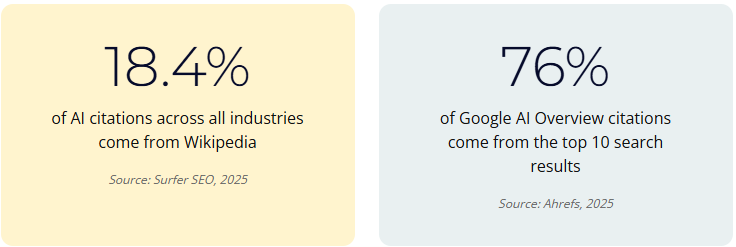
Two things follow from these numbers. First, AI visibility and traditional search visibility are not separate disciplines. The site that ranks well in Google is the site AI systems are likely to cite. Foundational SEO services for charities are not an alternative to AI optimisation. They are the precondition for it. Second, Wikipedia is the single most-cited general source. If your charity is notable enough to support a Wikipedia entry under their notability criteria, that is one of the highest-leverage investments you can make.
The AI-Ready Donation Funnel
This is the framework we use when auditing a charity’s AI readiness. Six components. Each one is concrete. Each one improves donor trust as well as AI visibility. The work is not glamorous. It compounds.
1. The machine-readable About page
Your About page is the primary source AI uses to describe your charity. It needs to contain, in plain text, the following: registered charity number, year of registration, named legal entity, registered address, primary geographies served, named beneficiary groups, mission in plain language, programme names, scale of impact in numbers. Wrap the page in Schema.org Organization or NGO markup. Add Person schema for trustees and senior leadership. The page should read naturally for a human and parse cleanly for a machine.
2. Schema.org NGO and DonateAction markup
Schema.org has explicit types for non-profits: schema.org/NGO, schema.org/Organization with NonprofitType, and schema.org/DonateAction for donation pages. The DonateAction type takes recipient, agent, price options, currency, and target URL. Implementing it on every donation page is a one-day technical task. Schema adoption among UK charities is unmeasured publicly, which is itself the finding: most are not doing this. The early adopters get disproportionate visibility.
3. Specificity in your impact content
Replace “supporting vulnerable communities” with “supporting 1,247 unaccompanied minors aged 13-17 across South London”. Replace “global reach” with “active programmes in Kenya, Sierra Leone and Bangladesh”. Replace “improving lives” with “delivering 38,000 mental health crisis interventions in 2024”. The specificity makes you citable. It also makes donors trust you more. Both audiences are looking for the same thing.
4. The transparency hub
One page that aggregates: Charity Commission registration number with a link to the register, audited accounts for the last three years, annual impact reports, named trustees, governance documents, fundraising regulator membership, FRSB or CIOF code statement. 53% of UK donors say “most donations reach the cause” is the single most important driver of trust (Charity Commission, 2025). 39% cite “transparency on fundraising and spending”. The transparency hub answers both. It is also exactly the page AI systems look for when asked about admin costs and accountability.
5. FAQPage schema covering the questions AI is asked
Add an FAQ section to your About, donation and impact pages. Use FAQPage schema. The questions to cover are exactly the ones donors ask AI: how much of my donation goes directly to the cause, what is the admin overhead, who are your trustees, where does the money go, how do I know my gift will make a difference. Answer each one in 40-60 words, in plain language, with the schema markup wrapping it. FAQPage-marked pages are 3.2x more likely to appear in Google AI Overviews (Frase, 2025).
6. External authority signals
Cited mentions on BBC, Guardian, Charity Commission features, sector publications, regulator listings, awards. These are E-E-A-T signals (Experience, Expertise, Authoritativeness, Trustworthiness) that AI systems use to triangulate whether you are a real, credible organisation. Earned PR is now also a search function. The journalist who quotes your CEO in a Guardian piece on care leavers is also building your AI visibility.
The full framework is the actionable piece behind this article. Implementing it across the six components takes a competent charity digital team approximately two to three quarters. The visibility gains compound over the following 12 months. This is also the territory generative engine optimisation services exists to operate in: translating mission-led organisations into the structured data layer AI now uses to choose who to cite.
People are asking Gemini which charities have the lowest admin costs. If your data is not structured, the AI will guess. Or recommend someone else.
The Counterpoint: The Bigger Crisis Is Cost of Living
An honest framing. The dominant fundraising challenge facing UK charities in 2026 is not AI visibility. It is the macro environment. Public donations dropped nearly 10% between 2024 and 2025 (CAF UK Giving). Only 50% of people gave at all in 2024, down from 58% in 2019. Among 16-24-year-olds, the number is 36%, down from 52%. That is approximately four million fewer UK donors than there were five years ago. The reason cited overwhelmingly: cost of living.
22% of UK charities reported operating deficits in 2023. Government grants are down approximately £1bn a year in real terms since 2020. More than 20 UK charities closed or restructured in the first half of 2025. The sector’s average digital maturity score is 5.1 out of 10. Only 44% of UK charities have a digital strategy at all (Charity Digital Skills Report 2025).
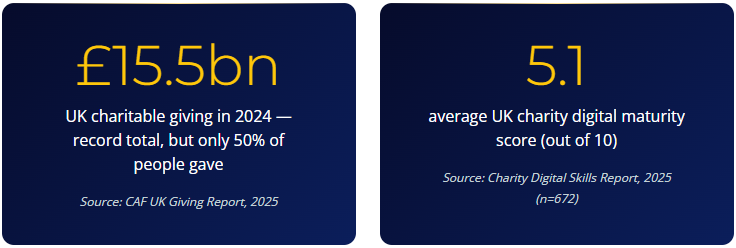
This is the context AI fundraising sits inside. Not separately from it. The argument for the AI-Ready Donation Funnel is not that AI is the biggest problem. It is that the work strengthens the things that matter for the bigger problems too. A clearer About page is better for AI and for donor trust. Schema.org markup helps AI and traditional search. A transparency hub builds the trust that drives 53% of giving decisions. Specificity in impact reporting helps donors and AI in the same edit.
Charities that pretend AI is the urgent crisis are misreading the room. Charities that pretend it does not matter are setting up the next decade’s invisibility. The right framing is: this is one of the foundations the next decade of digital fundraising will rest on. Build it now while the cost is low and the competition is light.
What the Trust Data Says (and Why It Aligns)
The 2025 Charity Commission Public Trust report is unambiguous: 57% of UK adults have high trust in charities (rated 7-10 out of 10), with a mean score of 6.5. The sector ranks second only to doctors. The trust has not collapsed despite a difficult macro environment. Trust is the asset.
What drives that trust is also documented. 53% of donors cite “most donations reach the cause” as the most important factor. 39% cite “transparency on fundraising and spending”. 60% of donors say seeing impact motivates them to give again. Only 36% of nonprofits provide regular outcome updates while 65% of donors expect them. Nonprofits with a Candid Seal of Transparency receive 53% more in contributions.
The signals AI uses to decide whether to cite you are the same signals donors use to decide whether to trust you. Specificity. Transparency. Verifiable identity. Named outcomes. Built into structured data once, the same work earns you both the citation and the gift.
Read those numbers next to the AI visibility findings and the strategic alignment becomes obvious. The signals AI systems use to decide whether to cite a charity are the same signals donors use to decide whether to trust one. Named impact. Verifiable identity. Transparent finances. Specific beneficiaries. The frameworks happen to overlap because both systems (algorithmic and human) are looking for the same underlying thing: evidence that the organisation is real, capable and accountable.
This is why the work matters even if AI search adoption stalls at 5% rather than growing to 50%. The same investments improve every other channel. Charity SEO improves. Direct response conversion improves. Donor retention improves. Stewardship metrics improve. The AI-Ready Donation Funnel is, in the most boring possible sense, a checklist for being a more legible charity. Legibility is the underrated fundraising skill of the next decade.
For the broader strategic context, see the Fuel Room for our work on AI search and demand generation, and our overview of AI-powered content systems for mission-led organisations.
Where to Start (and Where Not To)
If your charity has a digital team of one and a fundraising target to hit by March, the temptation is to put this article in the “interesting, not urgent” tray. Resist that tray. The action plan below sequences the work so that the cheapest, highest-impact items come first. None of this requires a large budget. Most of it requires editorial attention and a single sprint of technical work.
Where not to start: do not commission a “Charity ChatGPT plugin” or an AI chatbot for your website. The fundraising sector has been quietly littered with shiny AI initiatives that solve no actual donor problem. The leverage is not in deploying AI. The leverage is in being legible to the AI systems donors are increasingly using to find you.
Your AI-Ready Donation Funnel: 10-Point Audit
✓ Test what AI says about your charity now.
Ask ChatGPT, Gemini, Perplexity and Claude: “What does [your charity name] do?” and “What is [your charity]’s admin overhead?” Document every error. This is your baseline.
✓ Audit your About page for specificity.
Replace “supporting vulnerable people” with named locations, named demographics, named numbers. AI rewards the same specificity donors trust.
✓ Implement Schema.org Organization or NGO markup.
Include charity registration number, registered address, contact details, named trustees. One day of technical work. Disproportionate visibility impact.
✓ Add DonateAction schema to every donation page.
Recipient, currency, suggested amounts, target URL. Tells AI exactly what your donation pages are and lets them be referenced as such.
✓ Build a transparency hub.
One page aggregating Charity Commission registration, audited accounts, impact reports, governance documents. The page that answers the “how much reaches the cause?” question with evidence.
✓ Add FAQPage schema to your most-asked donor questions.
Cover admin overhead, how donations are spent, trustee accountability, impact measurement. 40-60 word answers, schema-marked. 3.2x more likely to appear in AI Overviews.
✓ Audit your Charity Commission filing.
Make sure the public-facing description on the register matches your website. AI systems triangulate. If the two disagree, the register usually wins.
✓ Assess Wikipedia notability.
Independent media coverage, named programmes, named locations, audited reach. If you meet Wikipedia’s criteria, pursue an entry. Wikipedia accounts for 18.4% of AI citations.
✓ Build PR alongside fundraising, not separately.
Earned mentions on BBC, Guardian, sector publications and regulators are now AI visibility signals. Treat journalist relationships as a fundraising channel.
✓ Repeat the test in 90 days.
Re-run the AI prompts from step one. Document the changes. The signal you are looking for is fewer hallucinations, more correct details, your charity appearing in answers it did not appear in before.
Frequently Asked Questions
Make your donation pages discoverable. Not just findable.
Free AI-readiness audit for your charity. We will tell you what AI sees when a donor asks about you, and what to fix first.
Sources