Open the analytics on your most expensive piece of content. The ultimate guide. The one that took a month. Three rounds of revisions. Internal reviews. A graphic designer. 5,400 words. The one at the top of the content hub that the team still points at in new business meetings.
Look at scroll depth. Look at time on page. Look at where people dropped off. The reader got to roughly the 1,600-word mark. That is the polite version. The less polite version is that most of them never made it past the intro. They landed, scanned the first two headings, found the answer or didn’t, and left. The other 3,800 words exist for nobody. They were written for Google in 2019, when Google still rewarded length as a signal of depth. 2019 is gone. The signals have moved. Most content calendars have not.
This is not an argument against depth. Depth still wins. The argument is that the monolithic 5,000-word guide, delivered as one continuous wall of prose, is now the wrong container for depth. It was always a compromise between what readers want (answers) and what algorithms historically rewarded (comprehensive coverage). The compromise no longer works. Because algorithms have changed. Because readers have always scanned. And because AI does not read the way Google used to read.
| The Ultimate Guide (2019) | Answer Architecture (2026) | What Changed |
|---|
| 5,000 words, one URL, one topic | 12 pages of 600-900 words, one cluster | AI extracts chunks. Give it extractable chunks. |
| Optimised for “comprehensive coverage” | Optimised for specific answer extraction | 53% of AI citations are under 1,000 words |
| Long intro, table of contents, conclusion | Direct 40-60 word answer under each question heading | Readers do not want preamble. AI does not cite it. |
| Success = ranks #1 on a head keyword | Success = cited in AI Overviews across dozens of queries | Position #1 CTR drops 58% when AIO appears |
| Measured by traffic | Measured by citation, conversion, pipeline | Clicks are fewer. The ones you get convert 5x higher. |
You are not writing articles any more. You are writing extractable answer units that happen to be published as pages. The faster your team accepts that, the faster you start appearing in the search environments that are growing. The longer you cling to the ultimate guide format, the more time you waste producing content that AI systems scroll past.
The Ultimate Guide Was a 2019 SEO Play (and 2019 Is Dead)
The ultimate guide format made sense when it was invented. Backlinko’s 2016 analysis of 912 million blog posts found that content over 3,000 words earned 77% more referring domains than content under 1,000. HubSpot was building its empire on pillar pages. Every agency in the world was telling clients to “publish the definitive resource on your topic”. The logic was sound. Long form signalled depth. Depth signalled authority. Authority signalled trust. Trust signalled rank.
Then Google started answering questions directly in the results page. Then featured snippets. Then AI Overviews. Then AI Mode, which gives an answer and sometimes offers sources afterwards as a courtesy. And the ground under the ultimate guide started moving.
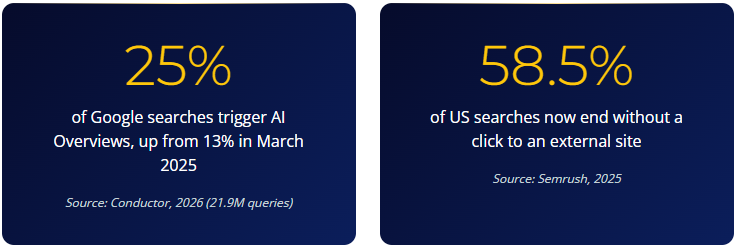
For certain query types the change is dramatic. Education queries went from 18% AIO trigger rate to 83%. B2B tech queries jumped from 36% to 82%. Restaurant queries from 10% to 78% (Conductor / Superlines, 2026). If your audience asks “what is” or “how does” questions, the AI summary is probably showing up for nine out of ten of them.
The ultimate guide was built to win those queries. It no longer wins them. The guide ranks, the AI summary appears above it, the reader gets the answer, and the click never happens. That is not a ranking problem. That is a category problem. The category is now “content that earns citation” and “content that does not”. The length of your guide is not the variable.
What Happened to HubSpot (The Canary in the Coal Mine)
HubSpot invented the modern pillar page. They wrote the playbook. They gave it to the industry for free. Between 2019 and 2023 they built one of the largest content libraries on the commercial internet, most of it structured as 3,000+ word ultimate guides anchoring topic clusters. It worked brilliantly. Until it did not.
HubSpot’s organic traffic went from 24.4 million monthly visits in March 2023 to 6.1 million in January 2025 (The Flock, 2025). A 75% collapse in under two years. In November-December 2024 alone, they lost nearly 5 million monthly visits. The blog that used to drive the majority of their leads now accounts for about 10% of them. Their CEO, Yamini Rangan, told investors organic search was “declining globally” because “AI overviews are giving answers, and fewer people are clicking through to websites”.
The company that invented the modern pillar page lost 75% of its organic traffic in two years. If HubSpot’s 2019 content strategy could not survive AI search, yours cannot either. Yours was just ten metres behind theirs on the same cliff.
The lesson is not that content is dead. HubSpot still matters. They now publicly claim to be the most-cited CRM in LLM responses. They pivoted. But the 20,000 ultimate guides they published between 2017 and 2023 are a cautionary tale, not a playbook. The playbook that built them stopped working the moment the underlying search behaviour changed. Most organisations are currently building the playbook HubSpot already abandoned.
The Numbers That Killed the Monument
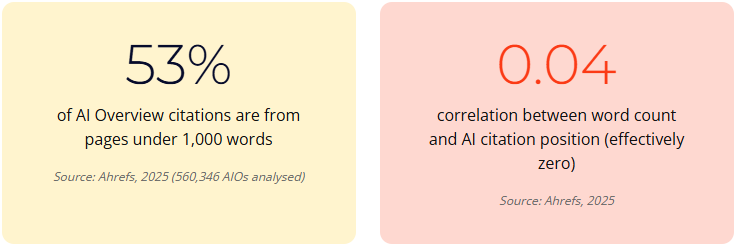
The most useful piece of research in the last year on this question is Ahrefs’ analysis of 560,346 AI Overviews and 1.6 million cited URLs. The findings should be printed out and stuck on the desk of anyone still planning a 5,000-word guide.
53.4% of AI Overview citations came from pages under 1,000 words. Only 16% came from pages over 2,000 words. The average cited page was 1,282 words. The average organic-ranking page was 1,188 words. Essentially the same. The correlation between word count and citation position was 0.04. Statistical noise. There is no length advantage. There never was, probably. There is definitely not one now.
Here is where the story gets useful. What does matter, according to Geneo’s citation research, is section length. Pages with 120-180 word sections between headings receive 70% more ChatGPT citations than pages with fragmented or padded sections. AI systems read content as chunks. They are looking for the extractable unit. If your content is structured so that each heading is followed by a self-contained 120-180 word answer, AI can lift it cleanly. If your content is a river of prose that runs for 800 words between headings, AI gives up and finds someone else’s version.
This is why the ultimate guide fails even when the topic is good. The sections are too long. The transitions are too conversational. The content is structured for humans who will supposedly read it start to finish, which they never do anyway. The AI sees a wall. It moves on.
You are optimising for the wrong unit. The page is not the unit. The section is. Every heading is a query. Every paragraph under it is an answer. Every answer is either extractable or ignored. Rewrite your content with that in mind and your AI visibility changes inside a quarter.
27% Scroll Depth: What the Reader Actually Does
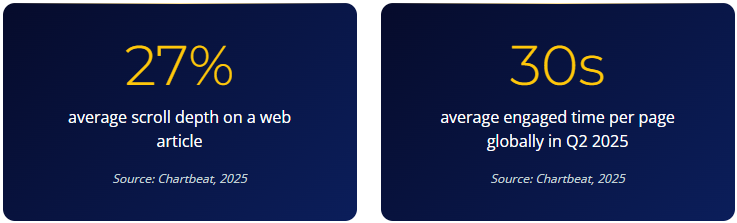
While we are being honest about who reads the ultimate guide, let us talk about how much of it gets read. Chartbeat’s global analytics data puts average engaged time on a page at about 30 seconds. Average scroll depth on a web article sits at roughly 27%. That is not a lapse in reader discipline. That is how reading on the web has worked for twenty years. Nielsen Norman Group named the F-pattern of web reading in 2006 and it is still the dominant reading behaviour in 2026.
Your 5,400-word guide is being scanned, not read. The reader is looking for the specific piece of information they arrived for. If they find it in the first two headings, they leave. If they do not find it, they also leave. In both cases, 4,000 words of carefully researched, carefully edited, carefully optimised content is seen by nobody.
The content-marketing industry has spent a decade writing for an imaginary reader who sits down, pours a coffee, and works through the guide methodically from introduction to conclusion. That reader does not exist. That reader never existed. The people who write ultimate guides are writing for a version of themselves that they hope lives somewhere in their target audience. It does not. Your target audience is on mobile, on lunch, between meetings. They want the answer. They do not want your build-up.
You did not write an ultimate guide. You built a cathedral. AI wanted a vending machine. The reader wanted an answer. Both of them left.
The Answer Architecture Model
This is the framework we use when we rebuild a client’s content operation around AI citation and answer extraction. It does not require throwing away the depth. It requires restructuring the delivery.
Step 1: Unbundle the guide into answer pages
Take the ultimate guide. Read the H2s. Each one is almost certainly a separate query that deserves its own page. A 5,000-word guide with 10 H2s becomes 10 dedicated answer pages of 600-900 words each. They interlink. They share a pillar. They cover the same topic. But each one answers a specific question directly, at the top, in 40-60 words, with supporting detail below.
This is not extra work. It is the same work, restructured. You already wrote 5,000 words. You are now arranging them for a world where AI is the first reader and humans are the second.
Step 2: Put the answer first
Under every H2, the first paragraph is the direct answer in 40-60 words. No build-up. No “in this section, we will explore”. The answer. If someone lands on the page from an AI citation, they see the answer immediately. If the AI lifts the paragraph into an Overview, the answer travels cleanly. This is not dumbing down. This is respecting the reader’s time and the AI’s extraction logic simultaneously.
| Element | Ultimate Guide Approach | Answer Architecture Approach |
|---|
| Opening under H2 | “In this section, we will explore…” | Direct 40-60 word answer, no preamble |
| Section length | 500-1,000 words between headings | 120-180 words per sub-section, clear breaks |
| Structure | Narrative flow from intro to conclusion | Self-contained answer blocks, interlinkable |
| Schema | Usually Article only | Article + FAQPage + HowTo where relevant |
| Success metric | Traffic to one URL | Citations across cluster, conversion per page |
Step 3: Structure for chunkability
AI systems do not read the page. They parse it. Headings tell them what each section is about. FAQ schema tells them what question each answer responds to. HowTo schema tells them the sequence of a process. Every structural signal you add makes the content easier to extract. Pages with FAQPage schema are 3.2x more likely to appear in AI Overviews (Frase, 2025). 28% higher citation rates have been measured specifically for FAQPage-marked content (Am I Cited, 2025).
There is a counter-study from Search/Atlas (December 2024) that found no correlation between schema coverage and AI citation. Worth mentioning for the sceptics. The practical position: schema is cheap to add, the evidence leans positive, the downside is negligible. Add it.
Step 4: Build the cluster, not the monument
The 10 answer pages that replace the old ultimate guide interlink tightly. Each one links to the others where relevant. Each one links to the cluster hub. The hub is no longer a 5,000-word article. It is a directory: here is every question we can answer on this topic, each with its own dedicated page. Topic clusters still drive roughly 30% more organic traffic and hold rankings 2.5x longer than standalone content (HireGrowth analysis, 2025). The cluster model was never the problem. The size of the pieces within it was.
This is what answer engine optimisation actually looks like when it is executed. Not “add a FAQ at the end”. A fundamental change in how content is structured, measured and architected.
Where Long-Form Still Wins (the honest counterpoint)
Long form is not dead as a concept. It is dead as a default. There are three cases where depth delivered at scale still wins.
The first is backlinks. Backlinko’s study of 912 million blog posts found content over 3,000 words earns 77% more referring domains. BuzzSumo’s 2025 analysis put long-form at 3x more backlinks on average. If your content strategy is partly a link-building strategy, long-form research-heavy pieces still earn links. Original data. Definitive industry reports. White papers. These are long-form assets that function as link magnets and thought leadership. Different job. Different format. Keep them.
The second is genuine reference content. A complete legal guide to UK data protection. A comprehensive breakdown of NHS procurement frameworks. When a reader needs to know everything, and there is no short answer, long form earns its place. The test: is there a short answer that works? If yes, write the short answer. If no, write the long one.
The third is brand authority. Content that makes the reader think “these people genuinely know this subject” can be long. Chartbeat’s data shows engaged time continues to rise with word count up to approximately 4,000 words, when the piece is well structured. Note: “well structured”. Not a wall of text. The engagement exists when the content has clear headings, strong pacing and genuine insight. It disappears when the content is long for the sake of being long.
The argument is not that length is bad. The argument is that length as a proxy for quality is dead. Write long when the subject requires it. Write short when the answer is short. Stop writing long because your 2019 content calendar said “ultimate guide” in the title field.
The Visitor Quality Paradox
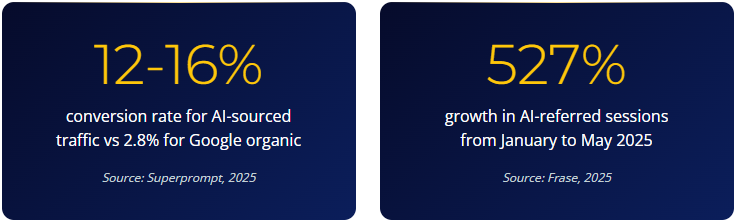
Here is the part that most “AI is killing content” posts miss. Clicks are down. Quality is up. AI-sourced traffic converts at 12-16% against 2.8% for traditional Google organic. That is 5 to 23 times higher depending on the source. 73% of AI traffic converts on first session compared to 23% from standard search (Superprompt, 2025). AI-sourced customers show 67% higher lifetime value and 73% lower churn (Rank.bot, 2025). Ahrefs reported that 0.5% of their traffic came from AI search but drove 12.1% of their signups.
Fewer visitors. Each one is worth dramatically more. The visitor has been pre-filtered by the AI: they did not click because they were casually browsing. They clicked because the AI summary was not enough. They wanted the depth. They wanted the source. They arrived ready.
Brands cited in AI Overviews also earn 35% more organic clicks and 91% more paid clicks than those not cited (Seer Interactive, 2025). Citation is a multiplier across every channel. Not being cited is a penalty that compounds. The ultimate guide does not earn citations because AI cannot extract cleanly from it. The answer cluster does. That is the whole game.
This is why the rebuild matters now, not in 2027. AI-referred sessions grew 527% in the first five months of 2025. The behaviour shift is accelerating. The window to build answer architecture before competitors do is closing every quarter. Our generative engine optimisation services exist for exactly this moment: translating the old content estate into something the next generation of search will actually cite.
What to Do With Your Existing Guides
Do not delete them on a Monday morning. Audit first.
Pull every long-form piece over 2,500 words. For each one, document: current organic traffic, current AI citation status, backlink profile, commercial value. Then sort into three piles.
- Still earning. Backlinks, steady traffic, pipeline contribution. Keep. Restructure internally into clearer sections with 40-60 word answers under each heading. The structural surgery, not the demolition.
- Dormant but valuable. Real depth of expertise, no current performance. Break into an answer cluster. The 5,000 words becomes 8-10 pages of 600-900. The pillar becomes a directory. The authority is preserved, the distribution is rebuilt.
- Zero value. No traffic, no links, no genuine expertise. Consolidate, 301-redirect or delete. Thin and abandoned long-form content is actively damaging site authority. Removing underperforming content has been shown to improve overall ranking performance.
The team will protest. People are attached to the pieces they spent weeks writing. The attachment is not the business. The audit is the business. Browse the Fuel Room for more on how the ground has shifted, and consider where AI-powered content systems fit into the rebuild.
Your Action Plan: Answer Architecture Rebuild
- Audit your existing long-form. Pull every piece over 2,500 words. Document organic traffic, AI citation status, backlinks and commercial value. Sort into “keep”, “rebuild” and “retire”.
- Pick one pillar to rebuild first. Take your single most important ultimate guide. Unbundle its H2s into 8-12 dedicated answer pages of 600-900 words each.
- Rewrite every section as an answer. 40-60 words directly under each H2. No preamble. The answer. Supporting detail follows.
- Add structural signals. FAQPage schema where questions appear. HowTo schema where processes appear. Article schema across the board.
- Measure citation, not just traffic. Track brand mentions in ChatGPT, Perplexity and Gemini for your target queries.
- Retire dead weight. Long-form pieces with no traffic, no links and no unique expertise are actively damaging site authority.
- Stop commissioning new ultimate guides. Brief every new piece as an answer cluster from the start.
Frequently Asked Questions
Get discovered by AI. Not just indexed by Google.
Free answer architecture audit. Find out which of your pages are earning citations and which are just taking up space.
Sources
- Ahrefs (2025) – 53.4% of AI Overview citations are from pages under 1,000 words; correlation between word count and citation position is 0.04 (560,346 AIOs analysed)
- Conductor / Superlines (2026) – 25.11% of searches trigger AI Overviews, up from 13.14% in March 2025; education queries went from 18% to 83%
- Semrush (2025) – 58.5% of US searches end without a click; 83% zero-click rate on AIO queries
- Seer Interactive / Search Engine Land (2025) – Organic CTR on AIO queries dropped 61%; brands cited in AIOs earn 35% more organic clicks and 91% more paid clicks
- Ahrefs (2025) – Position #1 sees 58% CTR reduction when AI Overview present
- Chartbeat (2025) – Average engaged time globally: 30 seconds in Q2 2025
- Chartbeat via Matt Jackson – Average scroll depth on web articles: 27%
- Geneo (2025) – Pages with 120-180 word sections between headings receive 70% more ChatGPT citations
- The Flock (2025) – HubSpot organic traffic dropped from 24.4M to 6.1M (75%) between March 2023 and January 2025
- Frase (2025) – FAQPage schema pages are 3.2x more likely to appear in Google AI Overviews
- Am I Cited (2025) – 28% higher citation rates for FAQPage schema pages
- Frase (2025) – AI-referred sessions grew 527% January-May 2025
- Superprompt (2025) – AI traffic converts at 12-16% vs 2.8% Google organic; 73% convert on first session
- Backlinko (912M blog post study) – Content over 3,000 words earns 77.2% more referring domains (counterpoint: long-form still wins for backlinks)
- HireGrowth / BuckleyPlanet (2025) – Topic-clustered content drives ~30% more organic traffic and holds rankings 2.5x longer